

Movement along the outline
SCO searches for money for joint growth. In Dushanbe, heads of government discussed how to turn trade ties into investments and transport routes
**Movement along the contour**
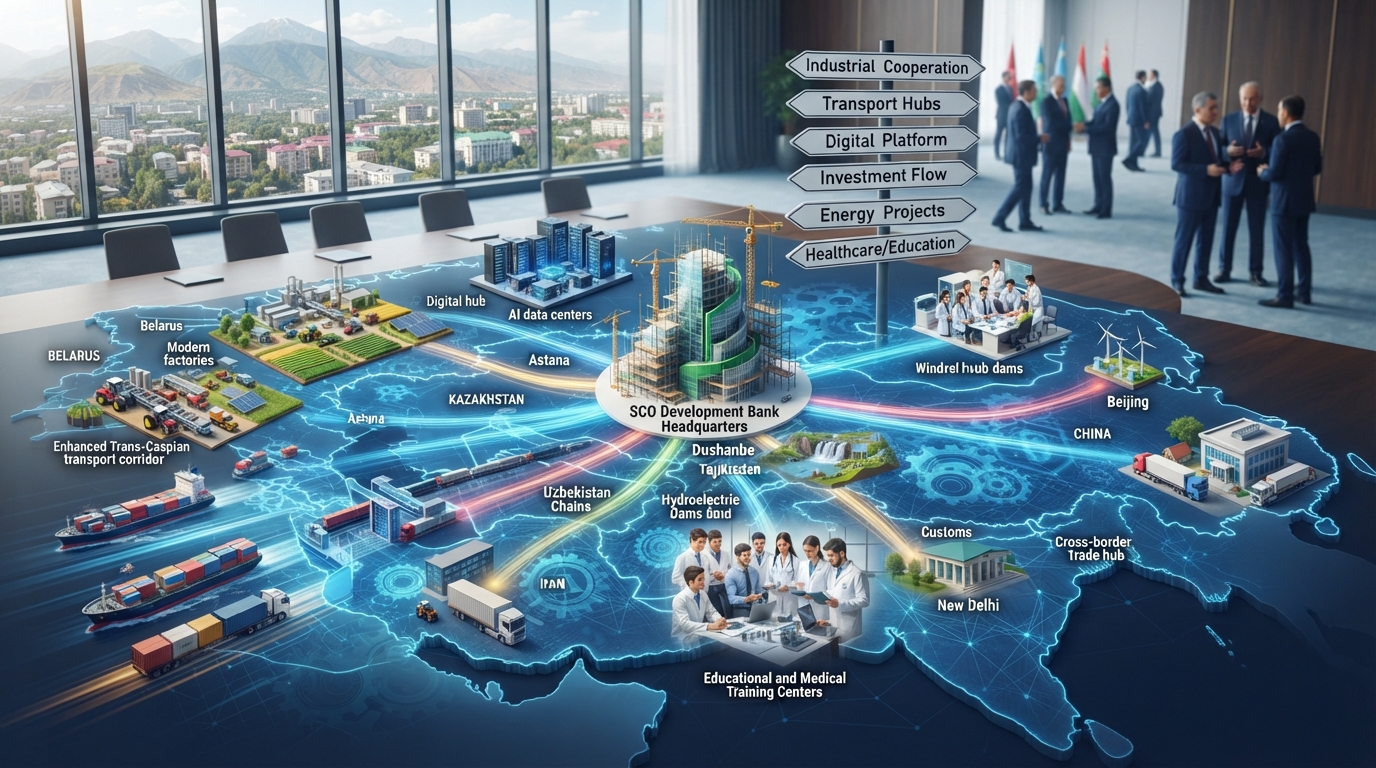
The meeting of the Council of Heads of Government of the Shanghai Cooperation Organisation (SCO), held in Dushanbe, highlighted the key issue on the association's economic agenda: who will finance joint development and under what conditions. Participants proposed creating manufacturing facilities, simplifying transportation, and expanding settlements in national currencies. These initiatives are to be united by the SCO Development Bank, whose structure still requires approval.
Russian Prime Minister Mikhail Mishustin briefly outlined the priority: "It is important to focus on joint ventures and mutual investments." Among the tools, he suggested using Russian special economic zones and agreements on the protection and promotion of investments. Behind this proposal lies a desire to give trade a stronger manufacturing base: a joint venture means long-term cooperation, exchange of competencies, and the interest of partners in maintaining supplies.
Belarusian Prime Minister Aleksandr Turchin linked industrial cooperation with access to long-term capital. "The expansion of economic ties requires appropriate financial infrastructure," he stated. Minsk supports the earliest possible establishment of the SCO Development Bank and allows that it could become the foundation of the association's settlement and payment system. Belarusian interest is quite concrete: the joint production of automotive and agricultural machinery, as well as high-tech products, requires funds that must pay off over many years. According to experts, the most complex node of negotiations is forming precisely around the future bank. The founders will have to determine the amount of capital, the distribution of contributions and votes, borrower selection rules, and liability for potential losses. Which countries and industries will get preferential access to resources will depend on these decisions.
Kazakhstan proposed placing the bank's headquarters on its territory. At the same time, Prime Minister Olzhas Bektenov brought the transport and digital agenda to the fore: the modernization of ports and logistics centers, the development of the Trans-Caspian route, and the creation of a network of artificial intelligence centers. "We are determined to support these results and further offer our services as a digital hub in the SCO space," he noted. Astana thus declares its readiness not only to participate in projects, but also to host cooperation infrastructure.
For Tajikistan, the main issue remains the influx of investments. According to data cited by Prime Minister Kohir Rasulzoda, SCO states account for more than 70% of the republic's foreign trade turnover. At the same time, direct investments from these countries in 2025 amounted to just over $350 million. Dushanbe expects to increase investments in manufacturing and green energy. The Prime Minister also proposed a regular expert dialogue on water, energy, and climate sustainability.
In this part of the agenda, economic calculations are closely intertwined with relations between neighbors. The development of power generation requires simultaneously taking into account agricultural needs, water use regimes, and climate change. Expert dialogue can improve data exchange and project preparation. However, the construction of large facilities will require separate agreements, financial guarantees, and deals on who will purchase the generated electricity.
Kyrgyzstan's proposals could yield a faster effect. First Deputy Chairman of the Cabinet of Ministers Daniyar Amangeldiev called for introducing electronic documents, preliminary cargo information, and coordinated customs technologies on priority routes. Such measures make it possible to start with individual border crossings and carriers.
Prime Minister of Uzbekistan Abdulla Aripov made a number of proposals at the meeting:
- Development of an SCO industrial cooperation map. He emphasized that the time has come to reach a new level and build sustainable cross-border chains of cooperation, production, and value addition.
- Granting the "SCO-Invest" forum the status of a permanent platform. Uzbekistan expressed its readiness to host the next forum in 2027.
- Inviting SCO countries to a forum on artificial intelligence and advanced digital solutions in Tashkent in 2027. Aripov noted that expanding interaction in science, technology, and innovation requires special attention.
- Joint preparation of a conceptual vision: "SCO 2040 — a space of shared development."
- Accelerating the approval of the founding documents of the SCO Development Bank and launching its operations.
- Creation of a multilingual SCO data corpus and a coordination mechanism on food, water, and energy security.
Premier of the State Council of the PRC Li Qiang spoke in favor of sustainable transport corridors and production chains, as well as increasing the efficiency of the organization itself. In addition to large-scale tasks, China proposed financing the training of a thousand medical specialists from SCO countries, according to the website of the PRC government. This initiative already has a designated host side and number of participants, which makes its implementation more tangible.
At the same time, differences in national priorities persist. Iran's First Vice President Mohammad Reza Aref paid special attention to banking ties, independent payment mechanisms, and investment risk insurance. Representing India, Defense Minister Rajnath Singh stressed the need to respect state sovereignty when developing transport links and to avoid duplicating the functions of new structures. These positions show how difficult it will be to agree on universal tools that are equally acceptable to all participants.
In any case, the execution of agreements will remain mainly at the national level. The SCO Charter provides for the implementation of decisions through the procedures of member states and permits projects involving only interested countries. Therefore, industrial cooperation will be carried out by enterprises, transportation by transport operators and customs, and financing by banks and investors. The Secretariat and relevant mechanisms of the organization ensure coordination, but do not replace the customer, lender, or contractor.
The most likely path forward is launching a limited number of projects with clear participants, followed by the expansion of cooperation. For business, this could mean predictable supplies and new markets; for the population, jobs and more accessible services. The effectiveness of the Dushanbe meeting will have to be tested against concrete indicators: whether financing agreements have appeared, whether executors have been appointed, and whether work has begun. By the next meeting, it is precisely this information that will make it clear how far the SCO's economic program has advanced beyond agreed documents, experts note.
Following the meeting, a joint communique and decisions on industrial and transport cooperation were adopted, and the organization's budget for 2027 was approved. A concept for a digital platform for international multimodal freight transport was agreed upon. The chairmanship of the Council of Heads of Government passed to Uzbekistan, which will host the next meeting. Thus, the economic program has gained another deadline for political review — the year 2027.