

More than 2.5 million citizens in Uzbekistan have self-imposed a ban on getting a loan. How to enable and disable this protection
The self-prohibition service for obtaining a loan blocks the issuance of new loans in your name for free - as of July 2026, more than 2.5 million people had used it.
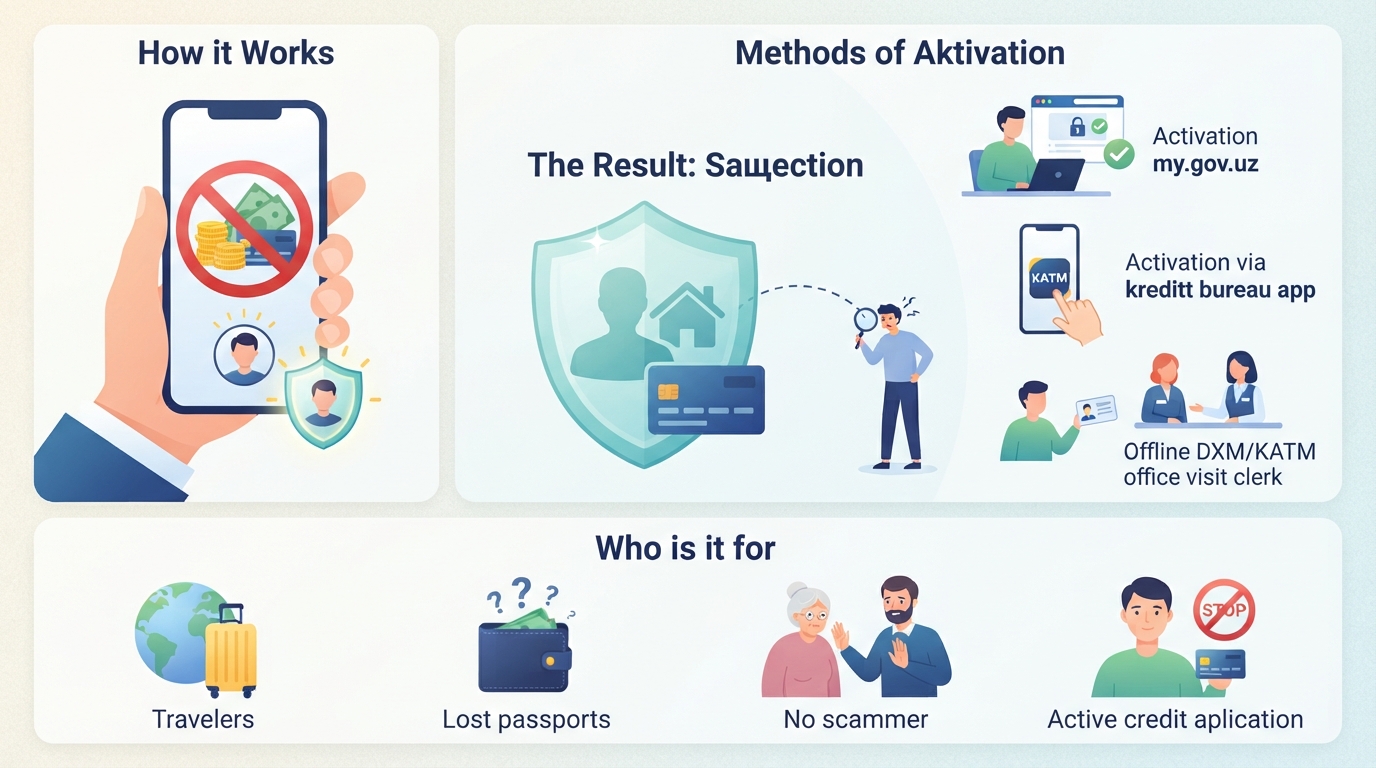
More than 2.5 million citizens in Uzbekistan have self-imposed a ban on obtaining loans. We will tell you how to activate and cancel this protection mechanism.
Cases of obtaining a loan in the name of another person can occur not only through a stolen passport, but also due to the leakage of personal data or the gullibility of a bank employee. Since June 2025, citizens of Uzbekistan have had the opportunity to voluntarily prohibit obtaining loans and microloans in their own name in order to prevent such problems.
This mechanism was introduced by the Law of the Republic of Uzbekistan No. O‘RQ-1043 dated March 4, 2025, and the relevant amendments came into force on June 6, 2025. According to the Credit Information and Analysis Center LLC, this service is rapidly gaining popularity:
* As of July 1, 2025: about 33.1 thousand people
* As of October 1, 2025: about 149.5 thousand people
* As of January 1, 2026: 438.3 thousand people
* As of July 1, 2026: more than 2.57 million people (1,497,389 men and 1,076,637 women)
This represents a more than 77-fold increase in one year.
Below we will consider how self-ban works, how to enable and disable it, which loans can be blocked, and who should use this protection.
**Legal basis of the mechanism**
The mechanism was introduced by the Law of the Republic of Uzbekistan No. О‘RQ-1043 dated March 4, 2025. This law added a new Article 16-1 to the Law "On Credit Information Exchange", which establishes the norm for entering information about individuals into the register of persons prohibited from concluding a credit transaction. The amendments entered into force on June 6, 2025.
**How does the ban work?**
After the ban is activated, a sign indicating the presence of a ban will automatically appear in any request for a loan sent to any financial institution connected to the credit information exchange system. If a bank or microfinance institution (MFI) issues a loan bypassing the register, the responsibility for this will lie with the creditor, not the person whose name was used.
**Methods for enabling and disabling the ban**
1. **Through the my.gov.uz portal (universal option):**
* This is a universal method that can be used from anywhere.
* The portal has a service called "Ban on concluding a credit agreement or canceling the ban".
* Authorization is carried out through the OneID system.
* **To enable:** Open the my.gov.uz website in a browser or in a mobile application (available on Google Play and App Store). Authorize through the OneID system. If you do not have an account, you can create one on the id.egov.uz website using your passport series and number. Type "Ban on concluding a credit agreement or canceling the ban" in the search bar of the portal and open the service page. Click the "Use the service" button, then select the "Activate" action. The system will automatically process the application and enter the data into the registry. Additional confirmation of the person through EDS or a personal visit is not required. An electronic document confirming the provision of the service can be downloaded immediately after activation.
* **To cancel:** Open the same service and select the "Deactivate" action.
2. **Through the "Credit Information and Analytical Center" (KATM) service:**
* This is available in the form of a mobile application operating under the name "KATM" and the infokredit.uz website.
* Through it, you can only activate the ban, it cannot be canceled in this way.
3. **Offline option (personal application):**
* Apply personally to the State Services Center (DXM) or the office of the "KATM" credit bureau with a passport.
* Here you can both activate and cancel the ban.
In all cases, the service is free.
**Which loans does the ban affect?**
The ban itself does not cancel existing obligations. Previously issued loans, credit cards and installment payments should continue as usual. The ban applies only to new applications. Since connection to the credit information exchange system is mandatory for banks and MFIs, the restriction practically applies to almost all official participants in the credit market.
Loans obtained not through official financial institutions, for example, from acquaintances or private individuals, are not subject to the ban in themselves, since such transactions do not go through credit history bureaus.
**Term of lifting the ban**
According to Article 16-1 of the Law "On Credit Information Exchange", an application to lift the ban, like an application to establish it, is immediately entered into the register by the credit bureau upon receipt. Previous reports about the launch of the service in 2025 indicated a period of up to two business days for lifting the ban. However, since the law contains a direct norm on the immediate entry of information, it is necessary to rely on the text of the law.
**Repeated activation and cancellation of the ban**
The law establishes the establishment and cancellation of the ban as a voluntary and free act, but there is no limit to the number of such applications. That is, the law does not prohibit the repeated activation and cancellation of the ban.
**Liability in case of violation of the ban**
According to Article 16-1 of the Law "On the Exchange of Credit Information", banks, non-bank credit organizations and payment organizations operating as MFIs are prohibited from concluding a credit agreement without obtaining information from the register about the presence or absence of a ban on a specific person. If the creditor violates this requirement and concludes a deal without the participation or knowledge of the person listed in the register, the creditor is liable for the legal consequences of such a deal.
The law also specifically provides for a fine of up to 5,000 BHM (base calculation amount) - about 1.875 billion soums. However, this sanction is applied by the Central Bank for violations of the law by credit bureaus in their activities, for example, non-compliance with the procedure for maintaining the register or violating the rights of consumers of bureau services. It is not a penalty directly applied to a bank or MFI for issuing a specific loan, bypassing the ban. In relation to banks and MFIs, the law uses a more general formula - "liability for the legal consequences of the transaction" - and does not indicate the amount of the fine established for this violation.
**Who is eligible to use this protection?**
* **Those working abroad or on a long-term business trip:** An application can be submitted from anywhere in the world via my.gov.uz. This is convenient for those who cannot personally control financial transactions in Uzbekistan.
* **In cases of lost or stolen passports:** Self-exclusion limits the ability to issue a loan in someone else's name until a new document is issued.
* **Those who want to be protected from fraudsters:** Especially those who want to protect their elderly relatives from fraudsters who act under the pretext of "account security verification".
* **Those who want to consciously exclude the possibility of taking out a new loan:** Useful for those who are paying off their current loan and do not want to take out a new loan until they have fully paid off the old one.