

More than 152,000 students in Uzbekistan live in rented apartments.
Deputies approved the second reading of amendments expanding benefits for students registering at their place of residence. The proposed social norm for housing space will no longer apply not only to dormitories but also to rented apartments. Currently, more than 152,000 students (20.5% of the total) live in these apartments.
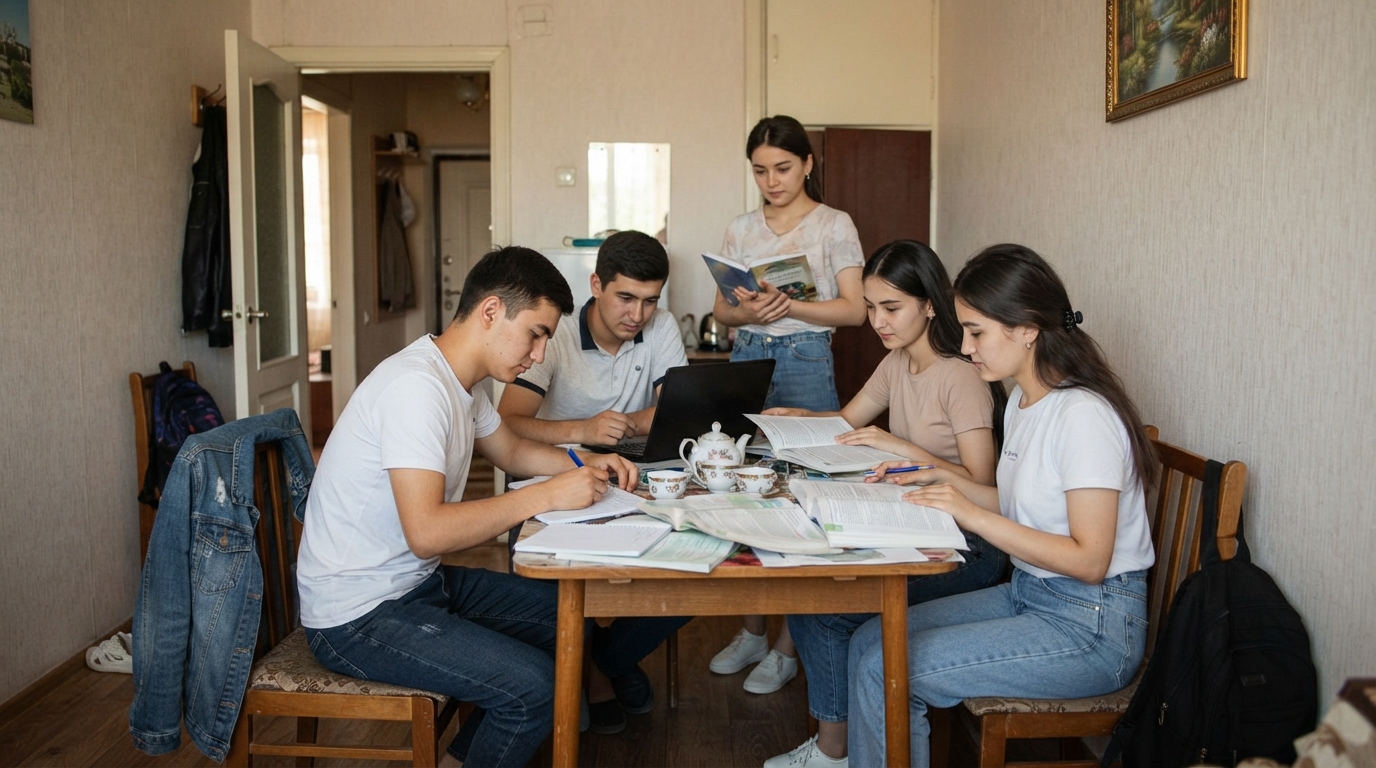
At the beginning of the 2025/2026 academic year, more than 152,000 students in Uzbekistan were living in rented apartments. This data was presented by Deputy Shukhrat Yakubov on August 18 at a meeting of the Legislative Chamber of the Oliy Majlis during a discussion of a bill aimed at simplifying the registration of citizens at their place of residence and stay.
Citing information from the Ministry of Higher Education, Science, and Innovation, Yakubov reported that at the beginning of the 2025/2026 academic year, 741,483 students were enrolled full-time in 202 higher education institutions across the country. Of these, approximately 441,000, or 59%, lived in their own homes or with close relatives, commuting from there to classes.
Another 102,000 students were housed in university dormitories, and more than 44,000 were housed in dormitories created through public-private partnerships. More than 152,000 students, representing approximately 20.5% of the total, rented housing.
"Today, more than 152,000 of our students live in rented apartments. It was precisely to protect their interests that the provision on rented housing was added to the bill," emphasized Shukhrat Yakubov.
The bill expands the category of students for whom the social norm for housing space will not apply when registering at their place of residence. While in the first reading, this exemption primarily applied to university students and students in student dormitories, by the second reading it was also extended to students in secondary vocational and vocational education institutions.
Furthermore, rented apartments were included in the document, as a significant portion of students actually live in them.
During the discussion, the question arose as to whether this relaxation would lead to an excessive number of students registering in a single apartment.
Colonel Ulugbek Mirzakambarov, First Deputy Head of the Department of Migration and Personalization at the Ministry of Internal Affairs of Uzbekistan, reported that this issue had been discussed with practitioners and the Ministry of Higher Education, Science, and Innovation. The Ministry of Internal Affairs concluded that extending the exemption to rented housing should not pose practical problems and would resolve the registration issue for a large number of students.
"About 70% of students are not provided with dormitories and are therefore forced to live in rented apartments. Typically, students rent housing in groups of four to five," he noted.
According to him, including rented apartments in the new regulation should resolve the problems many students have with registering at their place of residence and reduce the risk of administrative liability for failure to comply with registration requirements.
The bill was developed at the initiative of a group of parliamentarians and was previously, on August 11, conceptually approved in the first reading. In preparation for the second reading, its main provisions were retained, but a number of provisions were expanded to reflect the parliamentarians' proposals.
One of the key changes concerns the application of the social norm for housing space when registering at a place of residence.
The original version provided an exception to this requirement for university students and places in student dormitories. For the second reading, the scope of eligibility for this benefit was expanded: it is now also to apply to students in secondary specialized and vocational education institutions.
According to the rapporteur, this amendment will further accommodate the interests of more than 100,000 young people. Specifically, more than 37,000 students study in 92 academic lyceums across the country.
Deputies approved the law in its second reading.