

Mind the doors. "Theater+" staged the play "Three on a Seesaw" for the first time
"Theater+", which opened in Tashkent late last year, has turned to an adult audience for the first time after its children's performances. Director Mikhail Doloko staged the play "Three on a Seesaw" by the Italian playwright Luigi Lunari. "Gazeta" reviewer Dmitry Povarov attended the preview.
Mind the doors closing. "Theatre+" stages "Three on the Swing" for the first time
The hallmark of "Theatre+", which opened in December 2025 in the building of the former "Zarafshan" cinema and concert hall, has become immersive productions — that is, those where the viewer is completely immersed in the action.
For his debut in Uzbekistan, director Mikhail Doloko, who worked for more than 30 years in the Moscow "Kurazh" theater, chose a format that is still unusual for Tashkent, and addressed it to a children's audience. Three performances in the repertoire — "Paints", "The Toy Workshop", and "Father Frost's Chest" — are running successfully.
Now it's the adults' turn. "Three on the Swing", based on the play by Italian playwright Luigi Lunari, is a quite traditional production, built in the aesthetics of a modern studio stage, where the audience is assigned their usual place in the hall, but invited to figure out for themselves what is happening on stage. The Italian collaborated for many years with the great Giorgio Strehler, founder of Milan's Piccolo Teatro, so he is certainly a serious man.
At first glance, "Three on the Swing" is a pure situational comedy, but a closer look makes it clear that the story has, as they say, a double bottom — it is philosophical and far from simple. It is no coincidence that before the start of the performance, the audience was given a kaleidoscope — a toy promising an infinite variety of patterns, although each time it arranges them from the very same set of glass pieces.
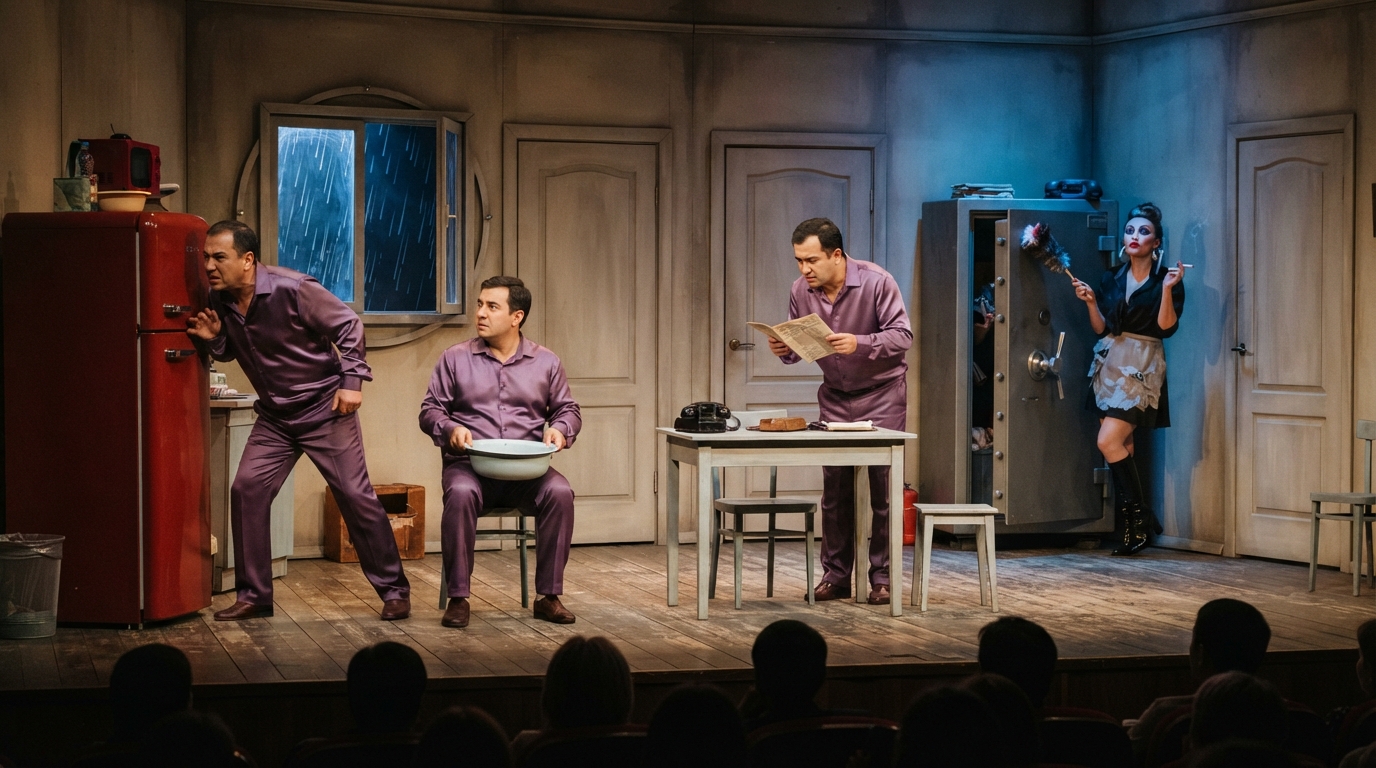
The setup unambiguously refers the educated part of the audience to Jean-Paul Sartre's "No Exit". Three middle-aged men find themselves in a mysterious room, wearing makeup in the spirit of the commedia dell'arte masks hanging on the walls in the theater lobby. Dressed in identical purple satin shirts and trousers, they differ sharply from one another in character and habits. The expansive Manufacturer (Ogabek Rustamaliev) burns with lust — he has arrived for an intimate meeting with an inhabitant of a women's boarding house. The resilient, simple-minded Captain (Feruz Bazarov) needs a certain firm where he must settle some business matters. The well-read Professor (Sherzod Sismatov) has dropped by a publishing house that is preparing his book for print.
The scenography is built with emphasized convention. Along the perimeter are three doors that sometimes open and sometimes do not. Only the one leading to the toilet functions properly. The window frame in the center of the stage rotates like a weather vane: outside the window, heat gives way to torrential rain. A red refrigerator resembles a magic tablecloth, obediently dispensing any ordered drink, right down to hot chocolate. There is also a model of a bulky safe — an object that for now prefers to keep its secrets.
The men who met by chance are forced to tolerate each other's company — a curfew has been declared outside the walls due to another pandemic. The world outside closes down, and the characters are left alone with themselves. At first, they entertain themselves with quite mundane activities: running to the toilet, soaking their feet in a basin, telling jokes and entertaining stories.
The young actors willingly join in this parade of comedic possibilities, at times turning the stage into an arena for a contest of ingenuity.
They are aided by musical quotes across a wide range: from Dmitri Shostakovich through Édith Piaf to Michael Jackson.
The Captain is particularly trying — played by Bazarov, he seems to struggle to find words and slips into unnecessary pauses. However, in a sad joke he tells about a man who decided to visit his hometown after 20 years, the flaws in his acting are redeemed by applause. Involving props in the action and making his partners and the audience wait for the denouement, the actor can convince the public of one outcome — and immediately replace it with another. The "swing" works properly.
With the onset of night in the second act, the pattern begins to change. The forced guests suspect that what is happening to them is no longer entirely of earthly origin. A Singapore telephone directory is discovered on the table, in which everyone finds their own first and last names with horror. The situational comedy takes a sharp turn, and the familiar set pieces begin to signify something completely different. Smart words like "existentialism" and "freedom of choice" pop up in the viewer's mind, while the mysterious room increasingly resembles the waiting room of the Lord God Himself.
The stage space begins to blink with pulsing light, and finally, the safe mentioned at the very beginning takes center stage. Unexpectedly, a cleaning lady (Viktoriya Neskubko) wearing Louboutins emerges from it, like a paraphrase, an almost classic deus ex machina. She has either come to clean up or really arrived from purgatory. "Is your son by any chance a carpenter?" they ask her suspiciously. "No, no!" the girl reassures them, lighting a cigarette. "Now, his father was a carpenter."
In this uncertainty, strictly speaking, lies the main difficulty of the production.
The comedy of the situation grips the young performers to such an extent that they do not always manage to switch to a more serious meaning.
The male trio is not yet fully coping with the task of maintaining the balance between the funny and the terrifying, the mundane and the metaphysical. Therefore, the dramatic finale hangs in the air. Instead of the anxious aftertaste that the author of the play seems to have relied on, confusion remains: how, exactly, did it all end?
The denouement, sounding to the accompaniment of the popular 1970s song "Believe It or Check It" by Soviet singer Lyudmila Senchina, turned out quite crumpled — an open ending is still no guarantee of great artistic depth. However, one certainly wants to believe in a good fate for this first adult production of "Theatre+". The program notes that the play also has a version with a female cast. This gives the production yet another turn.
Before the press screening, Mikhail Doloko said that when he was invited in Moscow to the premieres of plays he didn't like, in order not to offend the creators, he would say: "It made me think."
In the case of "Three on the Swing", this formula for now sounds more like a wish than a final critical verdict.
In the theater, one shouldn't rush to conclusions at all: behind one door there may be a bathroom, behind another — purgatory, and behind a third — merely the next act.
You can see what lies behind the next door in the new production of "Theatre+" on October 17, 18, and 23 at 19:00.