

Many Cubans in Florida voted for Trump - but their support in the midterms is not guaranteed
President Trump's Republican colleagues may feel the brunt of frustration among Cubans at the ballot box, writes the BBC's Will Grant.
Many Cubans in Florida backed Trump, but their midterm support is far from certain
Ismael Labrador voted for Trump, yet he says he was "blindsided" by the scale of deportations
Since the Trump administration began its crackdown on undocumented immigrants two years ago, the waiting room of Miami immigration lawyer Ismael Labrador, who was born in Cuba, has never been empty. His appointment calendar is full of relatives of detained immigrants trying to win their release before they are deported to their countries of origin.
Even though his business is thriving, Labrador says he wishes it were not.
"We have relatives living in fear right now, we've had relatives who have been deported back to Cuba, unfortunately," he says.
Cubans have long benefited from a preferred immigration status in the United States under provisions written into 1960s legislation known as the Cuban Adjustment Act. But Labrador says the large-scale arrests carried out across Florida by Immigration and Customs Enforcement (ICE) agents have made the Cuban American community more exposed in the US than it ever expected.
"The way I put it is that if you don't have a Green Card in the United States, you may be a target."
Countless videos on mobile phones have captured arrests in places once thought to be off-limits: parents taken outside schoolyards, at bus stops, youth sporting events and even inside courthouses at scheduled immigration hearings.
Few have had the effect of footage showing 39-year-old Ecuadorean immigrant Grace Calero and her 19-year-old daughter, Giulianna Carriel, being arrested in a hospital ward.
Two months ago, the pair were driving to work in Kissimmee, central Florida, when another car hit them and they were taken to hospital by ambulance. While they were being treated for their injuries, ICE agents came in and arrested them. They were deported back to Ecuador within days.
Labrador's cousin has also been swept up in ICE detentions. Despite his efforts, the immigration lawyer could not stop his own relative from being deported back to Cuba.
"It's hard when you're fighting against a lot of resources," he says.
The Trump administration has repeatedly said the president was elected on a promise to carry out mass deportations and is doing exactly that. "He stopped the invasion of our country and as a result of his policies more than 3 million illegal aliens have left the US," a White House spokeswoman told the BBC last week.
ICE, for its part, says it is targeting anyone who has broken American immigration law and is in the country illegally.
Labrador was among the 68% of Cuban Americans in Florida who voted for Donald Trump two years ago, a choice he now deeply regrets.
Trump made no secret of his immigration plans. During the 2024 campaign, he promoted his policy of mass deportations of undocumented migrants.
"On Day One, I will launch the largest deportation programme in American history", he said repeatedly at rallies, including in Florida.
Labrador, along with many thousands of disillusioned Latino voters like him, believed the administration would only deport people with criminal records.
"I think we got blindsided by the administration," he says.
"Personally, I voted for Trump because I wanted to get criminals out of the country," he says, claiming that "communists came in from Cuba under Biden."
"We wanted to have a safe America. We never thought that he was going to go after everybody."
"This isn't what I voted for," he insists.
Labrador is far from the only Cuban American in Florida to feel buyer's remorse over President Trump.
Congresswoman Maria Elvira Salazar, who represents Florida's 27th Congressional district, recently posted a video filmed outside the White House in which she distanced herself from his deportation policy, saying it had gone "too far".
"The same Hispanics who helped you get to the White House in 2024 feel betrayed today," she told President Trump.
Salazar is in a close contest with another Cuban American, the Democratic Party's candidate Eliott Rodríguez. Her close ties to Trump on immigration could cost her her congressional seat.
Florida remains a Trump stronghold. At a recent meeting of Cuban American entrepreneurs in Miami, the mood was still strongly pro-Trump. "Miami loves Trump, Cuban Americans love Trump," says real estate businessman Juan Omar Sixto, gesturing toward the other guests behind him.
"They agree with Trump that anyone who crossed the border illegally should be out," he says, even while acknowledging that he himself entered the US illegally six decades ago.
A poll released on Thursday by Florida International University found that not all South Florida Cubans agree: 76% said they disapprove of the Trump administration's deportations of Cubans with no criminal record. But support for the Republican Party remains firm, with 68% saying they plan to vote Republican in November.
Elsewhere in the country, Latino support is falling.
In the last election, Trump defeated Kamala Harris by 56.1% to 43% - the largest winning margin for a candidate in the state since 1988 - helped in part by support from Latino communities. But a recent NBC News/Telemundo poll of 8,000 registered Latino voters found that nearly 60% want Congress to be controlled by the Democratic Party, compared with just 35% who want a Republican victory.
The high cost of living is a major source of frustration, as residents say supermarket and petrol prices are impossibly high for working families.
But for many Hispanics, it is also partly because of stories like that of Heydi Sanchez.
Sanchez left Cuba in 2019 as the island slid into economic collapse and illegally crossed from Mexico into the US. After nine months in a detention centre, she was released under an i-220B Order of Supervision, which allows a person to remain in the US but leaves them under the constant threat of deportation.
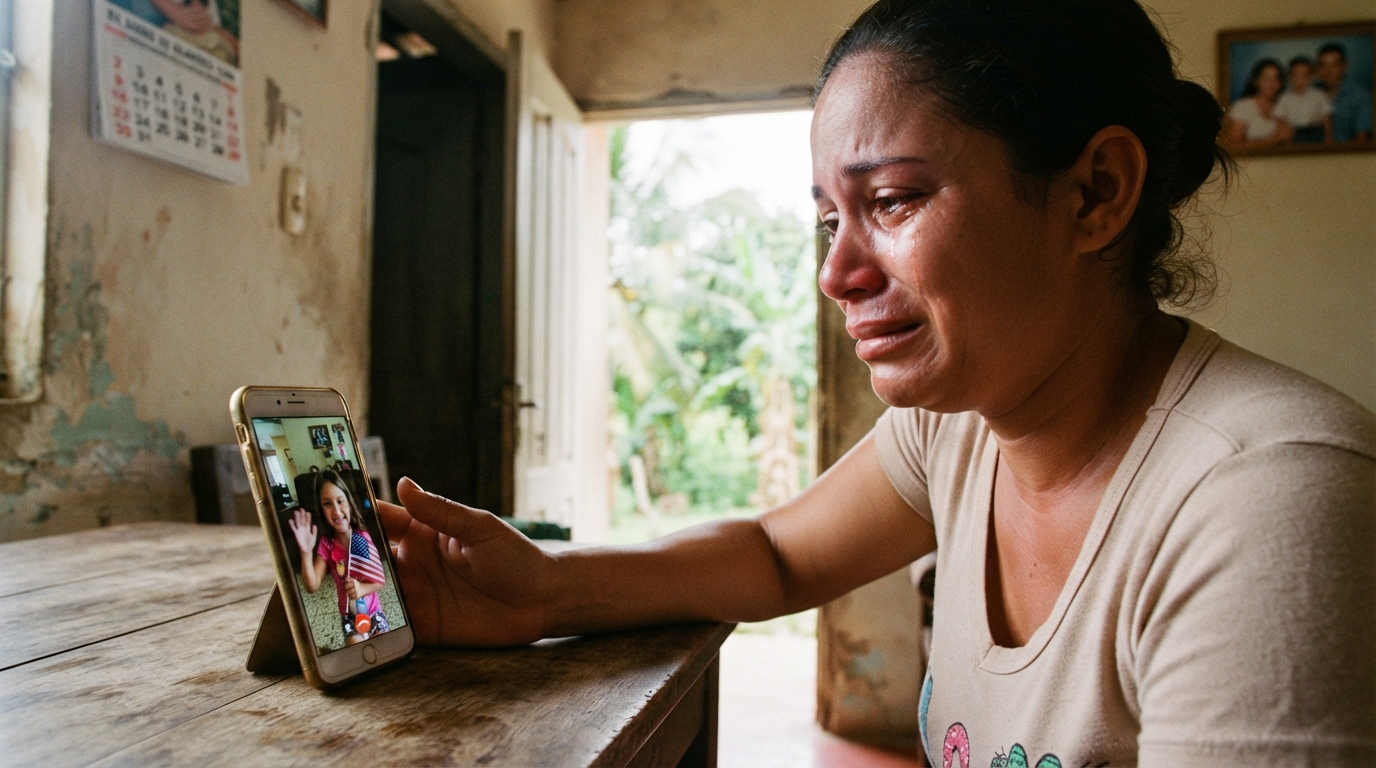
Heydi Sanchez was deported to Cuba and separated from her young daughter
Sanchez settled in Tampa, where she worked with autistic children and the elderly. After a difficult and costly fertility struggle, she and her husband had a baby girl named Kailyn.
Most i-220B holders try to regularise their immigration status through "humanitarian parole" and must report to ICE agents at scheduled appointments. Last year, President Trump revoked temporary humanitarian parole for about 300,000 Cubans. Sanchez realised something was wrong in her case when her routine ICE meeting was moved up without warning.
At the appointment, she was detained. Kailyn was taken from her arms and handed to her father, a US citizen. Within a day, Sanchez was on a deportation flight back to Havana in shackles, with no chance to appeal.
I met her in Cuba, where she now lives in a one-bedroom apartment in Mayabeque, a rural province outside Havana.
"It's like the sky fell in and crushed me", she says of being separated from her daughter.
"When we have video calls, she says: 'Mummy, come home.' And I say: 'darling, Mummy is away working.' What else can I tell her? How can I explain it?", Sanchez asks, unable to hold back the tears.
Despite support from several US politicians, including Maria Elvira Salazar, more than a year has passed since her deportation and Sanchez remains in limbo in Cuba.
In a statement, ICE said that "in this case, the parent stated they wanted to be removed without the child and left the child in the care of a safe relative in the United States".
While the Trump administration has stripped away Cubans' special immigration protections, it has also sent thousands of people back to an island Washington itself calls a "failed state". Cuba is enduring its worst-ever energy crisis amid a months-long fuel blockade imposed by the US.
After overwhelmingly voting for Trump in 2024, Cubans in Florida now see that they are just as vulnerable to deportation as any other diaspora. His Republican allies may feel the force of their anger at the ballot box.