

Low-risk pharmacies will not be inspected
It is proposed to introduce an electronic system of "risk analysis" for the control of business entities engaged in pharmaceutical activities in Uzbekistan. According to the draft regulation, enterprises and pharmacies will be divided into low, medium and high categories based on the risk of violation of the law. Business entities that are considered to have a low risk level will not be subject to inspections.
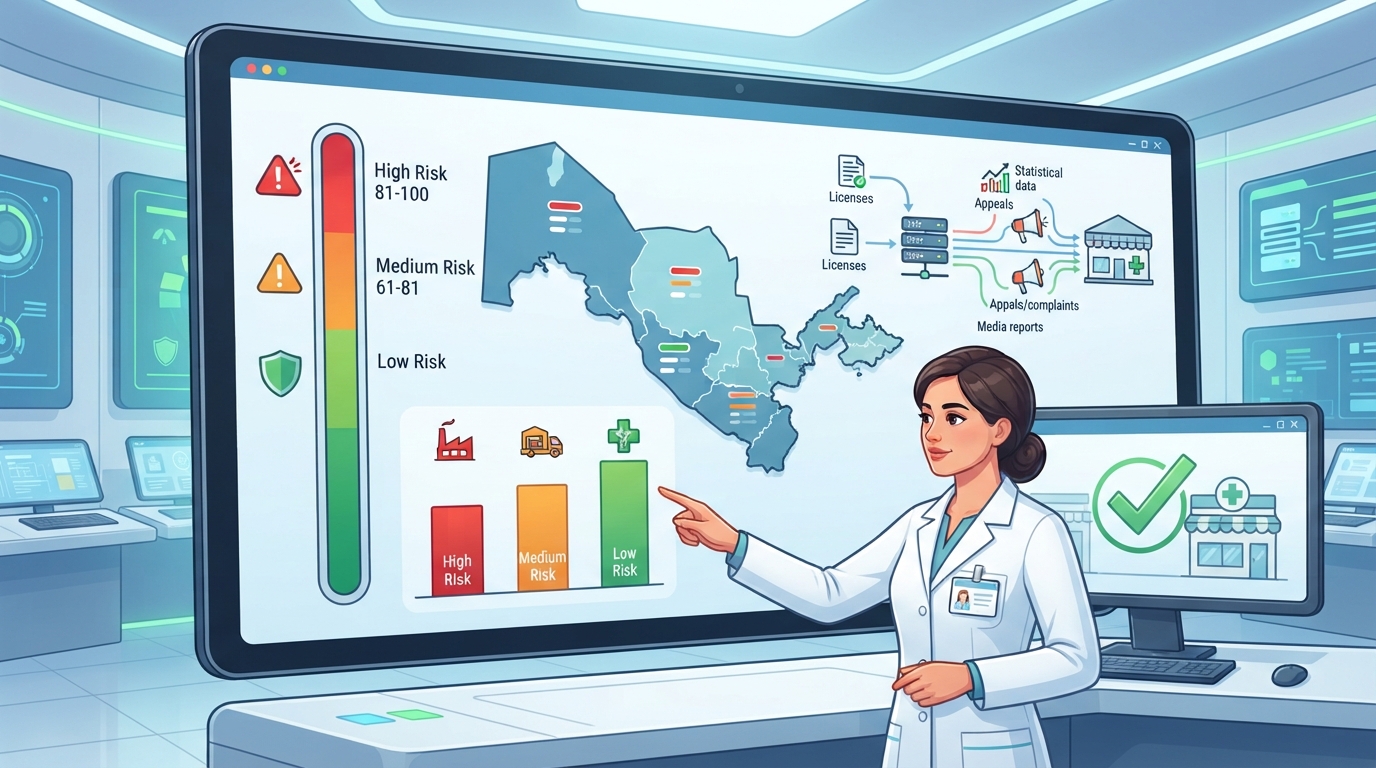
**Low-risk pharmacies will not be subject to inspections: A new electronic control system is being introduced in the pharmaceutical sector**
The "Center for the Safety of Pharmaceutical Products" under the Ministry of Health plans to introduce a new electronic system for controlling business entities in the pharmaceutical sector. This system, based on the principle of "risk analysis", is aimed at identifying entities with a high risk of violating the legislative requirements for pharmaceutical activities.
**How does the system work?**
The electronic system automatically assesses the risk of an entrepreneur violating the law based on specific criteria and scores. Separate indicators are set for entities engaged in the production, preparation and wholesale of medicines, as well as for entities that sell medicines and medical equipment at retail.
**Risk levels:**
Business entities are assessed on a 100-point scale and are divided into three risk categories:
* **High risk:** 81 to 100 points
* **Medium risk:** 61 to 81 points
* **Low risk:** 61 to 61 points
**Inspections and preventive measures:**
Preventive measures and inspections may be carried out in accordance with current legislation in business entities classified as high and medium risk. These inspections are carried out only within the scope of the competence of the "Center for the Safety of Pharmaceutical Products". Inspections are not carried out in entities classified as low risk.
**Documents are not required:**
To determine the level of risk, information on licensing and permitting, statistical indicators, previously identified violations, appeals from legal entities and individuals, information from the media, social networks and websites is used. It is not allowed to request additional documents or information from a business entity. The analysis process does not involve stopping, obstructing or directly interfering with the activities of an entrepreneur. It is worth noting that the detection of a risk of violation of the law through the electronic system alone cannot be a basis for applying a measure of influence to an entrepreneur.
**How are pharmacies assessed?**
Six main risk indicators have been established for pharmacies engaged in retail drug sales:
* If there is no necessary document confirming compliance with the requirements of pharmacy practice or its validity has been suspended - 10 points.
* Activities carried out outside the scope or address specified in the license – 20 points.
* Violation of the rules for storing medicines and medical devices requiring separate storage conditions – 30 points.
* Violation of the procedure for retail sale of medicines by prescription – 10 points.
* Receipt of a confirmed application for a violation of the law – 20 points.
* Absence of a manager in the pharmacy or his lack of advanced training – 10 points.
**The highest score for counterfeit medicines:**
12 risk indicators are provided for entities engaged in the production, preparation and wholesale sale of medicines. The highest score (35 points) is assigned to cases of production, storage or sale of illegal copies of registered medicines that have not passed state registration, do not meet labeling requirements, are of poor quality or counterfeit, as well as for the production, storage or sale of illegal copies of registered medicines. Also, failure to comply with relevant standards such as GMP, GDP and GSP, as well as deviations from the scope of activities specified in the license, will increase the risk score.
**Right to appeal:**
Entrepreneurs who are dissatisfied with the results of the risk analysis have the right to appeal to a higher authority or court.