

London Fashion Week 2026: The five trends we'll see in spring
As London Fashion Week comes to a close, here are the biggest trends for your wardrobe.
London Fashion Week 2026: The five trends we'll see in spring
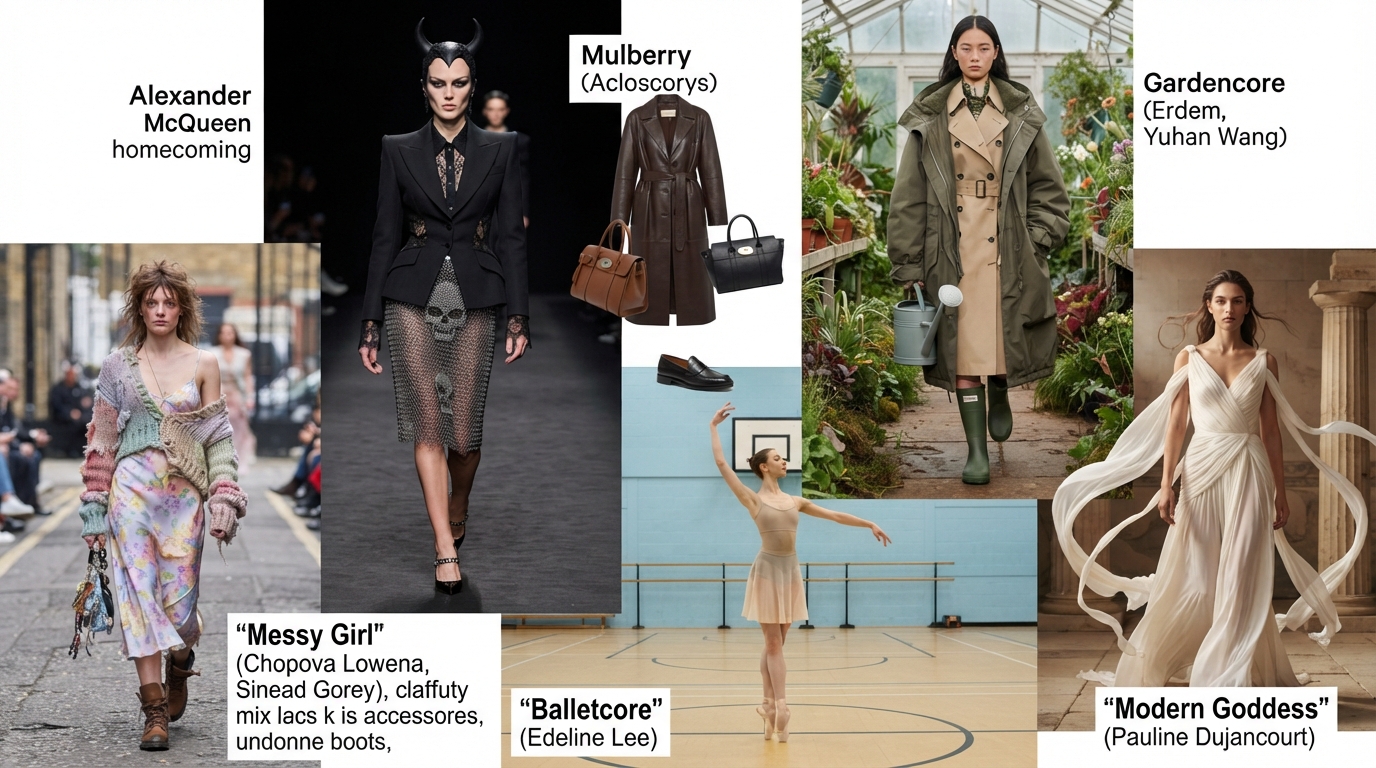
Alexander McQueen marked a historic comeback to London Fashion Week after 25 years, presenting a homecoming show that combined sharp tailoring with dark romanticism
This London Fashion Week has centred on return and renewal, as two of Britain’s biggest designers unveiled their spring/summer 2027 collections.
The first was Alexander McQueen, which as a brand shifted to London after 25 years of showing in Paris — something Laura Weir, CEO of the British Fashion Council, told the BBC was "quite a big deal for us".
Creative director Seán McGirr returned the brand to its roots, sending out devil horns, lace corsets and chainmail skull dresses on the runway.
Mulberry was the second designer to stage a major return, this time after a nine-year absence, with Christopher Kane's debut collection focusing on the brand's Baywater bag while leaning heavily into leather in coats, skirts and loafers.
Weir says the "big mission" for her and her team this season was to "re-platform London Fashion Week as not only a home for British design, but an engine for creativity and commercial growth".
Here are some of the major trends to emerge from London Fashion Week 2026:
Rejecting "quiet luxury" uniforms, Chopova Lowena, Sinead Gorey, and Conner Ives led London Fashion Week's embrace of the "messy girl" aesthetic by championing deliberate chaos, pairing intentionally undone tailoring and messy updos
"The number one trend for this season is messy girl," says Elektra Kotsoni, deputy director for Vogue Business and Vogue Runway, whose team predicts the trends ahead of each season.
She tells the BBC: "We're going to be having a messy girl summer" and says "it's a reaction to the clean girl and quite luxury aesthetics that took over our Instagram feeds," last year.
Kotsoni says that as "the world is quite messy" this way of dressing signals "resilience" and rebellion.
She says that if you want to copy the trend, combine pastel colours, dreamy florals, and tactile materials to create "unexpected clashes" that "look really messy".
This kind of what Kotsoni calls "crazy styling" was visible at London Fashion Week, with the loud clashes at Chopova Lowena, Sinead Gorey and Conner Ives.
Erdem, Yuhan Wang, and Bora Aksu embraced a "gardencore" mood, swapping quiet luxury for unpolished, allotment-ready chaos — pairing parkas and structured trench outerwear with kitchen-garden details
According to Kotsoni, gardening is officially cool in fashion.
A fresh take on the cottage-core looks that appeared after the pandemic, instead of gingham, wicker bags and sourdough starters, it is now about looking as though you have just been planting seeds or pushing a lawnmower.
"There are lots of gardening appropriate silhouettes on the runways," she says, including aprons, waterproof materials and trench coats.
It began with Spanish fashion house Loewe unveiling a watering can-shaped handbag a couple of months ago and has now moved onto the runway with Erdem, Yuhan Wang and Bora Aksu.
Kotsoni says "fashion is always a reflection of what's happening in the world" and likes how designers have been able to "take an interest like gardening and present it as something" tangible in a fashion show.
Dujancourt's free-spirited aesthetic, organic draping, trailing ribbons, and delicately hitched slip skirts
While some designers have drawn inspiration from the great outdoors, others have looked to film.
Another major trend identified by Kotsoni's team is the modern goddess — a reinterpretation of Ancient Greek styles and a nod to Christopher Nolan's hit film The Odyssey this summer.
Kotsoni says the pieces to watch for are "draped garments, breezy materials and lots of bohemian and flowy silhouettes".
Pauline Dujancourt's London Fashion Week show captured this style, focusing on maximum volume and billowing fabrics.
Kotsoni says these looks stand in contrast to how guests themselves have been dressing at this fashion week, suggesting a shift in direction.
"Everybody has been dressed really minimalist in a specific quiet luxury way and I think people are tired of that," she notes.
Mulberry, Justin Cassin, Enny Atelier and Vin + Omi all featured orange in thier shows
Whether you prefer melon, tangerine, ginger or coral, orange looks set to be the major colour trend for next year.
Kotsoni says she is unsure whether a shade of orange will be Pantone's colour of the year for 2027, as it has already been appearing in celebrity styling (it's not too late to copy Kylie Jenner and Timothée Chalamet's matching neon outfits
Mulberry, Justin Cassin, Enny Atelier and Vin + Omi all featured orange in their London shows and presentations over the last couple of days.
A school sports hall is transformed into a ballet stage for Edeline Lee's latest collection which drew inspiration from the intense discipline, repetition, and physical toll of classical dance
Ever the fashion muse, Chalamet is once again at the centre of another trend for 2027 — ballet.
After he said "no one cares" about the discipline in May this year, Kotsoni says she "thinks it's interesting" that it is now being established as a clear trend for next year.
Edeline Lee staged a striking show in London, with models taking to the runway en pointe in a transformed school sports hall.
"Ballet is very much in fashion," she says, noting that this month's Vogue Italia has La Scala's principle dancer Roberto Bolle on the cover, while Royal Ballet dancer Francesca Hayward has recently been modelling for Armani and Chanel.
"Ballet flats are massive and still will be [next year] and small silhouettes for shoes are going to be prevalent next season," Kotsoni adds, encouraging fans of the style to look in charity and vintage shops if they want to recreate the look.