

Atlas and adras on the runway. Why has global fashion suddenly started to look like Uzbekistan?
Atlas and adras on the runway. Why has global fashion suddenly started to look like Uzbekistan?
Velvet, embroidery, complex patterns, voluminous headwear, loose silhouettes, and items with a handmade feel have unexpectedly taken center stage in global fashion for the autumn-winter 2026/27 season.
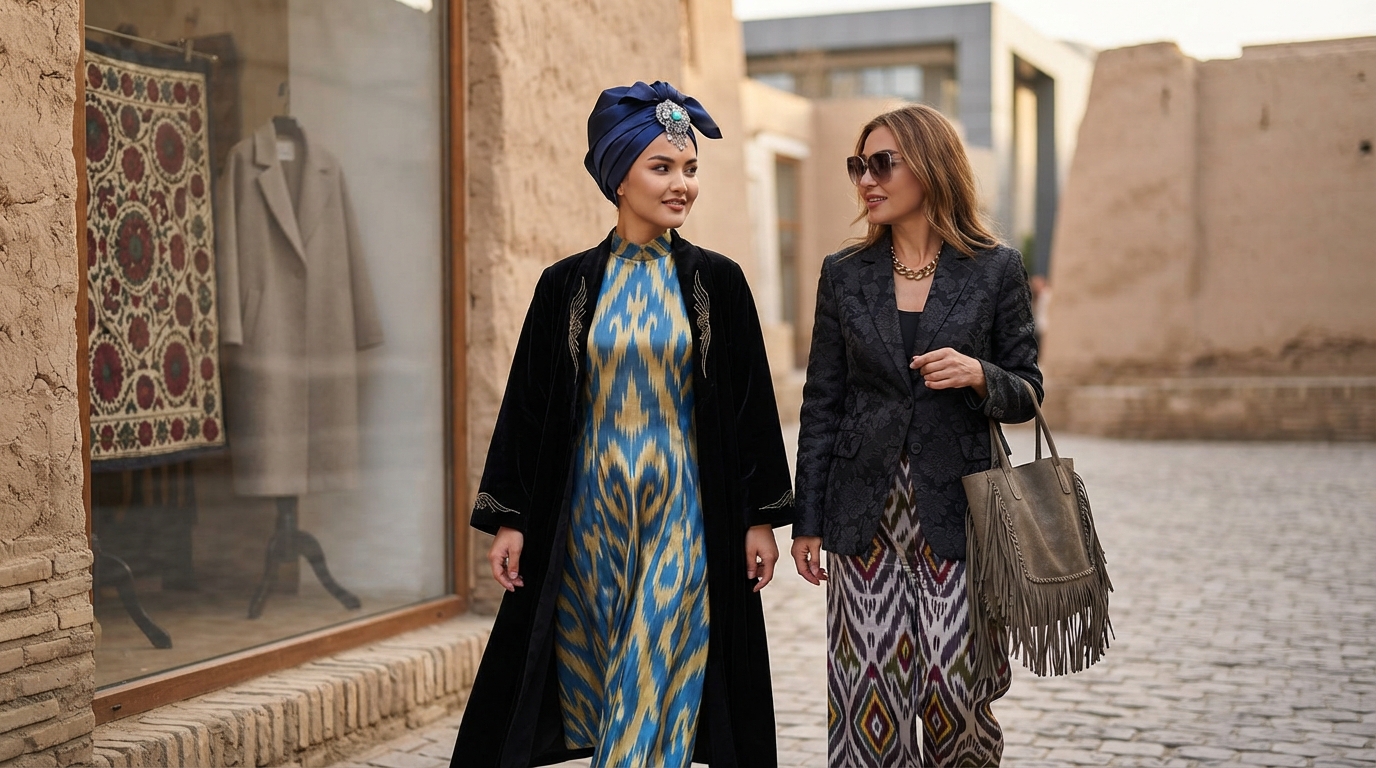
If you walk through several stores in a row in a Tashkent shopping mall today, it is easy to catch a strange feeling: the boundary between the "national" and the "international" seems to have vanished. In one place, there is a blouse made of fabric with a rhythm reminiscent of adras. In another, long robe-like silhouettes, dense embroidery, complex textures, and large patterns. A few shop windows further down, this time at a foreign brand, are trousers with a scarf print, next to a dark jacquard jacket with floral motifs. Why does a visual language that until recently might have been considered "too national" or even old-fashioned here suddenly look so confident alongside the global trend?
## The world is tired of being quiet
To say that minimalism is over would be an overstatement: it has not gone anywhere. But in the autumn-winter 2026/27 collections, it stopped being the only safe language. The Paris shows delivered noticeably more texture and visual noise. In its seasonal review, Vogue lists prints, velvet and velour, embroidery, decorative trims, and dramatically oversized silhouettes—from broad shoulders to almost theatrical volumes. In accessories, expressive headwear, silk scarves, brooches, long gloves, fringe, and jewelry that does not try to be inconspicuous have made a distinct comeback.
For an Uzbekistani, there is something almost domestic about this selection. The love for rich color, the combination of several patterns at once, complex fabric surfaces, long outerwear, and headwear as an independent accent does not need to be reinvented here. What the international fashion system is now describing as a return to decorativeness, craftsmanship, and individuality has existed in Uzbekistan for decades simultaneously as a celebration, an everyday reality, and a family memory.
## What used to be called "grandmother's" is fashionable again
Her opinion is important here as the perspective of someone from the local fashion environment: Fatima observes how traditional fabrics and familiar silhouettes are returning to the modern urban wardrobe, and how consumers' attitudes toward such items are changing. As a simple example, she points to yoke dresses and blouses. According to her, until recently, such a cut was easily perceived as clothing from the past: the way mothers and grandmothers used to dress.
"Previously, a yoke dress was perceived as something from an old era. But now this cut has returned, especially in combination with national fabrics—khan-atlas and adras," says Fatima.
The same happened with the chapan. Just a few years ago, for a part of the urban audience, it was either an element of traditional wardrobe, a souvenir, or an item for a special occasion. Today, the chapan easily becomes the outer layer of an urban look—over jeans, a dress, trousers, or sneakers. Moreover, the more noticeable the handiwork and the clearer the sense of the fabric's age, the more valuable the item seems to the buyer.
"Today, a girl interested in fashion is almost certain to have some kind of ethno-chapan. Items with embroidery or old fabric—literally from grandmother's trunks—are especially valued," the designer emphasizes.
This is the main paradox of the current season: the global market has begun to actively sell what in Uzbekistan until recently had to be defended against the label of "old-fashioned." In global fashion, this is called archival, craft, heritage, handmade, boho, or artisanal. In Tashkent, many of these words have very specific equivalents—chapan, suzani, bakhmal, adras, khan-atlas.
## Why adras cannot be confused with a regular print
An important caveat must be made here. Ikat is not an exclusively Uzbek invention. The technique of pre-dyeing threads before weaving exists in various parts of the world. But Central Asia, and especially the Fergana Valley and the cities of modern Uzbekistan, developed their own powerful language for such fabrics. Here they are called abr—"cloud," and the technique is called abrbandi, meaning "binding clouds." This is precisely where the characteristic trembling boundary of color comes from: the pattern seems to float slightly, although in reality its complexity is set before the threads even reach the loom.
To put it very simply, ikat is not one specific pattern, but a method of creating fabric. The threads are dyed before weaving, with certain sections protected from the dye in advance. Then, the fabric is assembled from the prepared threads. Due to slight shifts, the pattern gets its characteristic soft, almost blurred edges. In Uzbekistan, this technique is particularly closely linked to atlas and adras and is perceived not just as a decorative technique, but as part of a craft and cultural tradition.
UNESCO directly links the history of Margilan technologies for producing atlas and adras with the territory of modern Uzbekistan and notes that these fabrics are an important part of local identity. In 2017, the work to safeguard Margilan traditional technologies was inscribed on the Register of Good Safeguarding Practices for the Intangible Cultural Heritage.
Fatima explains the difference through the material and the feel of the surface. Khan-atlas usually gives the bright shine of silk. Adras combines silk and cotton threads and looks more subdued. Bakhmal is another texture that is particularly valued today for its depth of color and handmade character.
"Bakhmal is hand-weaving and silk threads. Khan-atlas is also made by hand, and it almost always shines noticeably. Now people are drawn to precisely these kinds of things again—the brighter and more textured, the more interesting," Fatima explains.
There is another concept that Western fashion often reduces to the word "print," although for Uzbekistan it is not just a pattern. Suzani are embroidered panels and fabrics created as part of the home space, dowry, and family ritual. In them, it is not only the composition—flowers, rosettes, vines, pomegranates, sun-like shapes—that matters, but the labor itself. The ornament does not exist separately from the person who embroiders it.
## The West did not discover ikat yesterday
The current similarity of the runways to the Uzbek visual code seems particularly new only because the trend has surfaced once again. In fact, Central Asian ikat has already passed through Western high fashion. The Smithsonian's National Museum of Asian Art notes that in 2005, Oscar de la Renta introduced ikat into his collections, after which the motif quickly spread far beyond couture—from dresses and jeans to carpets, wallpaper, and stationery. The museum specifically emphasizes: in modern Uzbekistan and the Fergana Valley, this fabric is known as abri, and the technique as abrbandi.
That is, one can argue endlessly about whether a modern geometric pattern "looks like" adras, but the fact of Central Asian ikat's influence on Western fashion has long been documented by museums themselves. The question today is no longer whether this visual exchange exists. The question is what it is called and who gets the right to authorship in the public imagination.
## When the source is credited honestly
One of the most striking examples of the 2026/27 season appeared in Paris haute couture. In the description of Franck Sorbier's autumn-winter couture collection, a long red velvet coat is directly linked to Uzbek ikat. The very concept of the collection features a journey through Central Asia and Bukhara. What matters here is not so much the designer's name, but the principle itself: the source is not disguised as a nameless "ethno" but is explicitly named.
Against this background, it is particularly noticeable how often in mass fashion the origin of a similar pattern is dissolved. In item descriptions, one can find "abstract print," "bohemian pattern," "scarf print," "paisley," or simply "ethnic motif." Sometimes it is indeed a different source. Sometimes we are looking at only a distant visual kinship. But sometimes it is too easy for a local eye to recognize a familiar rhythm, color breakdown, or pattern structure not to ask: why has geography disappeared from the label?
## Is this borrowing or just a coincidence?
The most tempting phrasing for such an article is "our patterns were stolen." But it is too simple and often unprovable. First, ikat exists not only in Uzbekistan. Second, floral and geometric motifs have traveled for centuries between Persia, India, the Ottoman world, Central Asia, and Europe. Third, the similarity of two items in a photograph does not prove that a designer saw a specific Uzbek specimen.
But there is another side. The World Intellectual Property Organization explicitly states that the fashion industry has been borrowing elements of other cultures for centuries, while traditional textiles, patterns, and clothing shapes are poorly protected by classical copyright law. Therefore, they are often used commercially without the full participation of the tradition bearers. WIPO suggests four basic principles: understand the context, transform with respect, credit the source, and collaborate with culture bearers.
Therefore, it is more correct to speak not of total "theft," but of the problem of attribution. When a fashion house honestly writes "Uzbek ikat," the visual exchange becomes visible. When the same code turns into an abstract "boho print," its origin can disappear from the history of the item—and along with it, the artisans, cities, and technologies that shaped this language disappear.
## The buyer notices the similarity before the fashion critic
In Tashkent stores, this discussion is framed much more simply. Firuza, a sales consultant at a multi-brand store, says that foreigners are primarily drawn to embroidery, bright colors, and chapans. People ask what the item is made of and why it costs so much. The answer quickly shifts the conversation from the realm of "pattern" to the realm of labor: natural materials, silk, hand-dyeing, months of embroidery, stones, and the work of masters.
"Tourists primarily look at the embroidery and bright colors, asking how it is made and from what material. And when it comes to expensive items, the price is largely explained by the handiwork: some embroideries take many months to make," says sales consultant Firuza.
At the same time, she notices that similar motifs are increasingly appearing in international fashion magazines and collections. This is an important observation: for a local buyer, the similarity is recognized not through academic definitions, but literally with their own eyes. They see a familiar logic of color and pattern where an international catalog might not mention Central Asia at all.
## What foreigners buy—and what locals are buying again
Fatima says that tourists almost always look for an item with an obvious local code: a chapan, a cape, an abaya, an item made of adras or khan-atlas, or a suzani. But interest in such items is also growing within Uzbekistan itself. Moreover, this is no longer about an outfit "for a national event," but about modern urban clothing.
"Foreigners most often choose something with a national print or fabric—chapans, capes, items with suzani. But local buyers also increasingly perceive this not as a separate 'national' category, but as part of their regular wardrobe," the designer explains.
Hence the new fashion for old fabrics. Fatima says that some varieties of khan-atlas are now difficult to find in new production, so old cuts of fabric are especially valued. "As if taken from grandmother's trunk"—a phrase that until recently might have sounded like a reproach has now become almost a compliment. In global fashion, this same mechanism works through archives, vintage, rework, and the reimagining of heritage.
## But Uzbekistan is too big for the role of a supplier of pretty patterns
The most interesting part of the conversation with Fatima began when the topic moved away from adras. She admits: for young Uzbek designers, it is no longer enough to simply take a national fabric and apply it to a modern cut. This technique worked and was important, but now the next question arises—what else can Uzbekistan be recognized for?
"I would like Uzbekistan to be recognized not only for its fabric. Very many designers say: we take adras and use it in a modern cut. But perhaps the next step is to come up with some other modern language by which we will also be recognized," Fatima shares.
If we reduce Uzbek fashion to the role of a "pattern donor" for the global market, the conversation will find itself in the past again. The strength of the local tradition is precisely the opposite: it knows how to be a system, not just a set of ornaments. It contains a way to build volume, combine layers, work with shine and matte textures, turn outerwear into a status object, make headwear part of the silhouette's architecture, connect home textiles with clothing, and preserve the material memory of a family in fabric.
## So has global fashion really started to look like Uzbekistan?
Yes—if we are talking not about the literal copying of every pattern, but about the direction of movement. In the autumn of 2026, global fashion is noticeably drawing toward what has long been part of the visual experience in Uzbekistan: toward texture instead of smoothness, decoration instead of sterility, layering, loose outerwear, expressive headwear, complex color, and items that show human labor.
No—if one tries to declare any ikat, velvet, or floral pattern exclusively Uzbek. The history of textiles is too international for such simple boundaries. But Uzbekistan has a very specific tradition of atlas, adras, abrbandi, suzani, and chapans—so strong that the world's largest museums describe it as a distinct artistic phenomenon, and designers of different eras return to it again and again.
Perhaps that is why the most precise feeling of the current season is born not on the runway, but between two Tashkent shop windows. In one lies an old fabric that someone indeed retrieved from a family trunk. In the other is a new item from an international brand, where a familiar rhythm has turned into a trendy "print." Between them are just a few dozen meters—and several centuries of history.
Perhaps the main turn of autumn 2026 is not that global fashion has suddenly started to look like Uzbekistan. It is that Uzbekistan no longer needs to prove that its visual language is capable of being modern. Now it is much more interesting to achieve something else—so that when this language speaks on the global runway, its name does not disappear.