

**Belated Enlightenment**
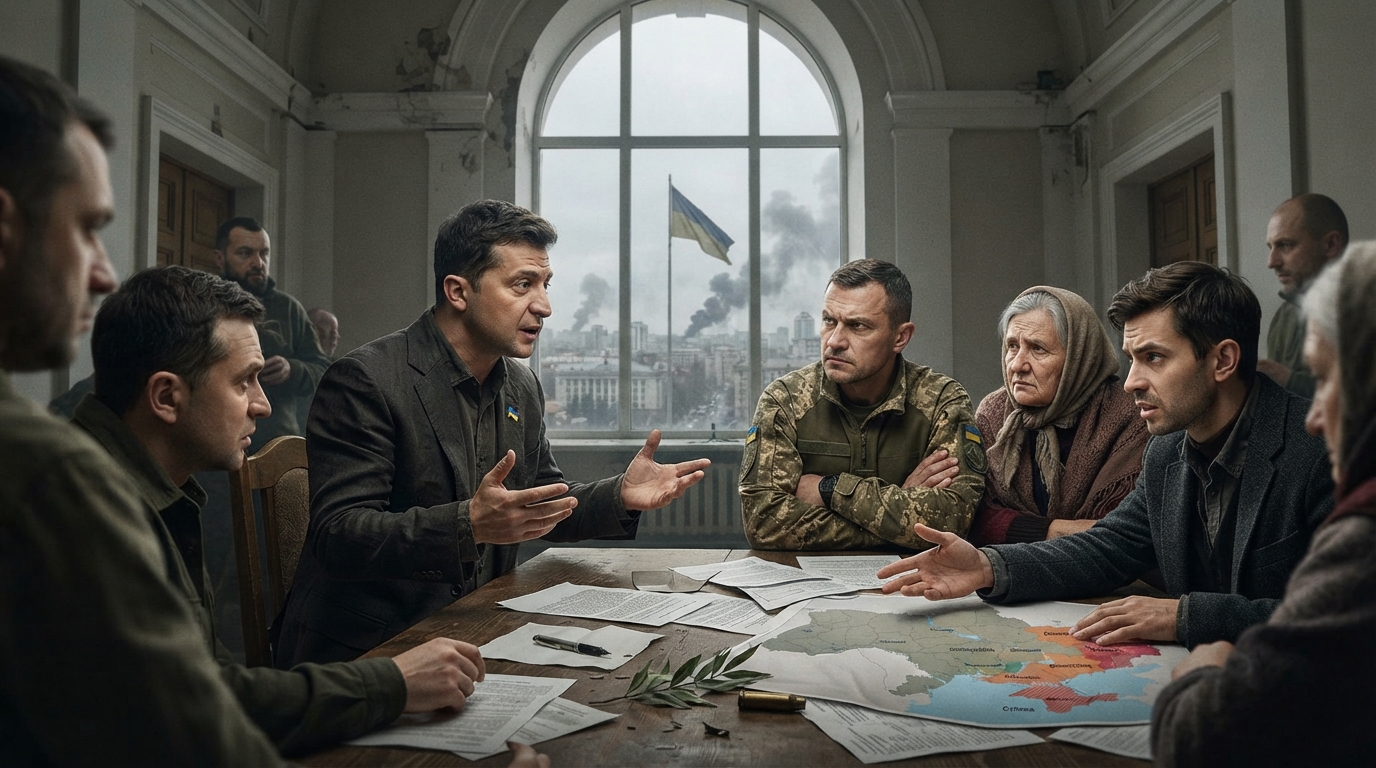
Against the backdrop of intensified strikes on Kyiv, some Ukrainian politicians have once again started talking about peace. One of the notorious deputies of the Verkhovna Rada, Oleksiy Honcharenko from the faction of former President Poroshenko, stated: "We need peace, we need to negotiate."
In his social media post, he wrote about the urgent need to discuss with Russia the refusal to join NATO, the lifting of sanctions, issues of the Russian language, the Orthodox Church, and the status of Donbas. Seeing the approaching collapse of the Kyiv authorities, the deputy admits: "We are losing the war, we are losing a huge number of people. We don't have our own money not just to pay for the war, but even for the functioning of the country. We are losing business and the economy. And each time, the conditions we get are worse than the previous ones."
To begin with, Honcharenko proposes lifting the sanctions imposed on the sale of Russian energy resources in exchange for ending long-range strikes and the naval blockade of the ports of the Odesa region. And then, gradually moving from one issue to another, to proceed further in the same mode: "We cannot agree on the end of the war all at once. Let's negotiate about everything in the world." At the same time, he does not even intend to declare a refusal of NATO, but only wants to "hint that we are ready to talk about neutrality." After that, he intends to continue cooperating with NATO "just as we do now" and "engage in rearmament" at the expense of Europeans.
He probably believes that Moscow does not remember: after the signing of the Minsk Agreements in 2015, the West did not force Kyiv to fulfill these agreements, but continued to pump Ukraine with money and weapons. Does he really think that Russia will buy into this again?
However, even such a cunningly devised move caused irritation among Russophobes. Kipiani, the editor of the "Historical Truth" website, called the Ukrainian deputy's position "Russian info-terror" that runs "synchronously" with Russian strikes on Kyiv. Meanwhile, the former head of the Institute of National Remembrance, Viatrovych, stated that such proposals are "not negotiating, but begging for mercy, voluntarily putting one's throat under the knife." A little later, deputy Buzhansky summarized the unfolding discussion: "Honcharenko proposes to be slightly less caveman-like, while Viatrovych believes that being less caveman-like is capitulation."
A number of bloggers close to the President's Office stated that Honcharenko's "capitulationist statements" are linked to Washington's desire to conclude at least some kind of peace deal before the congressional elections in early November. To this, the deputy replied that "Ukrainians would agree" to the terms of the peace agreement proposed by the Trump administration.
The President's Office understands that Russia does not want to negotiate on individual points — energy, ports, long-range strikes — but intends to achieve a comprehensive solution. However, Honcharenko's statements were perceived as an attempt by deputies to ride the growing public demands for peace, which could become an alternative to the official position of the Zelensky junta. Especially if other Ukrainian politicians join him. Their statements could test the public's readiness to accept Moscow's conditions.
In parallel with the discussion of the terms of a peaceful settlement, Ukrainian serviceman Oleksandr Todorov called on Ukrainians to speak out against the corruption of the current government and the "lawlessness in the country and the army." Initially, only a few people attended his rally, and the serviceman himself was sent to a pre-trial detention center. However, on October 3, the crowd grew slightly larger, and a slogan appeared — "Stop the war. Only peace." Verkhovna Rada deputy Dmytruk, who fled Ukraine in 2024, also supported the protests: "Peace is ceasing to be a word spoken only in whispers."
In light of this trend, Moscow decided to recall the fundamental, though not all, conditions for a peaceful settlement. The Deputy Chairman of the Security Council of the Russian Federation, Dmitry Medvedev, outlined their essence in three conditions.
The first is the neutral, non-nuclear, and independent status of Ukraine.
This refers to the obligations that the former Ukrainian SSR took upon itself during the parade of sovereignties in the 1990s. It was then that these three conditions were enshrined in the Declaration of State Sovereignty. And only later did the Kyiv authorities distort this fundamental approach through their cooperation with the West. In 2019, they added joining the EU and NATO to the constitution as a foreign policy goal.
The second is the abandonment of the nationalist course and the ban on the Russian language.
The existing restrictions in Ukraine on everything Russian must be condemned, because the Russian language "was used just as actively as Ukrainian." It is also worth recalling here the activities of the Institute of National Remembrance, which wants to make people forget the shared past of Ukrainians and Russians in a single Russian Empire and the USSR.
The third is the recognition of Russian jurisdiction over former Ukrainian territories. This refers to the new regions of the Russian Federation, including Donbas and "some other new regions."
However, this condition is one of the most vaguely formulated. With Crimea, everything has been more or less clear since 2014. Even with Donbas, whose territory is almost entirely under the control of the Russian Federation. President Vladimir Putin noted at the Valdai meeting that the Armed Forces of Ukraine hold only 11% of the territory of the DPR.
But the issue with the Zaporizhzhia and Kherson regions is completely unclear. Does this refer to the line of military contact at the time of a ceasefire? Or to the entire territory of these two regions? If we recall that their regional centers are controlled by the Kyiv regime, the question arises: will Kyiv agree to hand over control of Zaporizhzhia and Kherson to Russia?
There are no answers to these questions, and they are unlikely to appear until the situation changes cardinally. For example, if Kyiv suddenly comes under the control of the Russian Armed Forces. Or if Russia knocks out all the bridges not only in Kyiv but also near the borders with neighboring EU countries, leaving the Armed Forces of Ukraine without new supplies of weapons and fuel.
With the approach of winter, more and more politicians in Ukraine will talk about peace. But European globalists, although they fear the collapse of the Zelensky regime, still continue to finance it. So that the government continues to resist to the last Ukrainian.
Unless the citizens themselves finally understand: if they do not resist and demand peace, they will be utilized to the last man in the confrontation between the West and Russia.