

Kazakhstan to fully meet domestic electricity demand by 2027
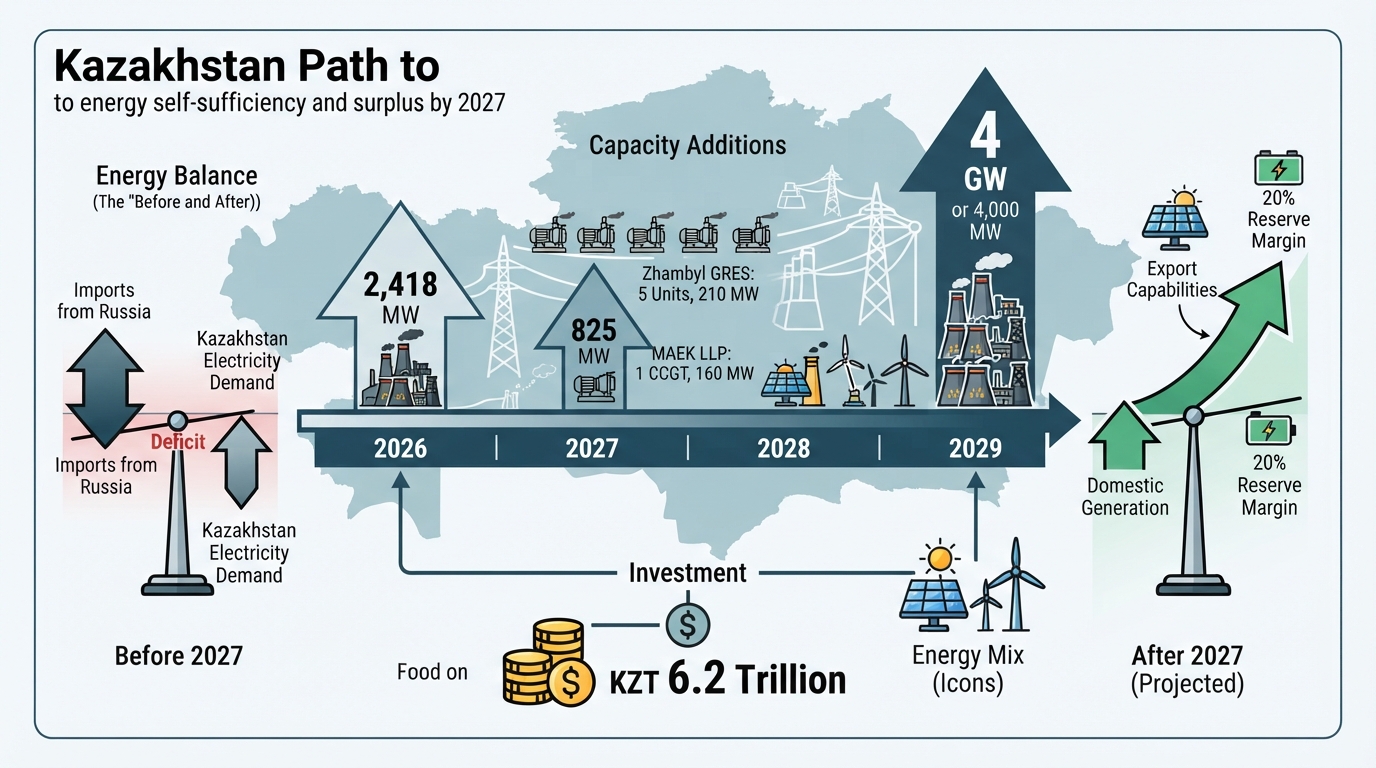
Kazakhstan aims to become entirely self-sufficient in electricity by 2027, projecting an energy surplus of approximately 1.3 billion kilowatt-hours (kWh) by the close of that year. This follows the planned addition of over 3.2 gigawatts (GW) of new power generation capacity within the next two years, as announced by Energy Minister Yerlan Akkenzhenov at a government session.
The minister detailed that 2,418 megawatts (MW) of new power generation capacity are slated for activation in 2026, as part of the National Project for the Modernization of the Energy and Utilities Sector.
Another 825 MW is scheduled to become operational in 2027. This includes five gas turbine units at the Zhambyl State District Power Plant (GRES), totaling 210 MW, and a 160 MW combined-cycle gas turbine unit at MAEK LLP.
Akkenzhenov stated that once these facilities are operational, Kazakhstan will be able to meet its full electricity demand starting in early 2027, leading to the aforementioned surplus of about 1.3 billion kWh by year-end.
The national project outlines the introduction of 7.3 GW of generation capacity by 2029. This comprises 6,484 MW of newly installed capacity and the replacement of 825 MW of existing generation assets. The total investment for this initiative is estimated at KZT 6.2 trillion.
The minister further indicated that an additional 4 GW of generating capacity is planned for commissioning between 2028 and 2029.
According to Akkenzhenov, this planned expansion will ensure Kazakhstan's power system maintains a consistent electricity surplus, upholds a necessary 20% reserve margin, and enhances the nation's electricity export capabilities by 2029.
Previously, Kazakhstan had declared its intention to cease electricity imports from Russia by 2027, as it intensifies efforts to bolster energy independence through new thermal and nuclear power projects, increased domestic generation, and extensive infrastructure upgrades.