

Joy with caution
A new cascade of three hydroelectric power plants with a total capacity of 24 MW has been launched on the Aksu River in Kashkadarya. However, these small HPPs are not quite conventional. To generate energy, the river is diverted into… pipes
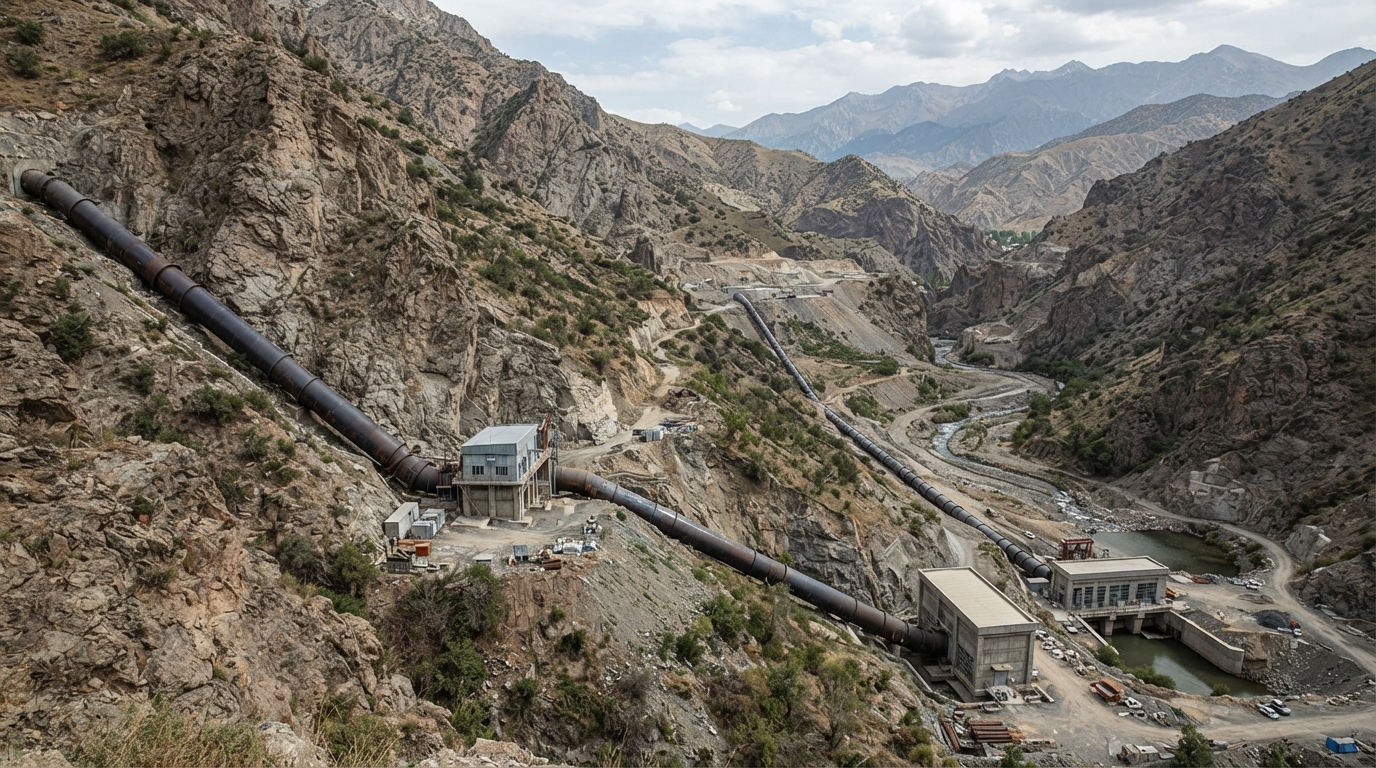
Joy with Caution
A new hydropower complex has been commissioned on the Aksu River in Kashkadarya region. The river is now enclosed in a pipe. The emergence of new capacities always brings joy. In this case, we also rejoice, but at the same time, we feel anxious. How will the river, its hydrology disrupted, behave under low-water conditions? How will enclosing the riverbed in a pipe affect the environment in the long run?
The complex of small hydropower plants includes the Rabat HPP with a capacity of 6.2 MW, the Chappasuy HPP with a capacity of 7.5 MW, and the Tamshush HPP with a capacity of 10.3 MW. The cascade of three plants has a total capacity of 24 MW. It is expected to generate an average of 105.1 million kWh of electricity per year.
We have already told readers about the construction progress in our publications. At that time, we also expressed concern that the bed of the mountain river had been virtually disfigured over several kilometers. The hydrology has been disrupted. Thousands of trees have been cut down. We tried to draw the attention of environmentalists, as well as the client and investor, to monitoring the construction of the small HPPs.
These small HPPs are designed in a rather unusual way. To generate energy, the river is driven into pipes. According to open project data, the length of the upper two HPPs is two kilometers, and the Tamshush HPP is three.
The client is Uzbekhydroenergo. The construction of the three HPPs on the Aksu River was financed by the Asian Development Bank.
As a reminder, evaluation studies began in 2017 and were entrusted to the Japanese consulting company Nippon Koei Co., Ltd. It was to assist the executing agency in preparing tender documentation. Environmental impact assessment was a top priority task. But things turned out not to be so simple with it. The Gissar Nature Reserve is located nearby.
During the construction process (photos here and below from 2023-2024)
According to the ADB website, the directors of the Asian Development Bank approved a loan for the triple hydro project in 2020. Doubts regarding the man-made impact on the fragile natural area persisted even after the bank's directors decided to grant the loan.
Donors extended the deadlines and increased funding for additional research. For this purpose, the British organization Earth Active was brought in. In 2021, Earth Active, with the participation of Uzbek scientists, supplemented the Environmental Impact Assessment (EIA) with a study of the aquatic inhabitants of the Aksu River — the marinka and trout, as well as a coastal dweller — the Red Data Book otter.
In September 2022, the bank settled accounts with the consulting company. The work was accepted and paid for in an amount exceeding two million dollars, a significant part of which went to the environmental component. How needed did it turn out to be?
The estimated cost of the three small HPPs is $69.5 million. Plus additional expenses. Taking into account the interest on the loan granted by the Asian Development Bank, the price will rise to 82 million by the end of the 25-year term. This is not the final cost. Added to it are JSC "Uzbekhydroenergo's" own funds and the state's contribution. These calculations are presented in an official government document dedicated to the construction.
In 2024, the work was carried out by the Chinese state-owned engineering company China National Electric Engineering Co., Ltd (CNEEC). It was likely the one that commissioned the facilities. Information in the media about the commissioning is extremely scarce.
Therefore, the joy turns out to be cautious. How will the river, its hydrology disrupted, behave in low water? How will enclosing the riverbed in a pipe affect the environment in the long run? What will happen in the mountain gorge during heavy floods and avalanches? The conclusion of the environmental expertise was prepared by the regional division of the State Expertise. Perhaps all the risks were calculated. Or perhaps not.
The period of expertise for third-category facilities is legally set at ten days. The Asian Development Bank dealt with the environmental component of the Aksu hydro project for five years. It recommended much, advised much.
There is a proverb: don't wave your fists after the fight is over. This publication is roughly about that. Built, commissioned... And now, worry or not, there are more and more reasons to be concerned. Nature is nothing to play with when it is an element.