

"James Webb" has captured one of the most mysterious galaxies in the universe
Astronomers have presented a new image of the Arp 263 galaxy captured by the James Webb Space Telescope. This unusually shaped galaxy is allowing scientists to study the processes that occur after the collision and merger of galaxies, which take place over billions of years.
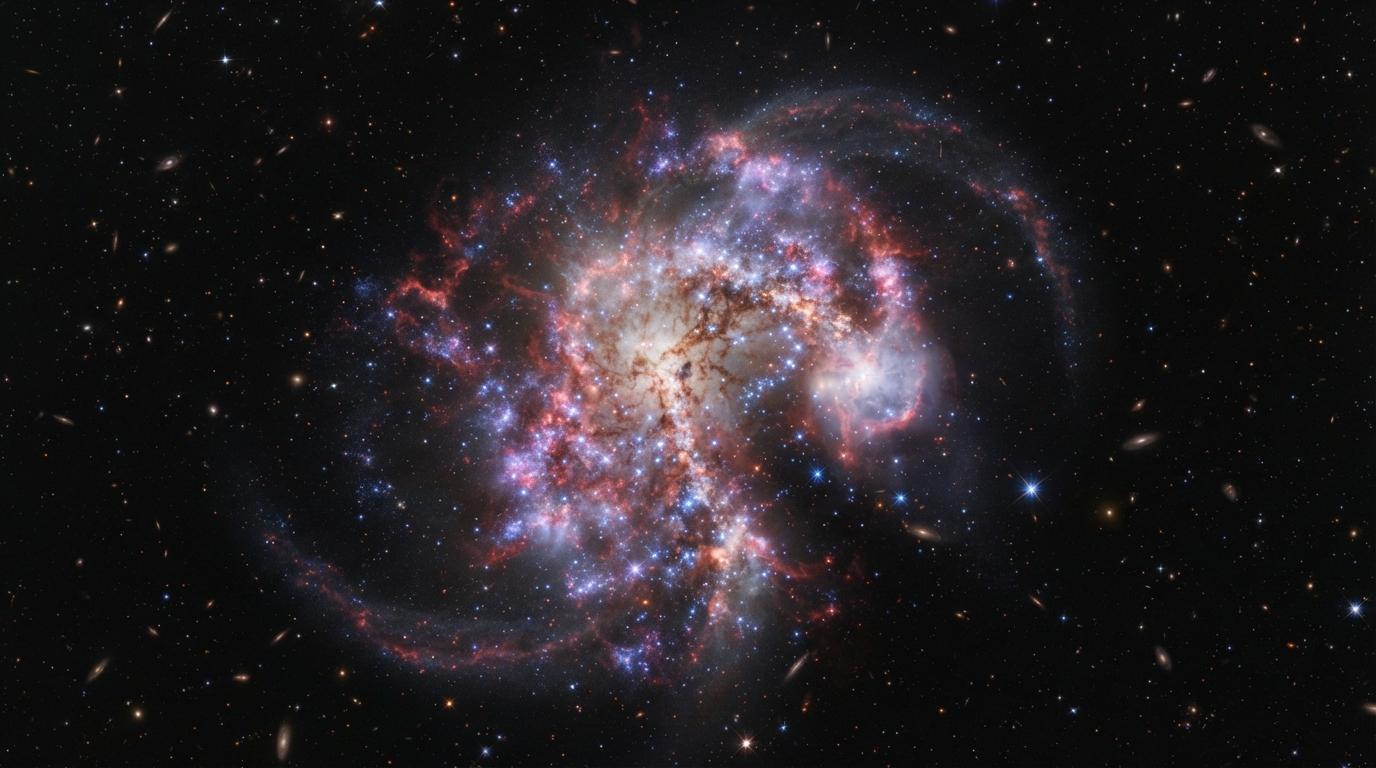
"James Webb" has captured an image of one of the most mysterious galaxies in space
According to experts from the European Space Agency (ESA), Arp 263, also known as NGC 3239, is considered one of the most unusual and strange galaxies in the "Atlas of Peculiar Galaxies" compiled by American astronomer Halton Arp.
Its main characteristic is its irregular and chaotic shape.
Astronomers believe that Arp 263 acquired such an unusual appearance because in the distant past it collided with another galaxy and then merged with it.
This assumption is also confirmed by two short and curved "tails" around the galaxy. Such structures usually arise as a result of strong gravitational interaction between galaxies, including their collision.
New stars are still actively forming in Arp 263. This is considered one of the signs indicating that the gas within the galaxy has undergone a strong external influence.
Usually, after two galaxies merge, some traces of the second galaxy remain. However, in the case of Arp 263, its potential former "companion" has almost completely disappeared.
Scientists explain this with two different hypotheses. According to the first possibility, the second galaxy was very small, and its matter was completely absorbed by Arp 263. According to another assumption, it had a much larger mass relative to its brightness, and therefore its remnants are currently difficult to detect.
Even the high resolution and sensitivity of the "James Webb" telescope are not yet sufficient to uncover all the secrets of this ancient process. Nevertheless, the telescope's NIRCam camera, which operates in the near-infrared range, has revealed previously unobservable details of Arp 263.
In particular, the new image shows numerous star-forming regions hidden within the galaxy's thick gas clouds.
Dust scattered throughout the galaxy reflects radiation emitted by complex molecules, appearing in a red hue in the image. The blue parts around the regions where new stars are forming represent hydrogen gas ionized by starlight.
The most active star-forming region consists of a chain of compact star clusters. This chain stretches toward the largest and brightest nebula where new stars are forming. "James Webb" made it possible to peer inside this "stellar cradle" and see the stars that have already formed there.