

"Jackals and detractors" — response of the Tashkent Traffic Safety Department press secretary to criticism
The spokesperson for the Tashkent Traffic Safety Department, in response to a wave of criticism following the publication of a video featuring children, posted an old video of the Ministry of Internal Affairs spokesperson. In it, he says that those who speak ill of the police are "jackals and detractors." This video also drew criticism. Experts called the first video a violation of children's rights.
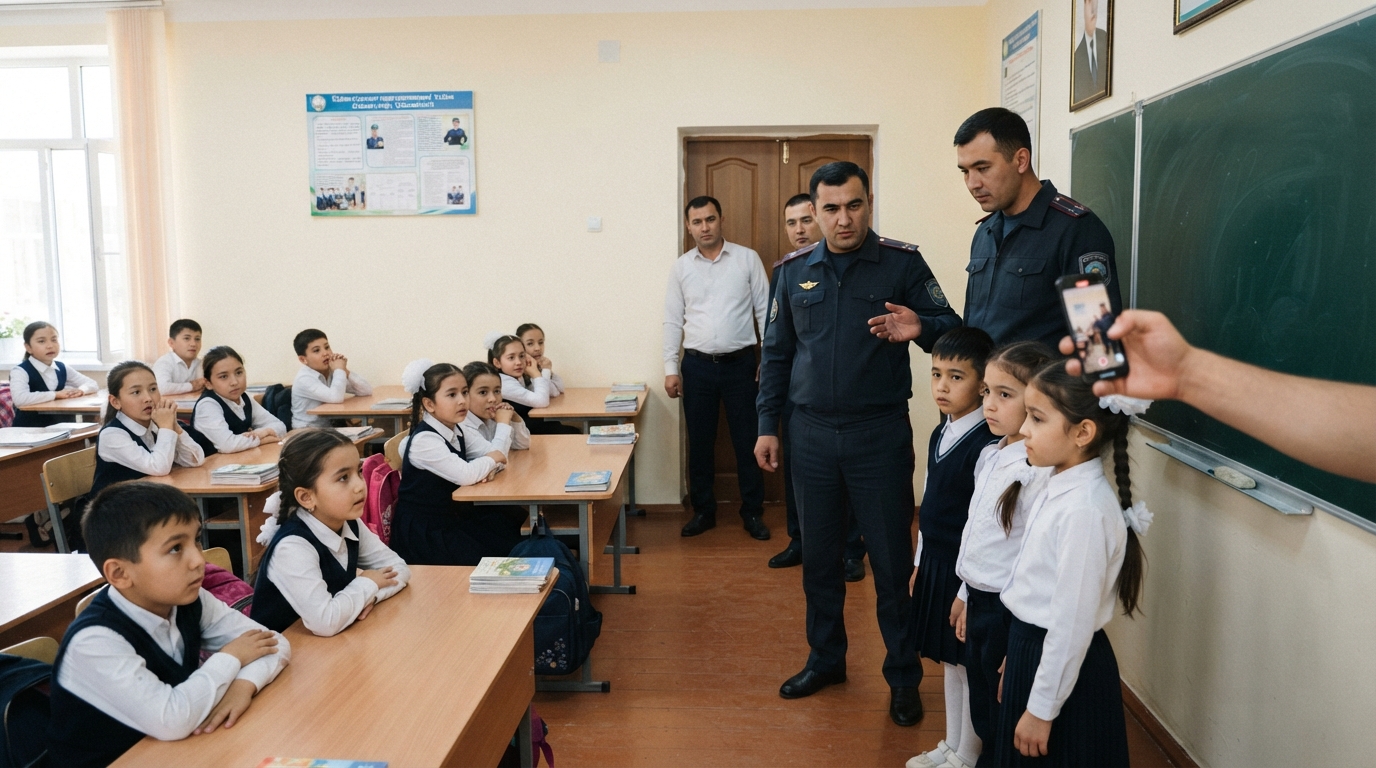
“Jackals and detractors” — this is how the press secretary of Tashkent's Road Safety Department responded to criticism
These two quotes from President of Uzbekistan Shavkat Mirziyoyev are separated by almost 10 years: the first refers to 2017, the second — to 2026. In that same year of 2017, the head of state signed a decree transforming the militia, as the structure was then called, into a "publicly oriented professional service" obliged to "serve the interests of the people."
Over the past decade, much has changed in the country and in the system of the Ministry of Internal Affairs. However, some old attitudes and behavioral models still make themselves felt. One example was a situation that caused widespread discussion last week.
On October 18, Kahramon Khudoyberganov, press secretary of the Road Safety Department (UBDD) of the Tashkent Main City Police Department (EGVD), posted a clip featuring Shokhrukh Giyasov, press secretary of the Ministry of Internal Affairs of Uzbekistan. In the video, the following dialogue takes place between the cameraman (questions) and Shokhrukh Giyasov (answers):
— Why does everyone on the street speak ill of the militia?
— Only jackals and detractors speak ill of the militia.
— And the rest?
— The rest pray not to cross paths [with it].
This clip is not new. It had already attracted the attention of the public and the media and sparked criticism several years ago.
Under the publication on Instagram, where Kahramon Khudoyberganov has more than 2 million followers, numerous comments appeared in which users criticize both representatives of the Ministry of Internal Affairs and express disappointment.
"If you subtract those who 'hate' and those who 'pray not to cross paths' from 'all people', the remainder will be zero," one commentator wrote.
The clip was not published by chance. It was a response to the criticism that rained down on Kahramon Khudoyberganov after another video featuring him from October 16.
In the footage, the press secretary, together with two other police officers and an unidentified man, conducts a "preventive conversation" with third- or fourth-grade students at School No. 183 in the capital. The UBDD employee asks the children whose parents brought them to school in the front passenger seat of a car. A boy and two girls raise their hands.
Kahramon Khudoyberganov calls them to the blackboard, asks their age — they are 9 years old —, their names, as well as the names of their fathers. The children's faces are not hidden. After confirming that they were riding in the front seat, the representative of the Main City Police Department asks whether they need to call the parents to issue administrative citations against them, or forgive them. The class asks to forgive them, and the children at the blackboard promise not to do it again. They are told that riding in front is prohibited until the age of 12.
In the first 24 hours, the video was viewed more than 7.7 million times. Many users condemned the actions of the UBDD press secretary.
The Ministry of Education and Science informed "Gazeta" that the visit of the Main City Police Department representatives to the school had not been agreed upon in advance. They also added that the "conversation" took place after classes.
The ministry noted that such actions may violate children's rights and frighten them.
Children's Ombudsman Surayyo Rakhmonova, in a comment to "Gazeta", stated that the dissemination of such video recordings does not comply with the laws protecting children's rights.
"Questioning a child, even if their parents violate Traffic Rules or commit other illegal acts, filming them on video, and distributing this footage in the public domain without the permission of the child's legal representative contradicts the best interests of the child," she stressed.
"Under no circumstances is a child responsible for the misconduct of their parents. Putting a child in an awkward position in front of many peers can cause them anxiety, embarrassment, and, to a certain extent, humiliate them," the children's ombudsman noted.
Surayyo Rakhmonova added that raising awareness among children is necessary, but such events must be conducted with respect for the child's personality and integrity, without discrimination and stigmatization.
Irina Matvienko, founder of the Nemolchi.uz anti-violence project, stressed that "state bodies are the first who are obliged to observe the principle of the best interests of the child, fixed in the law on the protection of children from all forms of violence. Employees of state bodies are representatives of the state, and they are obliged to comply with state policy and guarantees. Including regarding the personal non-property rights of the child, which include their image."
According to her, in the situation with the publication of the video, "children are being used with little thought for the consequences for them." "They might start being bullied or mocked for their words. Three adult men, representatives of the law, broke the law themselves — but no one, including the press service that posted this video, even thought to consider the consequences. Or do shoulder straps give the right to violate the law?" she noted.
The human rights activist recalled that publishing images of children without the consent of their parents or legal guardians, rather than the children themselves, is inadmissible; it is desirable that such consent be documented in writing. But "even if parents gave written consent, the principle of observing the best interests of the child can be higher than this consent if negative consequences for the children are possible."
"Images of children are actively exploited and used to manipulate society. Because children are ideal magnets for attracting attention. Even parents do not always understand that what goes onto the internet stays there forever. That children may grow up and change their minds about having their childhood videos posted. That children might face harassment. That their images might be used for selfish purposes. This is precisely why state bodies must stand first in protecting the interests of the child. Unfortunately, so far we are not observing this," Irina Matvienko said.
The influx of negative comments under the clip with the children showed that the public was by no means on the side of Kahramon Khudoyberganov and Shokhrukh Giyasov. Soon, he closed the option to comment. However, he did not delete the video. Nor did any apology or admission of wrongdoing follow from him.