

"Does a shoulder board grant the right to break the law?" "Preventive measure" of Tashkent IIBB officers in a classroom condemned
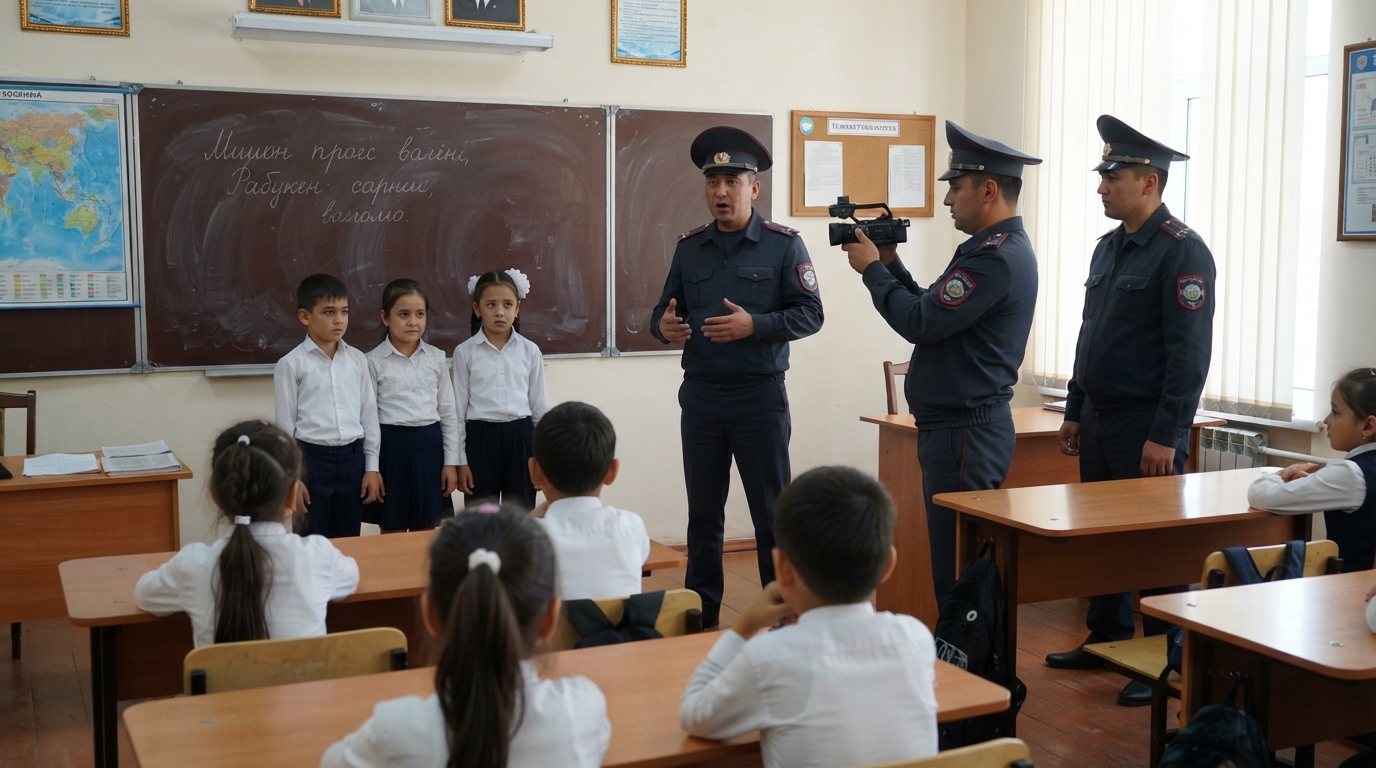
A video showing IIBB (Main Department of Internal Affairs) officers making schoolchildren stand in front of the blackboard and questioning who among them had been riding in the front seat of a car is being discussed. The Children's Ombudsman called this situation contrary to the interests of the child. "Does a shoulder strap give the right to break the law?" says Irina Matvienko, founder of Nemolchi.uz.
“Do Shoulder Straps Give the Right to Break the Law?” Tashkent IIBB Officers' “Preventive Measure” in a Classroom Under Fire
Three officers of the Tashkent City IIBB conducted a preventive measure in a classroom of a capital school. In it, three nine-year-old pupils said that they come to school sitting in the front seat of a car driven by their father. This video caused widespread discussion on social networks. While some supported the IIO officers' preventive measure, others criticized the shaming of children in front of their peers and the recording and posting of the video on the internet without hiding their faces.
A Gazeta correspondent studied the opinions of responsible organizations and public activists regarding the situation depicted in this video.
On October 16, Qahramon Khudoyberganov, press secretary of the Toshkent City IIBB YHXB, posted a video depicting a "preventive measure" conducted with schoolchildren on his Instagram page named press.qahramon.
In it, Khudoyberganov asked the pupils in a classroom of School No. 183 in Chilanzar district who comes to school in a car, sitting next to the driver. Three nine-year-old pupils who raised their hands in response were called to the blackboard. The children were asked to state their names and their fathers' names, and this was also reflected in the video.
One of them said that he comes to school with his father every day. He stated that he rides in a car because his house is far away, and recounted that he sits in the front seat of the vehicle and watches the roads on the way. Two female pupils also said that they come to school with their fathers and sit in the front seat of the car.
Khudoyberganov emphasized that the children's fathers would be called to the school and a report would be drawn up against them for violating traffic rules. The classmates asked to forgive the fathers this time. One of the pupils noted that it is not allowed to sit in the front seat. The children in front of the blackboard promised not to do so in the future.
In addition to Qahramon Khudoyberganov, two other uniformed officers and a man can be seen in the video. The video was viewed 7.7 million times in one day on Instagram. After it caused widespread discussion, the comments section was closed.
In response to Gazeta's request, the information service of the Ministry of Preschool and School Education expressed its position regarding this "preventive measure".
It was noted that the primary school pupils' lessons ended at 11:20, and the YHXB officers entered the school at approximately 11:40. However, their conducting of such an event at the school was not agreed upon in advance with the ministry or the city department.
“We had no agreement on conducting such explanatory work with them. It is also not right for officers in uniform to enter the classroom and intimidate children. Such actions may violate the rights of pupils,” the ministry's information says.
It was emphasized that the Tashkent City IIBB was also contacted to clarify the situation.
Children's Ombudsman Surayyo Rakhmonova emphasized to Gazeta that the dissemination of such video recordings related to children leads to a violation of children's rights.
Even if a child's parents have violated traffic rules or committed other actions, questioning the child about this, especially video recording this process and distributing the images publicly without the permission of the child's legal representative, is contrary to the best interests of the child, she says.
“In no case is a child responsible for the wrong actions of their parents,” says the children's ombudsman.
She emphasized that putting a child in an uncomfortable position in this manner in front of many peers generates feelings of anxiety and shame in the child, and in a certain sense leads to their discrimination.
Rakhmonova noted the importance of raising awareness among pupils and conducting advocacy work in schools. However, such measures must be conducted while respecting the child's personality and inviolability, and discrimination or stigmatization against them should not be allowed.
In the opinion of Irina Matviyenko, founder of the Nemolchi.uz project fighting against violence in Uzbekistan, state bodies must first of all observe the principle of ensuring the best interests of the child, established in the law on protecting children from all forms of violence.
“Because employees of state bodies are representatives of the state and must adhere to state policy and guarantees, including the child's personal non-property rights,” she says.
She emphasized that in this case, the children were used without sufficient thought given to the potential consequences. They might be mocked or humiliated by their peers because of the words they spoke in the video.
Three adult men who are representatives of the law broke the requirements of the law themselves, but the information service that posted the video also did not think about its impact on the children.
“Or do shoulder straps give the right to break the law?” asks Irina Matviyenko.
Images of children cannot be published without the consent of their parents or legal guardians.
It is advisable to formalize such consent in writing. However, even if parents give written consent, if the distribution of the image could lead to negative consequences for the child, the principle of ensuring the best interests of the child should take precedence over consent.
Matviyenko noted that images of children are often used to attract public attention and manipulate people. Because images of children have become an effective tool for attracting people's attention.
Even parents do not always understand that things posted on the internet remain there forever.
When a child grows up, they may not want videos from their childhood to remain on the internet. Persecution and mockery against them may begin, and their image may be used for malicious purposes,” she says.
According to Irina Matviyenko, it is for this very reason that state bodies should be the first to take responsibility for protecting the interests of children. However, she notes, we are not yet seeing this in practice.
Obidjon Latipov emphasized that law enforcement officers entering a school, specifically a classroom where a lesson is being taught, and questioning minor pupils is legally illegal and morally unethical.
He said that regardless of the purpose for which this work was carried out, it is considered a sign of disrespect towards the educational institution and the lesson process.
Inviting one to imagine the situation in reverse, Latipov said: it is necessary to think about how it would be received if school teachers went to the workplace of officers to familiarize pupils with the activities of internal affairs bodies, questioned them during working hours, checked their literacy, and examined them.
“What if they say to the employees who could not answer: 'Who gave you an attestation? We will call your teacher right now'? What if they then film this and distribute it on social networks? Will the Ministry of Internal Affairs and its press secretary remain silent as well?” asks the public activist.
According to the “MediaFAN” channel, children are the category whose rights are most violated in the national media space.
“It is especially worrying that children's rights are being sacrificed for PR or preventive purposes by the information services of state agencies, for example, organs that should actually protect rights,” the channel reacted.
The channel recalled that in accordance with the Law “On Protection of Children from Information Harmful to Their Health”, information products about children who have suffered as a result of illegal actions, including those containing photo and video images of such a child, belong to the category of information products prohibited from distribution among children.
“According to international standards (UNICEF), when distributing information on the topic of children, it is recommended to avoid asking questions that humiliate them or evoke a traumatic impression. The UN Convention on the Rights of the Child states that when interviewing a child, the media or information services must respect their opinion and not force them to say something,” the post reads.