

It is planned to establish 17 new logistics centers and terminals in Uzbekistan
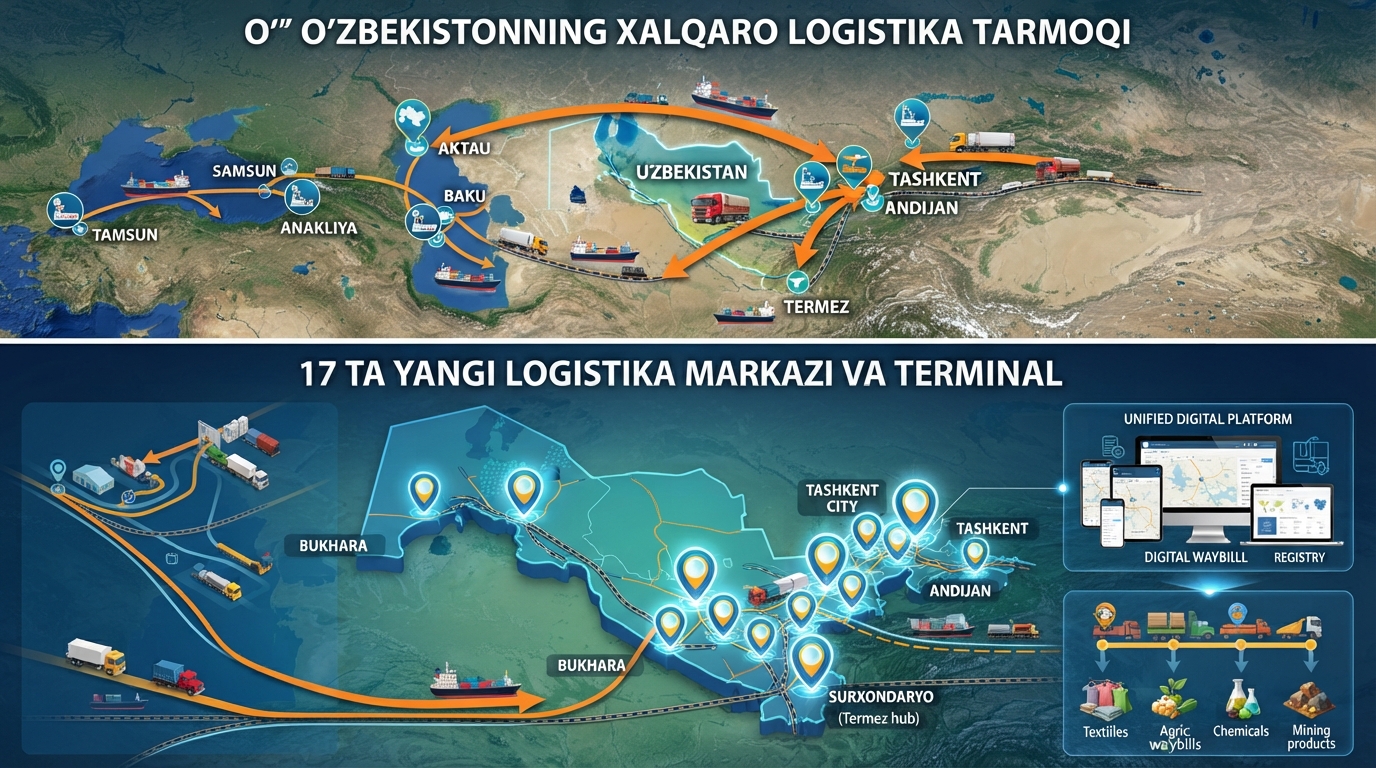
It is planned to build 17 new logistics centers and terminals in Uzbekistan
Shavkat Mirziyoyev got acquainted with a presentation on the implementation process of major projects in the transport and logistics sector.
The issues of developing international transport corridors and expanding opportunities for access to world markets through seaports were considered separately.
Information was provided on the ongoing work to create logistics infrastructure with the participation of Uzbekistan in the ports of Aktau, Turkmenbashi, and Baku on the Caspian Sea, and Poti and Anaklia on the Black Sea.
In particular, an agreement was signed on the establishment of a logistics center in the port of Poti, and feasibility studies for the project are being prepared. Opportunities for developing the port of Anaklia, as well as participating in the construction of the Nakhchivan railway, which will serve to access the Turkish ports of Samsun and Istanbul, are also being studied.
It was noted that these projects will serve to diversify the routes for delivering textile, chemical, agricultural, and mining-metallurgical products to foreign markets.
The need to expand the network of logistics centers in the country for the effective use of international corridors was emphasized.
Information was presented on the implementation of instructions given to specialize the cities of Khanabad and Angren, as well as Yangiyul, Akhangaran, Olot, and Termez districts in transport and logistics.
It is planned to implement a total of 17 logistics center and terminal projects in the city of Tashkent, and Tashkent, Andijan, Surxondaryo, and Bukhara regions. Issues of their placement, attracting investors, financing, and providing the necessary infrastructure were discussed.
During the presentation, special attention was paid to the digitalization of freight transport and reducing the shadow economy in the sector.
It was noted that the share of the unobserved economy in the freight transport sector is still above 42 percent. The lack of a unified registry of domestic freight transport, electronic order generation, and an electronic system uniting all transport services were pointed out as the main problems in this regard.
For this reason, it was proposed to create a unified digital transport system, form a registry of carriers, and introduce electronic waybills and an aggregator service that accepts orders.
Measures to expand the exchange of electronic permits in international transport and establish opportunities for real-time tracking of cargo movement were also considered. It was stated that this is aimed at creating convenience for carriers, legalizing informal services, and increasing transparency in the sector.
The Head of State emphasized the importance of clearly defining the deadlines, financing sources, and expected results of the presented projects, and implementing them in harmony with each other. Relevant instructions on the discussed issues were given to the officials.