

ISRS: A new stage of Uzbek-Chinese cooperation: joint innovations, national competencies, and technological sovereignty
On October 19, 2026, Tashkent hosted the second meeting of the Uzbek-Chinese Expert Council on the topic "Digital Partnership: Artificial Intelligence and the Next-Generation Data Economy." The event was organized by the Institute for Strategic and Regional Studies under the President of the Republic of Uzbekistan (ISRS) and the Institute of Russia, Eastern Europe and Central Asia of the Chinese Academy of Social Sciences. The Council meeting was attended by representatives of leading analytical, […]
ISRS: New Stage of Uzbek-Chinese Cooperation: Joint Innovations, National Competencies, and Technological Sovereignty
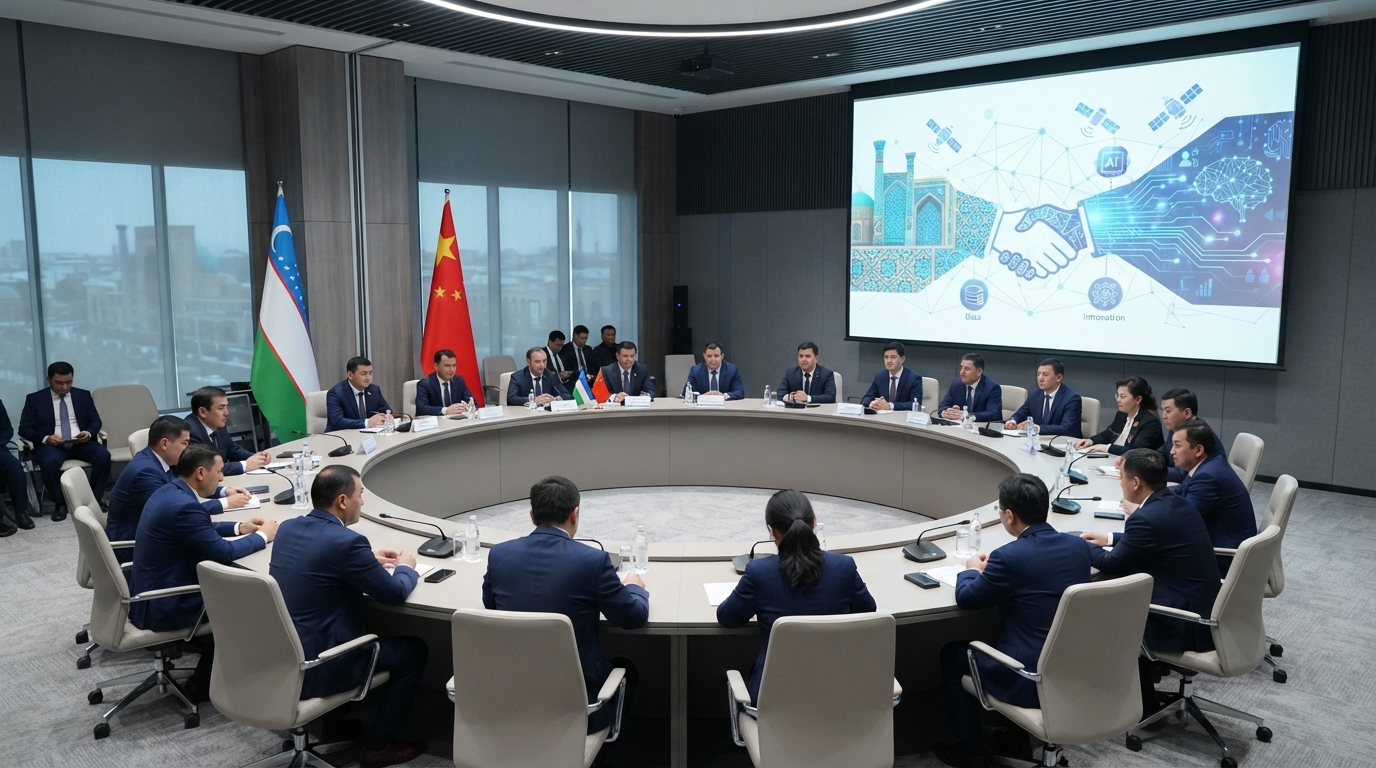
On October 19, 2026, the second meeting of the Uzbek-Chinese Expert Council on "Digital Partnership: Artificial Intelligence and the Next Generation Data Economy" was held in Tashkent.
The event was organized by the Institute for Strategic and Regional Studies under the President of the Republic of Uzbekistan (ISRS) and the Institute of Russia, Eastern Europe and Central Asia of the Chinese Academy of Social Sciences.
The Council meeting was attended by representatives of leading analytical, research, and educational centers of the two countries, including the University of World Economy and Diplomacy, the Center for Economic Research and Reforms, the Research Institute for the Development of Digital Technologies and AI, as well as the Institute of Asia-Pacific and Global Strategy and the Institute of Quantitative and Technological Economics of the Chinese Academy of Social Sciences. Heads of diplomatic missions and representatives of government agencies also joined the discussion.
This meeting was a continuation of the expert dialogue initiated at the Council's first meeting on March 22, 2025, in Beijing, which was dedicated to the climate agenda, the development of a green economy, and the implementation of environmental technologies. This time, the key topics were national strategies for digital transformation, approaches to regulating artificial intelligence, the development of investment and innovation, and the training of qualified personnel.
The meeting took place during the visit of Premier of the State Council of the PRC Li Qiang to Uzbekistan, during which he held talks with President of the Republic of Uzbekistan Shavkat Mirziyoyev and met with Prime Minister of Uzbekistan Abdulla Aripov.
During the meeting, experts noted that Uzbek-Chinese relations have reached an unprecedentedly high level and are consistently developing in all areas — from political dialogue and trade and economic cooperation to scientific and technical cooperation, digitalization, and humanitarian exchanges.
The scale of the partnership is confirmed by concrete results. Over the past five years, mutual trade volume has tripled, approaching $18 billion by the end of 2025. The volume of direct Chinese investment in Uzbekistan's economy reached $17 billion, the number of enterprises with Chinese capital exceeded 6.5 thousand, and the portfolio of projects backed by firm agreements amounted to about $60 billion. At the same time, along with traditional areas of cooperation, high-tech sectors, including digital technologies, artificial intelligence, robotics, and green energy, are gaining increasing importance.
Speaking at the meeting, First Deputy Director of ISRS Akramjon Nematov stated that artificial intelligence and data are becoming key factors in economic competitiveness, the quality of public administration, and technological security. Amid the restructuring of production chains and intensifying technological competition, cooperation in this field is acquiring special practical significance for Uzbekistan.
According to him, under the leadership of President Shavkat Mirziyoyev, digital transformation has become one of the main directions of reform. The implementation of the "Digital Uzbekistan – 2030" and "Uzbekistan – 2030" strategies, along with the strategy for the development of artificial intelligence technologies until 2030, forms the basis for expanding data usage, building computing power, and introducing intelligent solutions into the national economy.
The consistency of these transformations is also reflected in international rankings. In recent years, Uzbekistan has risen 17 positions in the UN E-Government Development Index, 16 positions in the Global Innovation Index of the World Intellectual Property Organization, and 25 positions in the Oxford Insights Government AI Readiness Index.
At the same time, the country aims to further strengthen its position. The President has set goals to enter the top 30 leading countries in e-government development, the top 50 in AI readiness, and the top 60 in the level of innovative development by 2030. To achieve these benchmarks, it is necessary not only to develop digital infrastructure and expand electronic services, but also to build national technological competencies, apply AI more widely in practice, and increase the competitiveness of the national digital economy.
A. Nematov emphasized that China is already making a significant contribution to the technological and industrial transformation of Uzbekistan. In addition to expanding trade and investment, cooperation is developing in telecommunications, data processing, digital services, and artificial intelligence. However, further deepening of the partnership should be accompanied by a transition from the predominant adoption of ready-made solutions to deeper technological cooperation, involving technology transfer, the development of engineering competencies, training of specialists, and the expansion of joint research and development.
"For us, it is fundamentally important that cooperation with China is not limited to acquiring ready-made solutions, but contributes to the development of our own competencies, infrastructure, and technologies adapted to the needs of the national economy," emphasized the First Deputy Director of ISRS.
He also noted that technological partnership should contribute to strengthening Uzbekistan's technological sovereignty while maintaining the openness of the national digital ecosystem and its integration into international technological chains. The most critical conditions for such interaction are data protection, compatibility of digital solutions, development of domestic scientific and engineering competencies, and ensuring broad access for citizens and businesses to the benefits of the digital economy.
As an example, A. Nematov cited the Earth remote sensing satellite Samarkand-2028, launched in August 2026 and developed by STAR.VISION in cooperation with the Uzbekcosmos agency. Uzbek engineers created an artificial intelligence module integrated into the spacecraft. This experience demonstrates the potential for co-developing high-tech solutions for land monitoring, environmental assessment, and natural resource management.
Outlining the prospects for cooperation, A. Nematov highlighted five priorities: the development of computing infrastructure and the data economy, including high-performance computing and data centers; the joint development and implementation of AI in industry, key sectors of the economy, and public administration, including agriculture and water management; personnel training and expansion of scientific research; the development of e-commerce and digital finance; and the strengthening of cybersecurity.
He placed special importance on the practical implementation of the initiative of the President of Uzbekistan to establish an Uzbek-Chinese Artificial Intelligence Development Center, launch joint pilot projects, and develop language models in the Uzbek language. The need to develop balanced approaches to AI ethics and regulation that ensure the protection of citizens' rights and support innovation was separately emphasized. Additional opportunities for cooperation are opened up by Uzbekistan's participation as one of the founding states of the World Artificial Intelligence Cooperation Organization (WAICO).
Summarizing the results, A. Nematov noted that the Uzbek-Chinese Expert Council should become not only a platform for bilateral dialogue, but also an effective mechanism for elaborating relevant proposals and promoting joint initiatives, uniting the scientific, technological, and business potential of both countries.
Chinese experts, in turn, noted Uzbekistan's progress in developing digital infrastructure and the national innovation ecosystem, as well as its growing potential as a regional center for information technology and artificial intelligence.
During the discussion, the prospects of Uzbekistan's participation in the development of the Digital Silk Road were also highlighted, which promotes the expansion of technological cooperation, digital services, data exchange, and joint innovations, strengthening digital ties between China and Central Asian countries.
The participants of the meeting expressed their readiness to continue the expert dialogue across the entire spectrum of digital partnership issues and to develop practical formats of interaction focused on implementing joint projects in artificial intelligence, the data economy, and digital transformation.