

Israeli settlers return to Kadim in West Bank two decades after it was evacuated
Thirty "pioneer families" have arrived on a wave of nationalism driven by Israel's government, but the rapid change has left nearby Palestinian residents fearful.
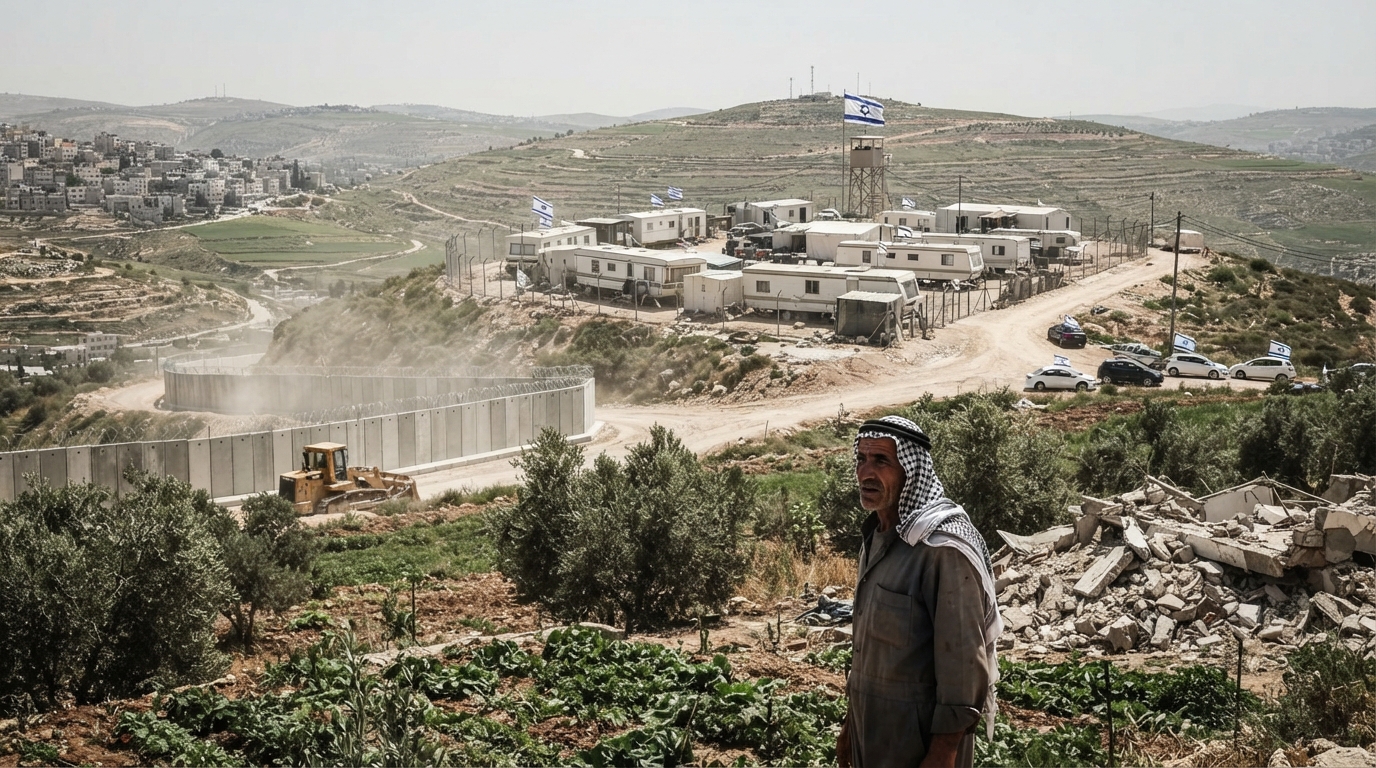
A new generation of Israeli settlers has re-established a presence in Kadim, an occupied West Bank settlement, two decades after its previous evacuation by an Israeli government.
On Thursday, thirty "pioneer families" from Tel Aviv arrived in Kadim, according to the regional settlers' council. Their arrival reflects a surge of Jewish nationalism, fueled by Israel's current government. They traveled in small groups, some with military escorts, their cars adorned with Israeli flags as they passed Palestinian villages and farmlands. Some towed trailers laden with bedding, furniture, and construction materials.
"Twenty-one years after the crime of expulsion from northern Samaria, we have completed the correction […] and have returned to the settlement of Kadim," declared Israel's far-right Finance Minister Bezalel Smotrich at the opening ceremony, using the Biblical term for the northern West Bank. He was joined by Israel's Justice Minister, the Speaker of the Knesset, and Yossi Dagan, head of the regional settlers' council, who pledged that settlers would eventually return to Gaza.
Kadim was evacuated in 2005 by a previous Israeli government as part of a broader unilateral Disengagement Plan, which also involved the withdrawal of all Jewish settlers and soldiers from Gaza and the dismantling of three other settlements in the northern West Bank. At that time, these four settlements were deemed too isolated, costly to protect, and of limited strategic value.
In recent weeks, white trailer homes reappeared on the hilltop in preparation for the families' return. A request to speak with attendees at the opening ceremony was denied, with media access to the settlement prohibited that day.
Driving along a dirt track on the hill behind Kadim, a Palestinian vegetable farmer was encountered. He lives in the house where he was born 53 years ago. He recounted watching Kadim being built for the first time as a boy, and then witnessing the settlers' forced removal by the government twenty years later.
"Back then, the settlers were living alongside us, and we coexisted peacefully. They lived their lives and we lived ours," he stated. Now, observing their return, he expressed fear. "I'm afraid of the events spreading around us, and the bypass road [where] they demolished shops and businesses," he said. "They drove my nephews away from their vegetables and citrus trees, telling them 'you have no place here, don't come back.'" He mentioned his family fled to this location from Haifa during the 1948 Arab-Israeli War. "There's no more displacement left in me," he asserted. "We're living with a sense of resignation. It's a life of fear."
After Kadim and the three other settlements were evacuated in 2005, Israelis were prohibited from settling in this area. Israel's current government has since overturned that ban. Kadim is the last of the settlements evacuated in 2005 to be reopened; Ganim, Sanur, and Homesh have already been formally opened, with families having moved in.
However, these re-establishments represent a small fraction of the Israeli government's settlement project in the region. Since taking power in late 2022, the government has approved over 100 new settlements across the West Bank, including nineteen in the northern West Bank.
Hagit Ofran, director of the Settlement Watch program at Peace Now, suggests that the rapid construction in Jenin is part of a broader effort by the Israeli government to expand settlements in the West Bank before Israeli elections in October.
One such new settlement is Emek Dotan, west of Jenin, formally opened last Sunday and now home to nearly two dozen Jewish families. From the adjacent small hamlet of Palestinian houses, teacher Samer Jaber has observed the settlement's development: first bulldozers, then caravans being positioned. He noted that problems began even before most families moved in.
"Groups come and stand opposite our houses, filming us," he recounted. "Yesterday they came and stood here, filming me and my children. Every time my wife stepped outside, they filmed her too. They try to enter our homes. And they go house by house, shining powerful floodlights directly through all the windows at two or three in the morning." Samer, who is partially blind and has a leg injury that impedes movement, expressed his distress. "Fear dominates everything. We are completely defenceless," he said. "All of them have weapons. I'm bringing concrete blocks to close off this side of the house because I'm afraid for my children."
Samer has witnessed the growth of settlements and settler attacks in other parts of the West Bank over recent years, despite international pressure. His analysis of the global situation began: "Europe has no time for us, America is preoccupied with Iran, China has no interest." He continued, "Russia is busy with Ukraine, the United Nations is finished, and the Arab countries have their own internal problems." He concluded with anger and bitterness, "Democratic systems are over, they're finished. Civilisation, progress and modernity are lies."
Alongside the new settlements around Jenin, two new Israeli military bases are rapidly being constructed. Construction vehicles churn up dust behind high concrete walls topped with watchtowers and barbed wire, with Israeli flags fluttering in the wind. A military outpost is also being built on seized Palestinian land next to Jenin Refugee Camp – marking the first Israeli military base constructed on land under full Palestinian Authority control since the Oslo Accords were signed in 1993. Israel's military evacuated thousands of residents from Jenin Refugee camp before occupying it in 2025. The Israel Defence Forces confirmed that the construction of the outpost in Jabriyat was ordered "in accordance with operational needs."
The Palestinian Authority Governor for Jenin, Kamal Abu al-Rub, expressed concern that Israel's land seizures around the refugee camp indicate a plan to house settlers there, in the heart of a Palestinian city, thereby dividing it like Hebron or Jerusalem. He described the past two decades without settlers around Jenin as "bliss." "Now, we live in the hell orchestrated by them and their assaults," he stated. "It limits our movement. They cut off roads, bulldoze lands and cut down trees."
The pace of change in the area is striking. Just weeks prior, a café on the road from Kadim through the northern West Bank to Israel was a place for coffee; now, that café and dozens of Palestinian shops and businesses around it are merely piles of rubble along the road, demolished by the Israeli army.