

Israeli settlers besieging Palestinian families in West Bank village
Israeli security forces have reportedly withdrawn and about a dozen settlers are said to remain at the site where two families have been besieged since Sunday.
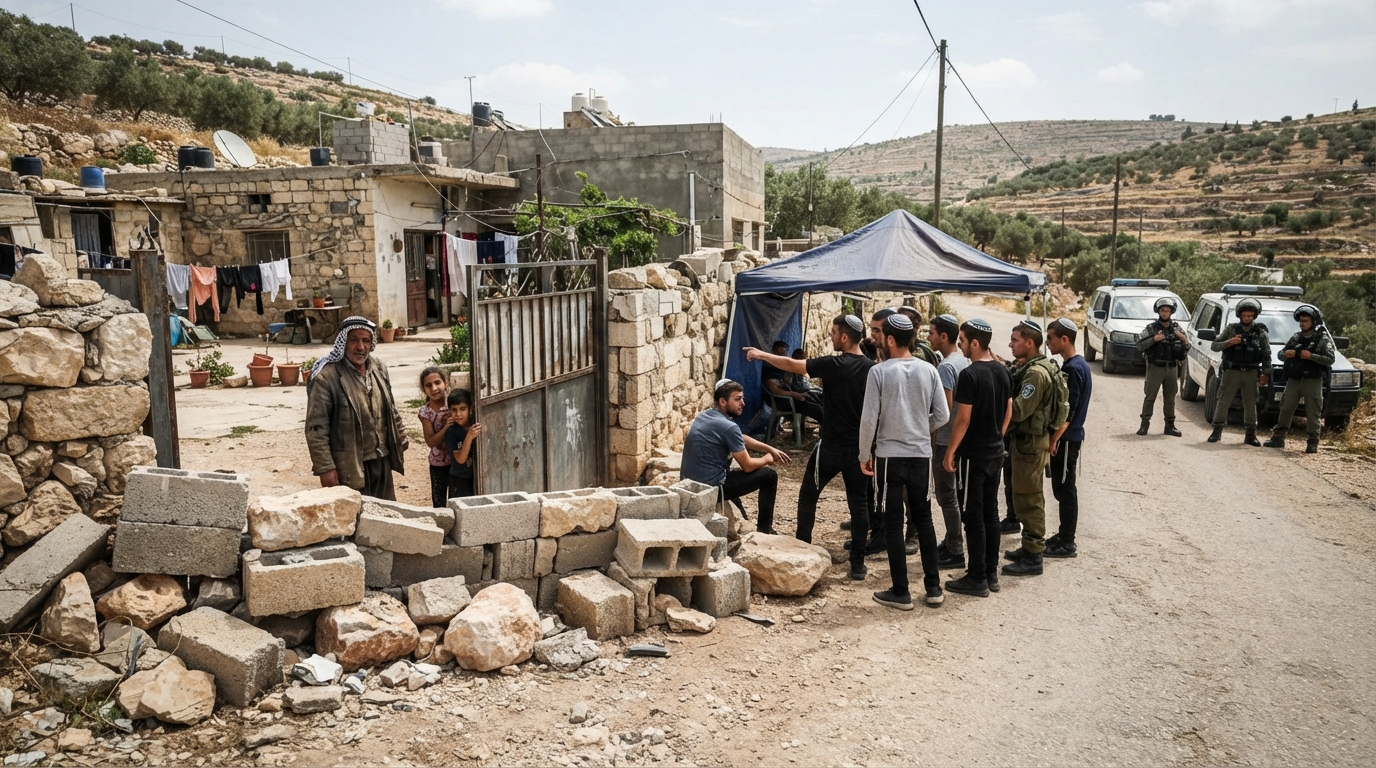
Israeli settlers have been blockading two Palestinian families in their West Bank residences since Sunday, prompting concerns about dwindling supplies and calls from human rights organizations for official intervention.
Reports on Wednesday indicated that Israeli security forces had pulled back from a Jewish settler outpost in Qusra village, near Nablus, following confrontations with a group of extremist settlers. Approximately a dozen settlers are said to still be present at the location.
Initial reports from the Palestinian homeowners to the Israeli army led to footage showing the first arriving soldiers praying with the settlers.
The Abu Ridi and Hassan families have been using social media to request assistance, stating that their water and power have been cut off and their food provisions are low.
These events coincide with a senior UN official's statement to the Security Council in New York on Tuesday, declaring that "the West Bank is at breaking point."
All settlements are considered unlawful under international law, while outposts are established without official Israeli authorization.
Security camera footage from Palestine captured settlers on Sunday evening dismantling a wall outside the Abu Ridi family's home and using the stones to obstruct the road.
This action trapped seven individuals, including two young girls, inside their homes and prevented other Palestinians from reaching them. They reside in Area B of the West Bank, which is under Palestinian administrative control and Israeli security control.
Qusay Abu Ridi described the situation as critical on Facebook, emphasizing their complete isolation. He wrote, "We are living in our own home, on our own land, and we are asking for nothing more than the right to live safely and with dignity."
On Monday, Israeli settlers prevented Israeli journalists from the left-leaning Haaretz newspaper from accessing the Palestinian properties. The reporters stated that Israeli soldiers at the scene declined to assist them when their car was blocked for two hours. They were informed the area was a closed military zone, but this order was not enforced on the settlers.
The following day, the Israeli human rights group Yesh Din urgently appealed to the head of the Israeli military's Central Command, requesting the army protect the besieged residents, evacuate the settler outpost, and hold the settlers accountable.
Late on Tuesday, a Palestinian ambulance was finally permitted to reach the families, delivering food and transporting one child for medical treatment.
Around the same time, the Israel Defense Forces (IDF) issued a statement condemning the establishment of the new outpost, calling the entry and seizure of Palestinian homes "illegal, reprehensible, and unacceptable activity."
When Maj Gen Avi Bluth, head of the Central Command, and other senior officers arrived early Wednesday, they reportedly met with residents and expressed "grave concern."
Subsequently, Palestinian security camera video shared with the BBC showed confrontations between Israeli soldiers and border police and a large crowd of settlers. The security forces deployed tear gas and stun grenades.
Other footage showed Israeli forces seemingly confiscating the canopy under which the settlers were sheltering, while leaving their other equipment.
The IDF stated, "Border Police forces evacuated the tent and are working to evacuate the civilians who were staying there. The incident is still ongoing."
It also announced that "disciplinary action would be taken against the security personnel involved, who were documented at the site several days ago."
Abdel Azim Wadi, the Palestinian village mayor, informed the BBC that local residents had observed "a clear and sustained pattern of targeting Qusra." Last month, a newly completed mosque was set on fire, with Hebrew graffiti sprayed nearby.
That settler attack was one of many that followed an incident in the Palestinian village of Tal. After Israeli settlers attacked Tal, it led to an escalation in which six people were killed – four Palestinians and two Israeli soldiers, one of whom served as a security coordinator for a nearby Israeli settlement.
In July, settlers also surrounded a Palestinian home in Jalud village, near Qusra, for over two weeks. The owners subsequently fled, and settlers have occupied the property since.
"Settler violence has reached unprecedented levels," Ramiz Alakbarov, the UN's Deputy Special Coordinator for the Middle East Peace Process, told the Security Council in a Tuesday briefing.
He detailed what he called "the sobering human toll" and noted that the Nablus Governorate, in particular, has been severely affected by recent violence.
According to UN figures, 76 Palestinians, including 18 children, have been killed in the West Bank this year by Israeli forces or settlers. Concurrently, three Israelis, including one civilian, were killed in confrontations with Palestinians and in an alleged ramming attack by a Palestinian in the West Bank.
Since January 2023, 127 Palestinian communities in the West Bank have experienced full or partial displacement, with 47 entirely displaced, impacting over 6,390 Palestinians, the UN reports.
It has recorded that in 2026, approximately 3,800 Palestinians, nearly half of them children, have been displaced due to settler violence, demolitions, and evictions.
Speaking at the UN meeting, Israel's Ambassador to the UN, Danny Danon, rejected the notion that settlements impede peace. He asserted that they would remain and expand, citing his country's biblical, historic, and legal rights to the land.
He told the Security Council that it "must understand a simple truth: we are not going anywhere."