

Israel opens up tenders for controversial West Bank settlement project
Plans to build on the so-called E1 area - east of Jerusalem - have long been internationally condemned and would in effect divide the occupied West Bank in two.
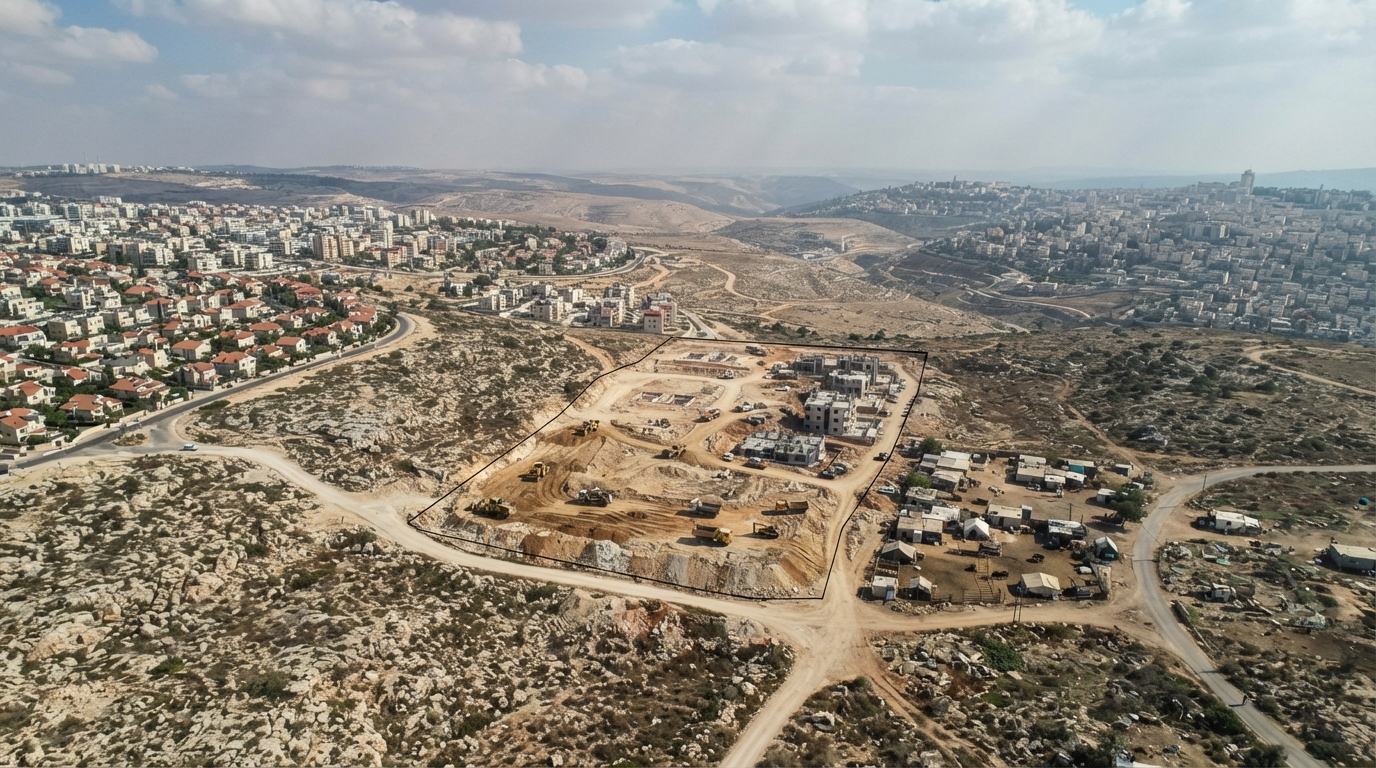
Israel has initiated a tender process for the construction of approximately 1,200 new homes in a strategically significant area of the occupied West Bank, a move seen as an effort by the government to preclude the possibility of a Palestinian state.
The proposed development, located in the E1 area east of Jerusalem, has consistently drawn international condemnation. Critics argue that this project would effectively bisect the West Bank and isolate East Jerusalem.
The deadline for submitting bids is set for October 19, just days before Israel's general election on October 27. This timing is expected to make it considerably more difficult for any subsequent government to reverse the awarded tenders.
Under international law, all settlements are deemed illegal. Since occupying the West Bank and East Jerusalem during the 1967 Middle East war, Israel has established around 160 settlements, housing 700,000 Jewish residents. Palestinians seek this land, along with Gaza, for their envisioned future state. An estimated 3.3 million Palestinians currently reside in these areas.
Despite strong international opposition, successive Israeli governments have permitted the expansion of settlements. However, this expansion has accelerated significantly since Prime Minister Benjamin Netanyahu's return to power in late 2022, leading a right-wing, pro-settler coalition, and following the onset of the Gaza war, which began with Hamas's October 7, 2023, attack on Israel.
For decades, Israel had postponed construction plans in E1 due to international pressure. Many of its allies and Palestinians contended that such construction would severely undermine prospects for a two-state solution by effectively dividing the West Bank.
Nevertheless, the current Israeli government authorized E1 construction a year ago, explicitly stating its intention to "erase" the concept of a Palestinian state. Despite a legal challenge to these plans by Bedouin Palestinians residing in the area and Israeli peace organizations, the housing ministry has now issued a tender for 1,234 of the 3,401 housing units that the Israeli government approved last August.
This tender covers an area of approximately 12 square kilometers (4.6 square miles) situated between East Jerusalem and the settlement of Maale Adumim. Upon the unveiling of these plans, Finance Minister Bezalel Smotrich, an ultranationalist and settler, declared that the idea of a Palestinian state was "being erased."
The October 19 bid deadline, preceding the October 27 general election, is intended to allow the government to finalize agreements with contractors, making it substantially harder for a future administration to cancel these construction deals.
Israel captured the West Bank, including East Jerusalem, from Jordan in the 1967 Middle East War. In 1980, it annexed East Jerusalem, a move largely unrecognized by the international community.
Opponents of the E1 project have warned that its implementation would effectively prevent the establishment of a Palestinian state. They argue it would sever the northern West Bank from the south and impede the development of a contiguous Palestinian urban area in the center, connecting Ramallah, East Jerusalem, and Bethlehem.
Peace Now, an Israeli anti-settlement watchdog that has legally challenged the plans, stated: "The government is trying to sign contracts with contractors before the elections so that it will be much harder for the next government to cancel the construction." The organization added that even partial implementation of these construction plans would "fundamentally" alter "the geographic and strategic character of the area by severing the northern West Bank from the south and isolating East Jerusalem." Peace Now concluded, "Building in E1 will ruin the possibility of reaching an end to the conflict and a peace arrangement based on two states."
Jamal Juma, a Palestinian activist with the Stop the Wall campaign, who lives in Jerusalem, expressed concerns about the project's devastating impact on Palestinians. He told the BBC, "It is destruction of the communities, it's destruction of families... this is a disaster." Juma further noted that over 40 Bedouin communities would be affected and face eviction.