

Is there a tomb of Nefertiti behind Tutankhamun's tomb?
Geophysical measurements conducted near Tutankhamun's tomb showed areas with low rock density. They could be buried corridors and unknown chambers, but the existence of such voids and their connection to Nefertiti has not yet been proven.
**Is Nefertiti's tomb hidden behind the tomb of Tutankhamun?**
A team of researchers led by Mamdouh al-Damaty, an archaeologist from Ain Shams University, has presented the results of investigations conducted on Tutankhamun's tomb KV62 in the Valley of the Kings.
The report, published on September 17 as part of the Amarna Royal Tombs Project, combines field measurements from 2023–2024 and a re-analysis of previous studies.
The authors specifically emphasized that this is not about a recently discovered tomb, but rather a new interpretation of the gathered geophysical data.
The research relies on a hypothesis proposed by Egyptologist Nicholas Reeves in 2015. In his opinion, Tutankhamun's relatively small tomb may have been built in the outer part of a larger royal burial complex, and the inner chambers might have been separated by walls.
Reeves suggested that the original owner of the larger tomb could have been Nefertiti. However, previous geophysical surveys yielded contradictory results.
The new study utilized ground-penetrating radar and microgravimetry. Microgravimetry measures very small changes in gravitational force, allowing the density of underground rocks to be determined.
The authors interpreted certain signals as signs of a buried corridor and potential hidden chambers. At the same time, the ground-penetrating radar did not show clear voids within a distance of about two meters from the walls of the burial chamber.
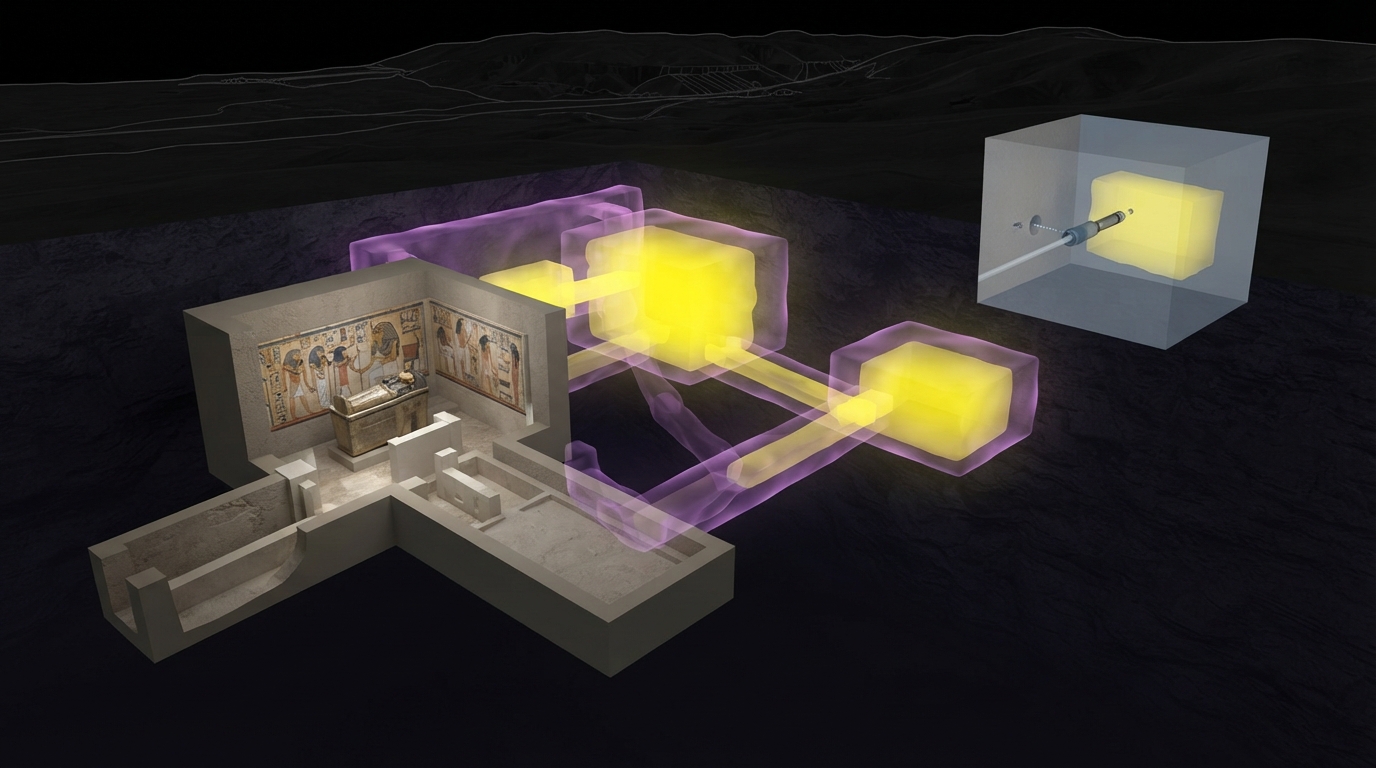
The three-dimensional diagram presented by the researchers is not a ready-made map of discovered chambers, but rather a model based on varying levels of confidence.
In the diagram, two potential chambers whose existence is assessed as relatively reliable are shown in yellow, while sections with a lower level of confidence are shown in purple. The existence of corridors connecting them also remains a hypothesis for now.
The size and volume of the potential hidden voids depend on assumptions regarding what kind of material they are filled with.
Independent experts interviewed by Nature received the results with interest, but said it is still too early to draw a final conclusion.
The researchers propose to test the hypothesis by drilling a small hole and inserting a camera into it. This will require permission from the Egyptian authorities.