

Is the world's largest economy the US or China?
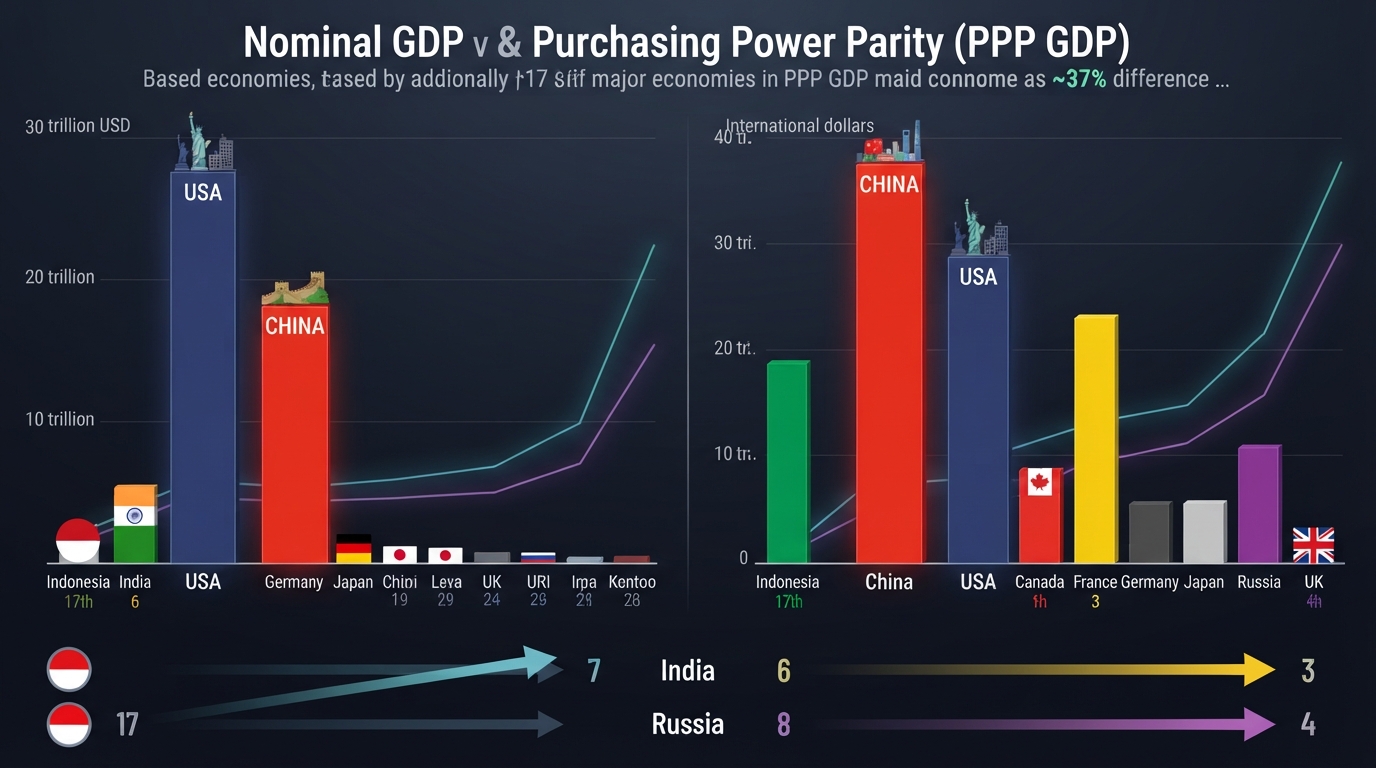
According to forecasts for 2026, the United States remains the world's largest economy by nominal gross domestic product. However, when taking into account price differences in countries, China comes out in first place. Using the same method, India occupies the third position, Russia the fourth, and Indonesia the seventh.
Is the world's largest economy the US or China?
The infographic presents the figures for 20 countries by nominal gross domestic product — GDP — as well as by purchasing power parity.
Nominal GDP calculates the value of goods and services produced in a country by converting it into dollars at the market exchange rate. Purchasing power parity, on the other hand, takes into account price differences between countries: it compares how many goods and services the same amount of money can buy in different countries.
According to nominal estimates, the US economy is projected to reach $32.6 trillion in 2026, while China's is projected to reach $21.5 trillion.
By purchasing power parity, China's GDP is estimated at 44.6 trillion international dollars. This is approximately 37 percent higher than the US figure. China surpassed the US by this method for the first time in 2014.
Among the countries listed in both rankings, the largest difference in position is observed in Indonesia. While it ranks 17th in terms of nominal GDP, it takes seventh place when purchasing power is taken into account. In this case, Indonesia ranks above major economies such as Canada, France, and the UK.
India's position also changes significantly. The country rises from sixth place in the nominal ranking to third place by purchasing power, leaving behind Germany, Japan, and the UK.
India's GDP by purchasing power parity is estimated at 19.2 trillion international dollars. In Germany, this figure is 6.6 trillion. That is, using this method, the Indian economy is almost three times larger than Germany's.
Russia, meanwhile, is ranked eighth in terms of nominal GDP and fourth in terms of purchasing power. In the second calculation method, its economy is estimated at 7.5 trillion international dollars, placing it above Japan and Germany.
This difference in rankings does not mean that a country's economy has grown sharply in a short period — two different measures are being applied for a single year. Furthermore, the total size of the economy is not the same indicator as per capita income or standard of living.
The figures provided are not the final results for 2026, but forecasts by the International Monetary Fund.