

Is India's internet boom running into an undersea problem?
At least 13 of India's 18 intercontinental cables come ashore within six kilometres of Mumbai's Versova beach.
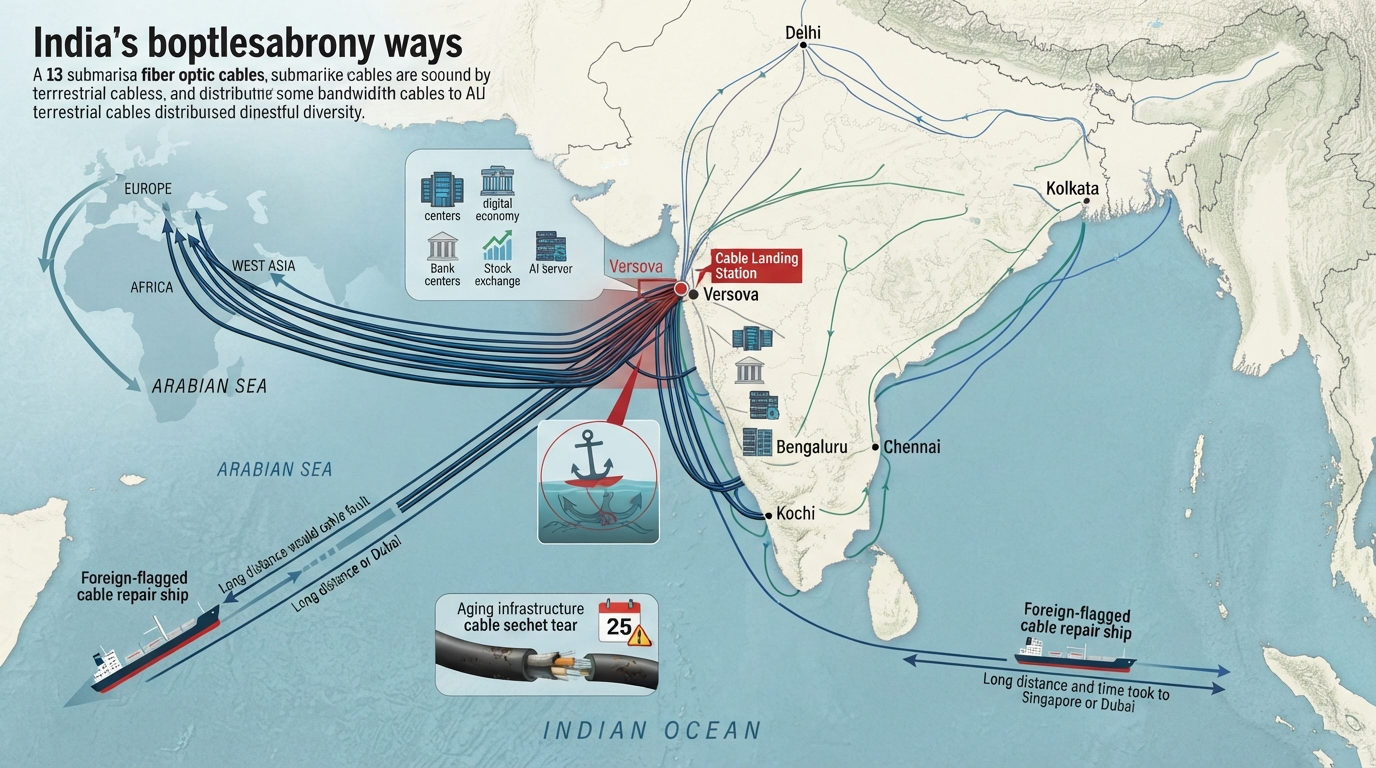
Is India’s internet surge heading toward an undersea bottleneck?
Low-cost data has made India one of the world’s largest internet markets. Yet one of the country’s biggest digital weak points lies along a six-kilometre stretch of Mumbai’s Arabian Sea shoreline.
Near Versova, a crowded neighbourhood in the city’s northwest, at least 13 of India’s 18 intercontinental submarine cables, external land within six kilometres of each other. In total, they transport as much as 95% of India’s international bandwidth to Europe, Africa and West Asia.
“This network faces a critical vulnerability due to severe geographic concentration,” says Anwesha Sen of Takshashila Institution, a think tank. “If several of those cables were cut simultaneously, either accidentally or deliberately, a bulk of India’s westward bandwidth to West Asia, Africa and Europe would be impacted.”
Because cable systems can reroute traffic, a break would not trigger a complete blackout. Experts say data could be redirected through other landing points, including the southern cities of Chennai and Kochi. (India’s 18 subsea cables land in Mumbai, Chennai, Cochin, Tuticorin, and Trivandrum.)
Even so, slower performance — even slight increases in data travel time — could prove expensive for banks, stock exchanges, cloud providers and government networks. AI infrastructure may be especially vulnerable because it depends on large-scale, high-speed data movement.
That weakness reflects how heavily the world’s digital traffic relies on these cables.
At least 13 of India’s 18 intercontinental cables land within a six-kilometre stretch at Mumbai’s Versova beach
They are the internet’s concealed highways — strands of optical fibre laid on the seabed that move data between continents as light pulses. Humans have installed about 870,000 miles (1.4 million km) of them, “lacing the Earth tightly together,” writes Samanth Subramanian in his new book The Web Beneath the Waves. These cables carry roughly 99% of global communication traffic.
Cheap data has helped turn India into one of the world’s biggest internet markets. By late 2025, it had more than a billion broadband subscribers
India’s expanding digital economy and services sector are increasingly dependent on these cables.
But the country’s growing reliance on this invisible system sits awkwardly beside how little of it India actually possesses.
India accounts for about 20% of global data consumption, but it is linked to only around 3% of the world’s submarine cables.
It has 21 cable landing stations — coastal entry points where undersea cables connect to land networks — compared with roughly 1,900 planned and active worldwide, giving India about 1% of the global total, according to the Broadband India Forum (BIF).
“We need to grow the number of cable landing stations several fold,” says Aruna Sundararajan, chairperson of BIF.
Experts say this is the contradiction at the centre of India’s digital transformation: the country is becoming a powerhouse for internet services and data centres without controlling enough of the physical infrastructure that connects it to the rest of the world.
A recent Takshashila Institution paper finds that 11 of India’s 18 international cables are more than 20 years old, nearing the nominal 25-year operating life of submarine cable systems.
“It’s true that a significant share of India’s landing cables are approaching economic end-of-life, and that is a legitimate area of focus,” says Amajit Gupta, group CEO and managing director of Lightstorm, a digital infrastructure company.
Then there are cable faults — a much more common threat than intentional attacks.
Globally, there are an estimated 150-200 cable faults a year
Most are caused not by saboteurs but by fishing, ship anchors, natural hazards and equipment failure.
“We’ve seen a version of this scenario play out with the Red Sea disruptions,” Gupta said, when traffic was rerouted east through Singapore and onward to the US.
And when an undersea cable fails, India has another major weakness: it has no domestic subsea cable-repair ships.
Repair vessels must come from overseas and receive permission to work in Indian waters.
“Every cable fault in Indian waters depends on foreign repair ships from Dubai or Singapore. Once a foreign ship is assigned, it must obtain licences to operate in Indian waters, adding weeks to an already lengthy process,” says Sen.
That reliance on foreign repair capacity is the deeper vulnerability.
“The bigger structural issue for India isn’t rerouting capability - it’s repair capacity,” says Gupta.
“That combination – dependence on foreign repair capacity and regulatory lead times – represents the real bottleneck,” he says.
Repair, however, is only part of the problem.
Gupta says the issue is not whether India is retiring old cables, but whether new terrestrial and subsea capacity can keep up with AI-driven demand. “The industry cannot afford to catch up; it must stay ahead,” he says.
That demand is also driving a rapid expansion of data centres — the computing hubs where data is stored and AI models are trained and run. They too rely on fast, dependable connections to global cloud and internet networks.
, external show installed data-centre capacity has risen from 375MW in 2020 to about 1,575MW today.
That creates a possible mismatch.
“Subsea cable planning itself takes three-four years and then cable laying also takes up to two years depending upon cable length,” says Sundararajan. “Thus, there can be some lag in getting subsea cable capacity to feed the upcoming data-centre capacity.”
The larger obstacle may be India’s bureaucracy.
Sundararajan says 16 agencies spanning telecoms, defence, home affairs, shipping, ports, environment and state authorities are involved in approving the construction, operation and repair of subsea cables.
She says even establishing a cable landing station can require about 50 clearances across at least 16 ministries. “A core issue is fragmented governance, not a lack of technical capability.”
She wants India’s Department of Telecommunications to serve as the lead agency, with a single-window system to speed up permits for repair vessels.
Sundararajan says the government should pre-identify and pre-approve multiple cable landing sites on both coasts and in island territories under standard conditions, so companies do not have to begin the approval process from the start each time.
To become a true regional cable hub, she says, India needs “predictable regulation, open infrastructure and rapid repair mechanisms” — the sort of environment that has helped Singapore attract cables and data traffic.
Pooja Bhatt, an associate professor at OP Jindal Global University, says the mismatch is becoming harder to overlook.
“Given its young demographics and ‘Digital India’ aspirations, it makes sense for the nation to build and maintain its own internet infrastructure for security and governance purposes,” she says.
India has already made one move: the government now classifies submarine cable systems as critical telecommunications infrastructure, acknowledging their role in international connectivity.
Sundararajan says that designation should lead to quicker approvals, emergency repair systems and an Indian cable-repair capability, along with legally protected cable zones around landing sites and routes, limiting anchoring and trawling.
Technology may also offer help.
A system called Distributed Acoustic Sensing can convert optical fibres into sensors that detect vibrations from ships, anchors or underwater vehicles — potentially spotting threats before a cable is cut.
But the most immediate remedies may be more ordinary: more landing stations, wider geographic spread, faster approvals, protected cable routes and an Indian repair capability.
“Connectivity has historically clustered around Mumbai because the ecosystem, infrastructure and demand were already concentrated there,” Gupta says. “But that concentration is exactly the risk the industry needs to design away from.”
That change is already starting.
Four new submarine cable systems are being commissioned
with three more planned. Lightstorm is leading a consortium building one of them, I-2SEA, which will connect India with Malaysia and Singapore. The system will have dual landings in India — at Machilipatnam, offering a shorter subsea route to Hyderabad, and at a new landing site in South Chennai, adding diversity to existing routes.
For a country consuming data at extraordinary speed, the infrastructure carrying it remains unexpectedly fragile. India is building data centres and preparing for an AI-heavy future. The question is whether its cables, landing stations and repair capacity can keep pace.