

Iran killed her teenage daughter - now she is facing up to the regime
Samira's 16-year-old daughter Sevda was shot dead as they took part in mass protests in January.
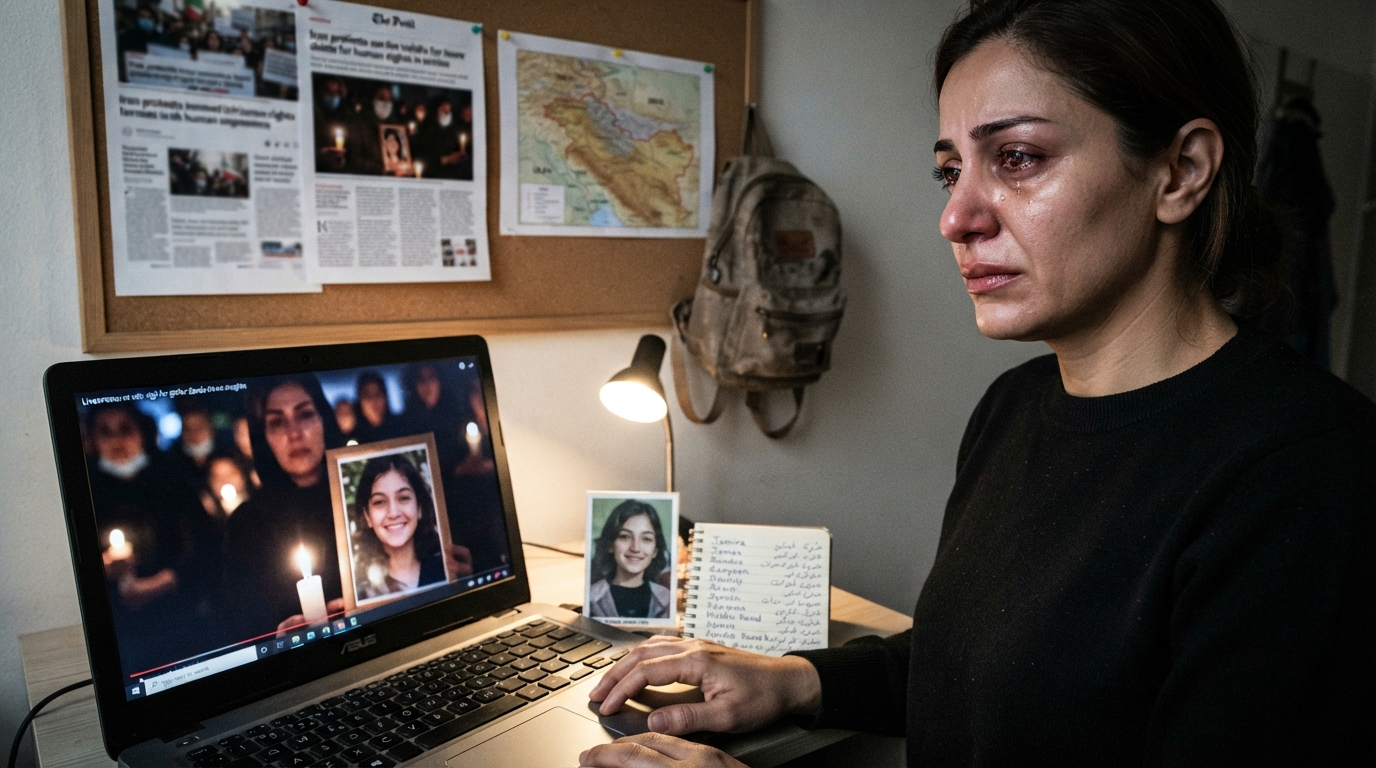
Iran killed her teenage daughter - now she is facing up to the regime
Samira says she was never political before.
"I worked in sales in Iran. I sold cosmetics," she tells BBC Panorama.
That changed completely the day her only child was shot dead in front of her by Iranian security forces. Sixteen-year-old Sevda was taking part in protests against Iran's repressive regime that swept the country earlier this year - before the US and Israel launched widespread air strikes which killed the country's supreme leader Ayatollah Ali Khamenei.
Samira says her grief turned to anger when Iran's authorities then obstructed, rather than assisted, her search for her daughter's body.
"I realised that finding Sevda wasn't the end, but just the beginning of all the harassment they put me through."
Samira made a dramatic escape from Iran on foot, crossing dangerous mountainous terrain.
She now lives abroad in hiding, calling herself a "one-woman army fighting the regime". Seeking accountability and justice after her daughter's death, she is determined to identify the security force members and officials she believes were responsible for firing the fatal shots during the protests.
"They'll bring me to the brink of death before they kill me, but finding me won't be easy… There is no going back," she says.
Samira is one of several Iranians the BBC has interviewed since the start of the year. Some, still inside the country, told Panorama they wanted to speak out despite the danger, saying it had become hard to hold on to hope after the mass protests were brutally crushed.
The Iranian embassy in London told Panorama that peaceful and legitimate protests had been taken over by foreign powers, including the US, which encouraged violence, supplied weapons and equipment, and undermined public security.
Sevda was killed on 9 January as she and Samira joined huge demonstrations on the outskirts of Tehran, the capital, which had started the previous month. They were sparked by economic frustration before growing into demands for an end to the country's Islamic Republic.
Although Samira says she was not especially political at the time, she says her daughter was. Sevda admired two other young women - Mahsa Amini, whose death in custody after an alleged breach of the mandatory headscarf rule sparked mass protests, and Nika Shakarami, who was killed during a later uprising against Iran's strict Islamic dress code for women.
"She kept them alive in her thoughts and always wanted to continue their path [of resistance]," Samira says.
The day before Sevda was killed, the number of protesters had been especially high. Samira says she and Sevda had answered a call from Reza Pahlavi, the exiled son of Iran's last shah (king), for demonstrations.
"The security forces had lost control," she says.
The surge in numbers alarmed Iran's government, and the next day a shoot-to-kill order was announced, Samira says. But she believed it was only an empty threat.
"They lied so much in Iran… We couldn't imagine a massacre of that scale."
She says they were also reassured by US President Trump's promise that he had their backs.
He told US media on 8 January: "I have let [the Iranian authorities] know that if they start killing people, which they tend to do during their riots… we're going to hit them very hard."
Even so, the crowds seemed smaller on 9 January, Samira says.
Sevda appeared to understand the danger, she says. Her daughter removed her earrings and gave them to her grandmother. She also gave Samira her phone passcode.
Mother and daughter joined the other protesters. Sevda then climbed onto a dustbin and started leading a chant.
"It seemed there were more forces than people," Samira says of the area where they were. "I don't know how, within one day, they gathered so many… Basijis and IRGC [Islamic Revolutionary Guard Corps] forces."
The IRGC defends the country's Islamic establishment, and the paramilitary Basij Resistance Force are volunteers for the IRGC.
"A sniper fired from the roof of a building on our right. The bullet must have come from the rooftop. The bullet went through her heart. I couldn't even scream. I just stared at Sevda - her body lying lifeless. Blood was gushing out her mouth and nose. I couldn't believe it, I couldn't believe she was dying. Her eyes were still looking at me."
Samira says she got Sevda to hospital and was told they were operating on her, but then the door opened and she saw Sevda had been zipped into a body bag.
Sevda's body was taken away. Samira says it took her days to find her daughter again. Like many others, she ended up at one of Tehran's biggest morgues.
"Teenagers - young boys and girls. So many had been killed," she cries.
"I died with every bag I unzipped. I'd never seen so many bodies. But I wouldn't give up."
At last she found her daughter. "Three bodies were piled on top of Sevda. That's how we found her."
Iranian authorities acknowledge that more than 3,000 people were killed in the protests, but say some were members of the security forces. One human rights group, Hrana, estimates the death toll at more than 7,000, most of them protesters.
Finding Sevda's body was only the start of Samira's struggle with the authorities, she says.
To be allowed to take the body away for burial, she says she was forced to say that "terrorists" rather than the security forces had killed Sevda.
"They did this to cover up what they'd done on 8 and 9 January, to hide how many people they had killed. They silenced families by telling them to say their loved ones were killed by Israeli or American terrorists."
Even so, she says she was prevented from visiting the grave after the funeral, or arranging a tombstone.
And Samira says the harassment went on. A few days before the ceremony marking 40 days since Sevda died - a highly significant moment in Iranian culture - she says she was called in by a local branch of the Ministry of Intelligence.
"They told me: 'You should give us an interview and say that Sevda was a Basiji and she was killed by the protesters. Then we will announce her [as] a martyr - you will then receive perks, a house, or anything that you want.'"
She believes this offer was driven by fear, because she had shared Sevda's death with an Iranian media organisation based in London once the internet was restored in the country.
"It scared them that I was in touch with external networks or those outside Iran."
To avoid giving the interview, Samira fled Iran as soon as the 40th day anniversary had passed.
"I didn't want to trade with my child's blood."
She says smugglers helped her escape. She crossed rivers and mountains to reach safety.
A video she recorded of her escape shows her anger clearly.
"This crap government, these bastards, they've harassed me so much," she tells the camera as she walks along a mountain path beside a deep ravine.
Samira says that after she continued giving interviews to foreign media from abroad, she was charged in absentia with a series of offences, including "moharebeh" - waging war against God - which can carry the death penalty.
To mark what would have been Sevda's 17th birthday, her relatives and friends held a vigil - with Samira watching from exile on a livestream.
"Then suddenly, the feed cut out," she says.
She says she later learned the event had been raided, and some of her family and friends arrested by the IRGC.
She says the authorities warned her family that if they kept gathering at Sevda's grave, her body would be exhumed and moved elsewhere.
Now, Samira posts online the names of Iranian security force members and officials she believes were responsible for firing the fatal shots during the 8 and 9 January protests she and Sevda joined.
"I want justice to be served for every single person whose name I expose, because they have killed so many young people. My goal is for them to be identified so they can be put on trial," she says.
When one of the men Samira named online was later found dead, a regime supporter offered a $5,000 (£3,732) reward for information about her location, assuming she was responsible. Iranian state media has since reported the arrest of nine people in connection with the death.
Despite the danger, Samira says she will not be silenced.
"Every day and every second without Sevda is very difficult for me. It's like a mother who has lost her heart, who has lost her being, has lost her life…
"But the fact that Sevda is not breathing has made it possible for me to stand on my feet… to think about honouring her life and her path... all those bodies I saw, all those body bags I opened looking for Sevda, they all made me fight the Islamic Republic until my last breath."