

'I don't even know if my parents are alive' - the war heroes jailed 25 years ago
The children of key politicians jailed 25 years ago without a trace in Eritrea want answers.
‘I don’t even know if my parents are alive’ - the war heroes jailed 25 years ago
Aster Yohannes and Petros Solomon fought in Eritrea’s war of independence
Hanna Petros Solomon is in tears as she describes how she and her siblings were effectively left orphaned 25 years ago, after their father was arrested in Eritrea and imprisoned without trial. Their mother was later detained too - and since then, no one has heard from either of them.
“He had a towel on his shoulders like a sportsman,” she tells the BBC, recalling the last time she saw her father, when she was 10 and he had gone out for a jog.
“He used to work out every morning.”
Her parents met while fighting in the long liberation war that led to Eritrea’s independence from Ethiopia in 1993.
Her father, Petros Solomon, was one of the war’s senior leaders and is seen by many as a national hero because of his key role.
After independence, he served as defence minister, then foreign minister, and was heading the fisheries ministry when his problems began.
That was in May 2001, when he and 14 other prominent politicians signed an open letter to President Isaias Afewerki urging the implementation of a constitution ratified after independence and calling for national elections. They became known as the G-15.
Isaias, leader of the Eritrean People’s Liberation Front (EPLF), which had fought Ethiopia, did not react kindly to the criticism.
As foreign minister, Petros Solomon met then-US President Bill Clinton and his wife Hillary
Without Hanna knowing it, her father had already been removed from his ministerial post, though he still went out early each day for exercise.
It was only a few days after 9/11 - while the world was focused on the al-Qaeda attacks in the US - that the full extent of Isaias’s anger became clear in what proved to be a turning point in Eritrea’s history.
In the early hours of 18 September, security forces took positions outside the homes of 11 senior government officials in the capital, Asmara, acting on the president’s orders.
Petros was seized by security agents as he left home in his tracksuit.
The family had no idea what had happened to him. Hanna and her three siblings went to live with their paternal grandmother while their mother, Aster Yohannes, was away studying in the US.
Hanna says it was only several days after Petros vanished that the situation became clearer, and the memories remain painful.
“My classmates told me that my father sold out his country.
“That is when I understood how serious the situation was, and how people framed my dad and his colleagues who fought for the independence of their country. I was hurt.”
In the US, Aster was stunned by what had happened and was in a very bad state. She asked government officials whether they could issue passports for the children, but they refused and told her to return home.
After agonising over the situation for two years and reportedly receiving assurances from government officials, she packed her bags and went back.
Hanna and her siblings desperately wanted her to return, but they were also afraid.
“I told her on the phone: ‘What if they arrest you?’” Hanna recalls.
“She insisted nothing would happen to her, saying: ‘I haven’t done anything wrong, and am only coming to raise my children.’”
Hanna says she later learned that President Isaias himself had promised Aster she would be safe. But when the family waited at Asmara International Airport on 11 December 2003, she never appeared through arrivals with the other passengers.
Their hopes faded along with the flowers they had brought: “It was a long, long wait. Eventually we gave up and went back home.
“First we called to the US, friends and relatives told us they saw her off at the airport.”
Then, ominously, an official phoned from the airport and asked Aster to collect her luggage. That was when they realised she had entered the country but would not be coming home.
All requests and pleas for information were ignored in the months that followed. Instead, Hanna’s grandmother was warned by the authorities to stop asking questions.
The family later heard that Aster was being held in the notorious prison known as Karshelli in central Asmara.
Hanna’s father is believed to be detained, along with the others arrested on 18 and 19 September 2001, in the remote, harsh and highly secretive prison known as Ela-Ero, in the eastern lowlands north-east of Asmara. Accused of treason, none of them has ever been tried or allowed to see relatives.
Around the same time, the government also shut down all the emerging independent newspapers and detained their editors and journalists - who are also believed to be held in Ela-Ero.
The Eritrean government - including its embassy in the UK - has not replied to the BBC’s request for comment about the prisoners’ whereabouts or whether they are alive.
Like many thousands of young Eritreans fleeing conscription and seeking better opportunities, Hanna left the country - crossing the border secretly without a passport.
Now 35, she is married and lives in the US, where she works as a trauma specialist - yet she still feels traumatised by the loss of her parents.
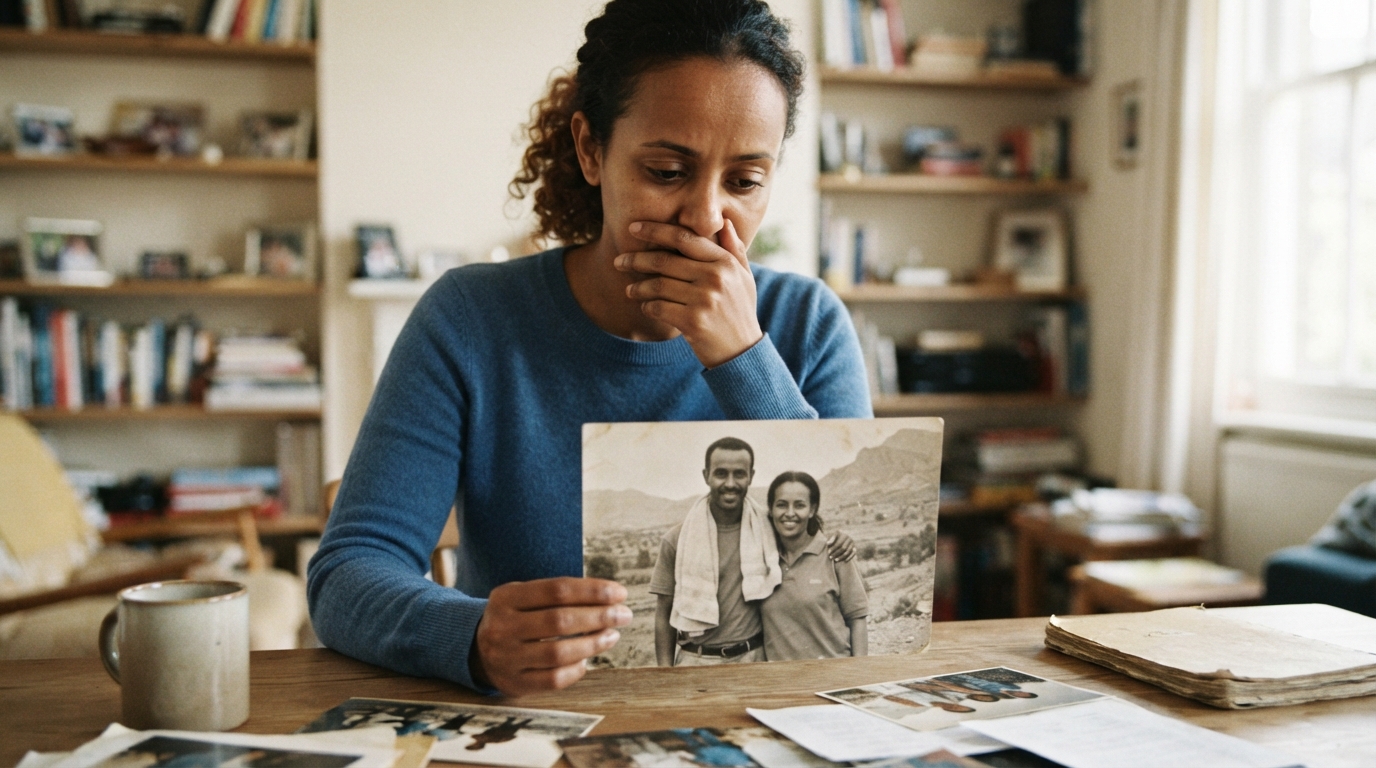
Looking at old photographs of them, she fears her memories of the happy times before their arrest may fade - the laughter, family gatherings and birthday parties: “My dad always wanted to gather people in the house, they were good days.”
Hanna often looks at old photos - this one shows her with her parents - and worries about her memories fading
She also misses her mother’s “unmatched” egg and potato sandwiches.
On trips to the coast when her father was fisheries minister, Hanna remembers him organising singing contests in the car: “He would ask us to sing one by one and whoever won would get a present.”
One of his favourite songs included the line: “I had a sweater, a blue sweater, that my sister took” - a reference to his sister, who was also a freedom fighter and was killed during the war.
She also remembers her mother’s love of music - singing and playing songs by Abba, Dolly Parton and Whitney Houston.
Until her father’s arrest, Hanna says September was a month of hope, with its three major Orthodox Christian festivals, including the Geez New Year. Now it brings her no happiness.
Ibrahim Sherifo knows that feeling well. Both of his parents, who were senior members of the ruling People’s Front for Democracy and Justice (PFDJ), were among the G-15 arrested 25 years ago.
He was 13 at the time
“For me 18 September 2001 is a dark day, but not only for me, it is a dark day for Eritrea and its people, because it is the day when law and democracy was detained,” he tells the BBC.
He is now 38 and living in exile in the Netherlands, where he was granted asylum, and is studying for an MA in political science - following in his father’s footsteps.
His father, Mahmoud Ahmed Sherifo, was local government minister and de facto deputy president before his detention.
Ibrahim Sherifo, pictured here with his mother Aster Fissehatsion in 1990, wants the government to let him know if she is alive
Ibrahim was with his mother, Aster Fissehatsion, staying with her sister when he remembers security agents knocking early in the morning and taking her away in her pyjamas.
Concerned about his father, Ibrahim immediately ran to his nearby house, but was told he had already been taken after going out for exercise.
Both Hanna and Ibrahim say they are deeply grateful to the friends and relatives who cared for them and supported them as they grew up without their parents, despite the risks.
They are also proud of what their parents believed in and of their courage in calling for reform.
“They had conscience and couldn’t observe idly while what they fought for what had been hijacked by Isaias and his coterie,” says Ibrahim.
“As a family, we should be informed whether they are alive or not,” he adds, accusing the government of trying to erase all memory of the political prisoners.
Hanna also wants the suffering of the many others whose relatives have disappeared over the years to be heard.
Human rights groups, including the UN, regard the G-15 prisoners as prisoners of conscience and have been demanding their release.
President Isaias, now 80, has still not put into effect the country’s first constitution - approved in 1997 - and remains in power without ever holding an election.
Hanna says that on the night before her father disappeared, she had a “bad feeling” - and had climbed into his bed and tied her legs to his with string while he slept.
“In the morning he woke up to find he was tied up and to release himself he pulled my legs and I woke up. I begged him not to leave but he assured me that he would return [after his run].”
Describing the years of grief since then, she says it feels like living in the deep sea.
“Sometimes it is calm and you can float, but other times the sorrow comes back to you like a wave and drowns you deep down.
“Sometimes you lose hope and you are out of breath.”
Asked what she would say if she could send a message to her parents, she replies: “Don’t worry about us.
“Like you survived the struggle through sheer steadfastness, we hope you can pull through this too and return to us.”