

Families' agonising search for answers as thousands still missing in Gaza
Ten months after a ceasefire was declared, thousands of Palestinians in Gaza are still reported missing.
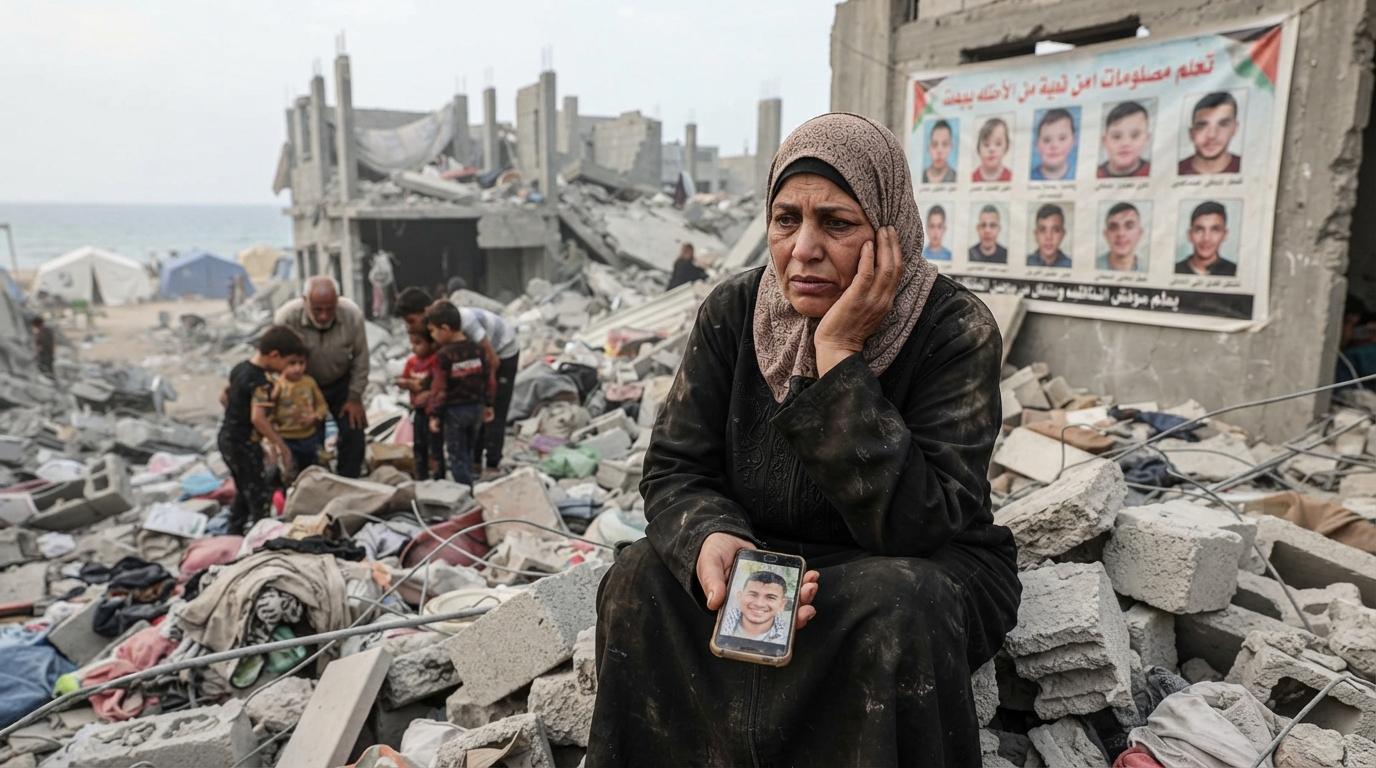
Families in Gaza are enduring an agonizing search for answers as thousands remain missing, including Ahmed al Madhoun, a 21-year-old with Down's syndrome, who vanished in May 2025.
Ahmed, described by his mother Majdiya as a "cheeky, chunky little fellow with an exuberant smile," was last seen heading to a local shop. From her partially destroyed home in Gaza City, Majdiya shares videos of Ahmed on her phone, showing him cuddling a kitten and gleefully belly-flopping into a swimming pool. "Everyone was his friend," she told the BBC, "He was loved wherever he went, and he always had a smile on his face."
His disappearance occurred amidst intense Israeli strikes in the area during the war between Hamas and Israel. Majdiya fears her son is dead but lacks certainty. "My God, I am not at peace," she expressed. "I have not lost hope but whether they find him alive or dead, buried under the rubble, only then will I be at peace."
Majdiya's anguish is echoed by mothers across Gaza. The Hamas-run health ministry in the territory, whose figures are considered reliable by the UN and accepted as accurate by a senior Israeli security source in January, reports over 73,000 people killed in Gaza since Israel's military campaign began. This includes approximately 1,200 fatalities since a ceasefire was declared last October.
However, the actual number of deceased Palestinians could be considerably higher, as the health ministry's count does not include bodies buried under rubble, leaving many missing individuals unaccounted for. The Red Cross has received over 5,000 requests to locate missing persons potentially buried in the destruction, while Gaza's Civil Defence agency estimates the number of missing to exceed 8,000.
Bodies are being recovered daily. Earlier this month, a mass funeral was held in Gaza City for over a hundred people killed in a 2023 Israeli attack, whose remains were only recently identified. The Red Cross notes that recovering bodies is challenging due to the extensive destruction and a shortage of bulldozers. Identification is further complicated by the time elapsed since death and a lack of DNA testing, attributed to Israeli restrictions on items entering Gaza.
Ahmed al Madhoun's family not only fears he may have been killed but also that he might have been detained by Israeli security forces. Majdiya al Madhoun has been searching for her son for over a year.
Over nearly three years of conflict, Israeli forces have detained approximately 7,000 Palestinians from Gaza. According to the Israel-based Public Committee Against Torture, more than 5,000 of these individuals were later released without charges. As of this month, around 1,300 detainees from Gaza are being held in Israeli jails without charge or trial, according to the Israeli human rights group HaMoked, which notes these figures do not include those held directly by the Israeli military.
Palestinian families are often not informed by Israel about the arrest or whereabouts of their relatives, as reported by HaMoked and other rights groups, compelling many to seek assistance from NGOs and lawyers. The BBC has inquired with the IDF and Israel Prison Service (IPS) regarding their alleged failure to notify relatives of detainees. Israeli authorities have previously cited wartime security as the reason for prolonged detentions and denied claims of arbitrary arrests.
Aida al Drimli from Gaza City's Sabra district shows a picture of her son, Mahmoud, a "calm, well-mannered young man" draped in a Palestinian scarf. Aida al Drimli has been searching for her son since 2024. Mahmoud disappeared, and his family initially feared he had died in an Israeli attack. "His father would go to the hospitals and look at the bodies," Aida recounted, "But I couldn't face it. I was completely devastated."
This summer, however, a photo surfaced on social media depicting two Israeli soldiers posing with a blindfolded and bound Palestinian detainee. Aida is convinced it is Mahmoud. "From his features, from his forehead, his mouth, his nose, the way he sits, the way he closes his mouth, his hands, his legs from below. He has the exact same features as my son," she stated.
Despite her conviction, Aida acknowledges that a single photograph cannot provide absolute certainty. "When my husband sat down and showed me the photo, I was relieved," she said, "But at the same time, I was very upset and my heart was broken when I saw my son looking like that. It was humiliating."
Both the al Drimli and al Madhoun families assert that neither they nor their sons have any affiliation with Hamas or any other militant groups in Gaza. The BBC contacted the IPS regarding both men, and they stated they had no record of holding either. The same question was posed to the Israeli military, which also operates detention centers and prisons, but no response was provided.
Israel does not permit international journalists, including the BBC, independent access to Gaza. The Al Drimli family has requested the Red Cross to investigate Mahmoud's potential detention, but Israel does not grant the Red Cross access to its prison records.
Tal Steiner, an Israeli lawyer who assists in locating Palestinians potentially detained by Israel, told the BBC that "Oct 7th changed everything." She explained, "The ban on the International Red Cross [visiting prisons] and the fact that the ICRC itself holds no lists of people held by Israel means we have to trace them individually one by one, per request by their families. It's a big strain on the ability to find those people, today."
Steiner emphasized that the uncertainty is the most difficult aspect for families. "It's an open wound. It doesn't heal. They have no rest not even knowing if their relative is dead or alive," she said. She added that over the past three years, Israel has made it significantly harder to trace potential Palestinian detainees. "To those not knowing where their family members are, that really adds insult to injury. It's a very difficult mental situation that can be carried for months and years."