

International hotel brands are strengthening their positions in Uzbekistan: the market is moving to a new stage of development
During the first seven months of 2026, the number of international chain hotels in the country grew by 27.5%, and their presence is increasingly expanding beyond Tashkent.
**International hotel brands strengthen their positions in Uzbekistan: the market enters a new stage of development**
During the seven months of 2026, the number of international chain hotels in the country grew by 27.5%, and their presence is increasingly expanding beyond Tashkent.
Uzbekistan is consistently strengthening its position on the global tourism map, not only due to the growth of inbound tourist flow, but also through the development of modern hotel infrastructure. One of the most notable signs of this transformation is the expanding presence of international hotel operators.
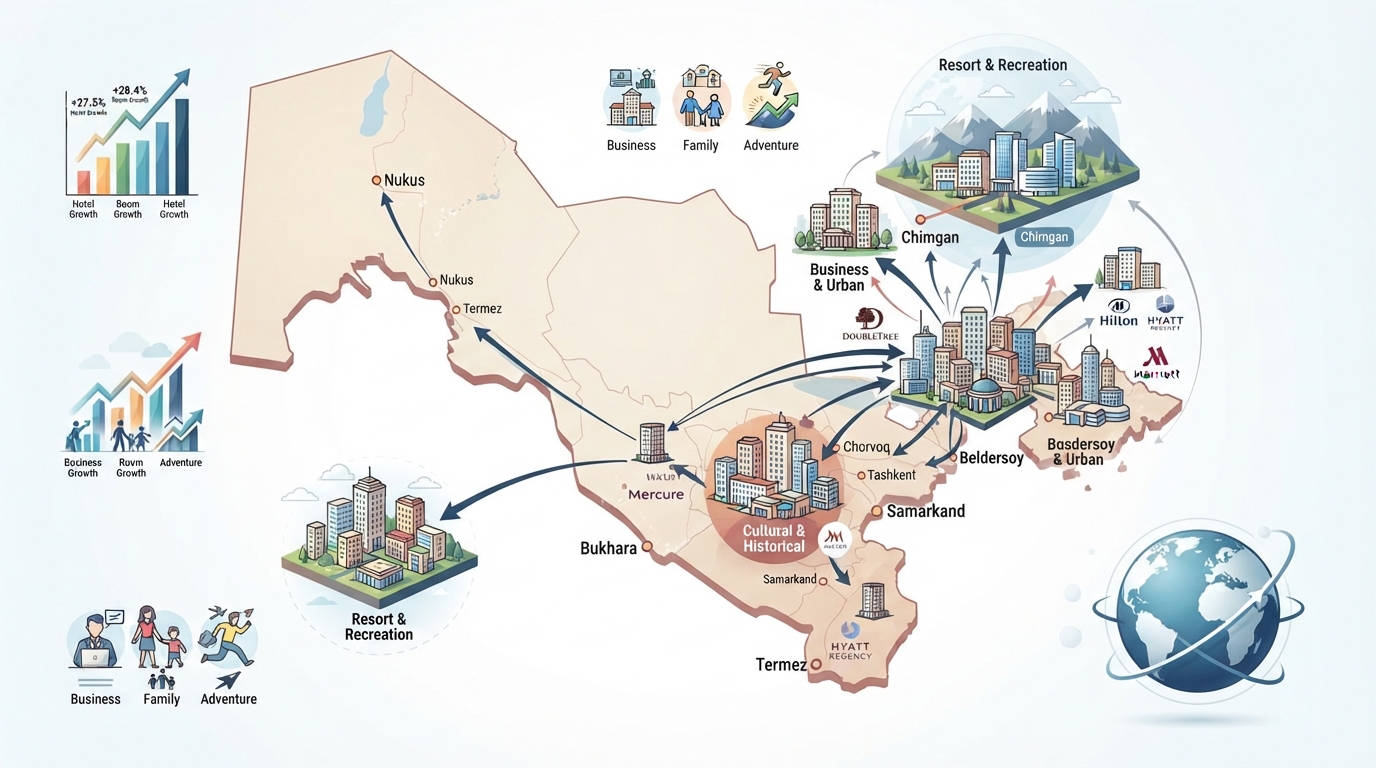
In just seven months — from the end of 2025 to August 1, 2026 — the number of international brand hotels in the country increased from 40 to 51, and the number of represented brands grew from 25 to 31. The room inventory rose from 5,191 to 6,664 rooms, and the number of beds increased from 9,340 to 12,096.
Thus, in a relatively short period, the number of international hotels increased by 27.5%, the room inventory by 28.4%, and the number of beds by almost 29.5%. During this period, 11 new properties of international brands were opened in the country.
These indicators point to more than just quantitative growth in the hotel market. They reflect a deeper process — the gradual integration of Uzbekistan's tourism infrastructure into the international hotel business system.
### From Tashkent to the regions
One of the key trends is the geographical diversification of the market.
While in the early stages international hotel brands were mainly concentrated in Tashkent, today new projects are emerging in Bukhara, Samarkand, Nukus, Termez, Chimgan, and Beldersay.
This is particularly important for the development of regional tourism. International tourists increasingly perceive Uzbekistan not just as a destination for visiting the capital, but as a country of comprehensive itineraries that include historical cities, natural areas, cultural sites, and recreational zones.
The appearance of recognizable international brands in the regions, in turn, improves the quality and predictability of tourism services. For foreign travelers, a familiar hotel brand often becomes an additional trust factor when choosing a new destination.
As a result, hotel infrastructure is beginning to develop following the formation of new tourist routes.
### Major international operators expand their presence
The most notable dynamics are shown by Wyndham Hotels and Resorts. During the period under review, the number of the chain's hotels in Uzbekistan grew from six to 11.
Its portfolio now includes Wyndham Garden Chorvoq Darvozasi, Ramada by Wyndham Nukus, Ramada Plaza by Wyndham Tashkent, TRYP by Wyndham Chimyon, and TRYP by Wyndham Tashkent Olympic City.
Wyndham's room inventory increased from 857 to 1,450 rooms, and the number of beds grew from 1,607 to 2,793.
The dynamics of Accor are equally indicative. The number of the chain's hotels grew from three to seven, the room inventory from 470 to 889 rooms, and the number of beds from 948 to 1,712.
The presence of the ibis, Mercure, and Movenpick brands is expanding in the Uzbek market. In particular, Mercure Tashkent North, Mercure Bukhara Old Town, and Movenpick Tashkent Old City have opened.
Hilton increased its number of hotels from seven to eight, and its room inventory from 1,109 to 1,274 rooms. One of the new properties was DoubleTree by Hilton Tashkent.
Hyatt's presence is also expanding: the number of hotels grew from one to two thanks to the launch of Beldersoy Resort and Spa Destination by Hyatt. The chain's room inventory increased from 300 to 445 rooms.
In the Marriott International segment, the number of properties remained at two; however, due to the expansion of JW Marriott Hotel Tashkent, the number of rooms grew from 280 to 415.
### The market becomes more diverse
A feature of the current stage is not only the growth in the number of international operators, but also the expansion of the range of hotel products.
Brands of various categories are represented in the market — from high-class properties to mid-scale hotels, city hotels, properties for business travelers, as well as resort and recreational complexes.
This corresponds to changes in the structure of tourism demand.
The modern tourism market is no longer limited to the "luxury hotel — mass tourist" model. Travelers have different trip purposes, lengths of stay, budgets, and infrastructure requirements.
Therefore, the presence of several international brands with different positioning allows for the formation of a more flexible offering — from business trips and individual tourism to family vacations and resort travel.
The development of the recreational direction in Chimgan and Beldersay looks particularly promising. The expansion of the hotel offering in mountainous areas creates conditions for turning natural and recreational potential into a year-round tourism product.
### International brands as an indicator of investment attractiveness
The expansion of international hotel chains can also be viewed as an indirect indicator of changes in the investment perception of Uzbekistan's tourism industry.
An international hotel operator decides to enter a new market based on a range of factors: tourism demand, economic dynamics, transport accessibility, investment climate, development prospects of a specific location, and the quality of infrastructure.
Therefore, the appearance of several major international operators at once indicates that Uzbekistan is becoming a more understandable and promising market for the global hotel business.
At the same time, the development of hotel infrastructure is capable of creating a multiplier effect. A new hotel generates demand not only for accommodation services, but also for transport, catering, retail, excursion services, entertainment, and other types of tourism services.
In the regions, this is particularly important: hotel projects can become part of a broader infrastructural ecosystem, stimulating the development of small and medium-sized businesses.
### Uzbekistan shows high dynamics in Central Asia
Long-term statistics show that the current growth is part of a larger trend.
According to the CMWP Uzbekistan study "Central Asian International Hotel Chains – 2025 Market Overview", between 2020 and 2025, the room inventory of international hotel brands in Uzbekistan increased by 272%.
For comparison, during the same period, growth in Kazakhstan was 52%, in Kyrgyzstan — 38%, and in Tajikistan — 33%.
Thus, Uzbekistan showed the highest rate of expansion in the international hotel segment among Central Asian countries.
This allows us to speak about the formation of a new competitive advantage for the country. It is no longer just about having historical and cultural heritage, but also about the ability to provide tourists with modern infrastructure of an international level.
### From quantity to quality of the tourism offering
At the same time, the further development of the hotel market will depend not only on the number of new properties.
For sustainable tourism growth, it is necessary that the expansion of the room inventory be accompanied by the development of transport accessibility, urban infrastructure, human resources, tourism products, and service quality.
It is the combination of these factors that determines whether the increase in hotel capacity can translate into real growth in tourist flow and an increase in the length of stay of guests in the country.
In this context, the regional expansion of international brands is particularly important. If hotel infrastructure develops simultaneously with transport, cultural routes, natural and recreational sites, the region gets the opportunity to transition from short-term visits to a fully-fledged tourism product.
### A new stage of tourism transformation
Today, Uzbekistan is gradually changing the very architecture of its tourism market. The country is transitioning from a model where the main advantage was its unique historical and cultural heritage to a more comprehensive system that combines attractions, transport, hotels, gastronomy, entertainment, and international-level service.
The growth in the number of international hotel brands is becoming one of the most visible manifestations of this process.
During the seven months of 2026, 11 new hotels of international chains appeared in the country, the number of brands increased to 31, and the room inventory approached 6.7 thousand rooms.
At the same time, the very nature of the ongoing changes is important: international operators are gradually moving beyond the capital, developing historical cities, tourist centers, and natural-recreational areas.
The next stage for Uzbekistan is to turn the quantitative growth of hotel infrastructure into a qualitative expansion of the tourism economy.
The more closely new hotel projects are linked to regional tourist routes, the transport system, and local businesses, the higher their contribution will be to creating new jobs, increasing tourist spending, and developing the regions.
Ultimately, an international hotel chain is not just a collection of hotels. It forms the infrastructural backbone of modern tourism, and today this backbone in Uzbekistan is expanding significantly.