

Uzbekistan’s aviation demand could grow 15% annually, Etihad Airways estimates
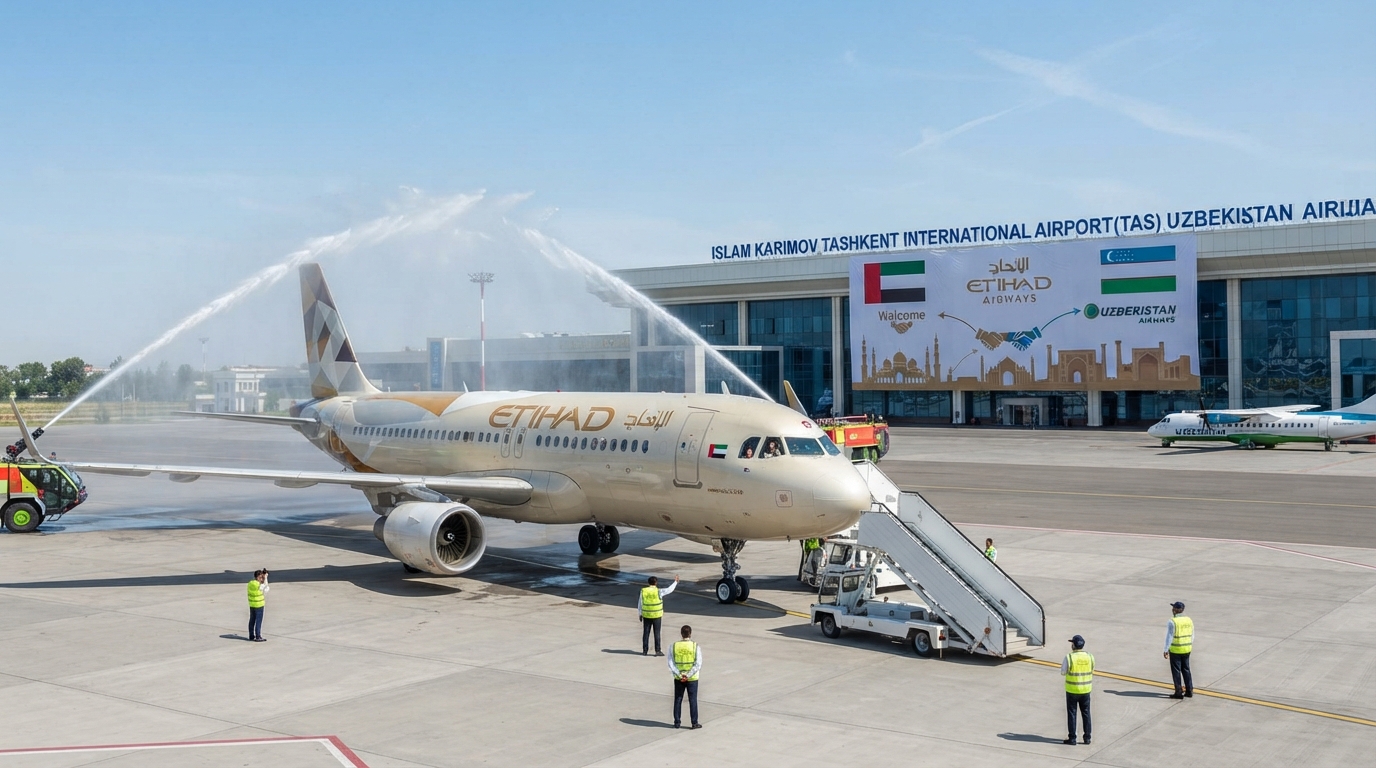
Etihad Airways projects that Uzbekistan's aviation demand could see an annual increase of approximately 15%, driven by the nation's economic expansion. This estimate comes from Jurriaan Pieter Stelder, Etihad's SVP Network, Scheduling and Alliances, who shared his insights with Daryo following the inauguration of the airline's inaugural service to Uzbekistan.
On August 9, Etihad commenced its daily non-stop service between Abu Dhabi and Tashkent, marking the UAE national airline's entry into the Uzbek market. This new route establishes a direct connection between the two capitals and provides Uzbek travelers with access to Etihad's extensive network via Abu Dhabi.
The airline anticipates that the route will cater to both direct passengers and those connecting to destinations across the Middle East, Asia, India, and North America. Stelder stated, "We do expect that only half of our passengers will be traveling between Abu Dhabi and Tashkent, and the other half will have a connection in Abu Dhabi to go into our global network in the Middle East, into Asia, India, or even into North America."
This launch is bolstered by a codeshare agreement with Uzbekistan Airways. Under this arrangement, Etihad operates the Abu Dhabi–Tashkent flights, while passengers can connect with Uzbekistan Airways to eight domestic destinations: Andijan, Bukhara, Fergana, Namangan, Nukus, Samarkand, Termez, and Urgench.
**Why Uzbekistan — and why now?**
Stelder explained that Etihad had been evaluating the Uzbek market for some time and identifies the country as one of the world's most rapidly expanding aviation markets. He remarked, "It's one of the fastest growing aviation markets in the world, I would say, and it has a lot of attractiveness for tourism," citing Uzbekistan's burgeoning tourism sector and the government's initiatives to develop the industry.
He also emphasized the economic outlook, noting that Uzbekistan's GDP has been growing by roughly 7–8% annually. Jurriaan Pieter Stelder stressed that this growth could translate into an aviation-demand increase of approximately 15% per year.
Stelder commented, "With such a growth market, with such a connection between the two countries, and so many Emiratis that would love to visit Uzbekistan, and so many Uzbeks that would love to visit the Emirates, there is a lot to offer, and there's a lot to grow."
The route also strengthens tourism ties in both directions. Abu Dhabi offers Uzbek travelers direct access to attractions such as the Sheikh Zayed Grand Mosque, Saadiyat Island, and Yas Island, while Uzbekistan provides Etihad's passengers with access to destinations like Samarkand, Bukhara, and Tashkent.
**More than one new route**
Etihad views its collaboration with Uzbekistan Airways as a foundation for further expansion, rather than merely a means to add Tashkent to its network. Stelder noted, "So, at the start, Uzbekistan Airways has chosen to only code-share to Abu Dhabi, but we are very much welcoming them to code more code-shares to other destinations beyond Abu Dhabi as well."
The two airlines also intend to leverage their respective market knowledge: Etihad brings expertise in the UAE and international connectivity, while Uzbekistan Airways possesses deeper knowledge of Uzbekistan and the broader Central Asian market. Currently, the domestic codeshare network has been implemented, with additional international connections awaiting regulatory approvals.
**Etihad’s digital vision for airlines**
Frank Meyer, Chief Digital Officer of Etihad Airways, stated that airlines in Uzbekistan will increasingly need to ensure digital services are as accessible as traditional customer-service channels. Etihad is investing in artificial intelligence to make interactions with passengers more natural, enabling customers to communicate with the airline without relying on lengthy forms or complex procedures.
He clarified that the objective is not to replace contact centers or travel agents, but to automate routine interactions, allowing employees to concentrate on more intricate passenger needs. For Uzbekistan's airlines, Meyer recommended prioritizing web and mobile services, and eventually, AI-powered communication.
Meyer highlighted, "We have to be able to offer all our services that we offer in our contact centers to our customers in a digital fashion. We have to make it easy for people to make a booking, and to change a booking afterwards, so it's all about speed and transparency."
The new Abu Dhabi–Tashkent route extends beyond establishing Etihad’s initial connection to Uzbekistan, providing the airline with a foothold in one of Central Asia’s fastest-growing aviation markets while linking Uzbek travelers to its broader global network.