

"Integration becomes real when it is noticed not at a summit, but in everyday life." Experts on the future of Central Asian cooperation
How is the modern Central Asian identity being formed, and should the current dialogue model evolve into deeper integration? Gazeta has discussed this with experts and parliamentarians from the countries of the region.
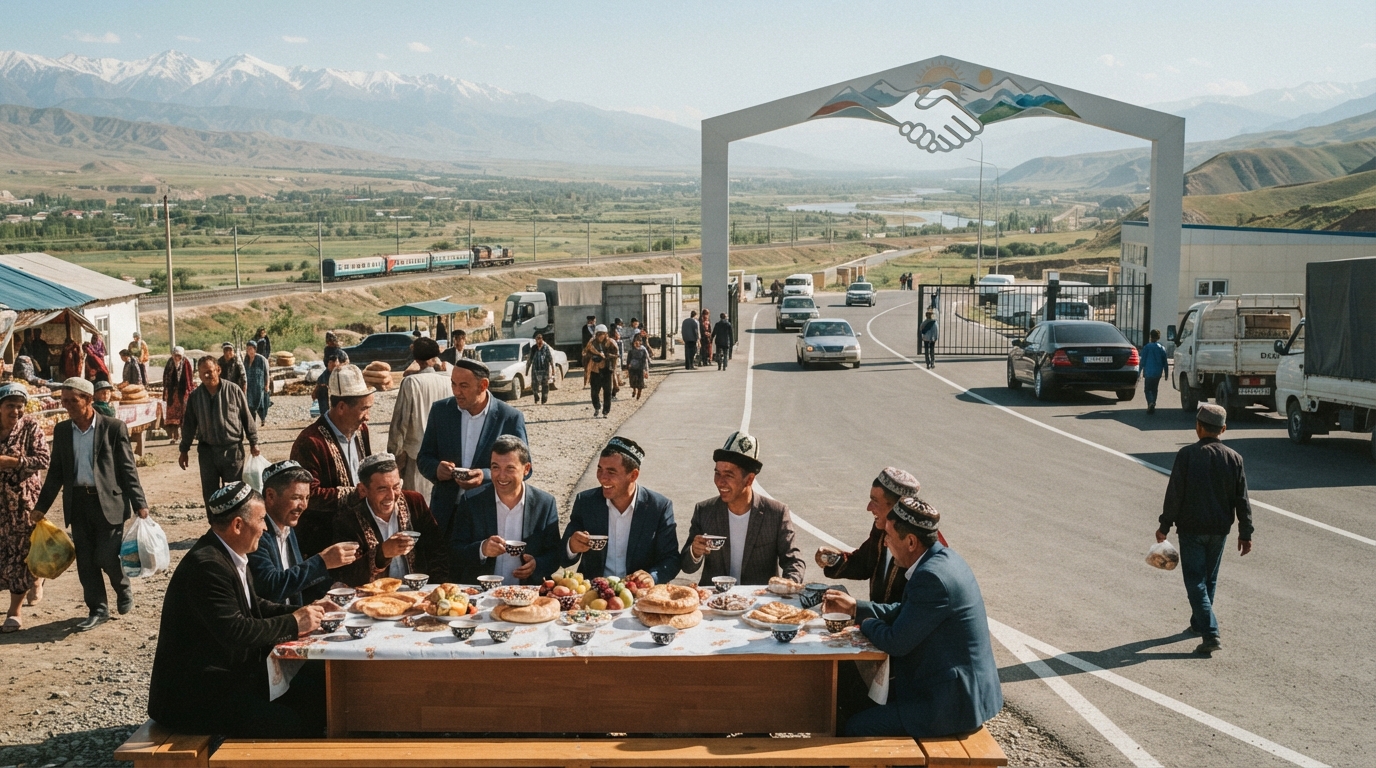
"Integration becomes real when it is noticed not at a summit, but in everyday life." Experts on the future of Central Asian cooperation
An international expert meeting titled "Central Asia in the Context of Global Shifts: Own Strategies, Regional Security, and the Formation of New Cooperation" was held in Cadenabbia, Italy.
The event was organized by the Konrad Adenauer Foundation's Regional Programme for Central Asia. Representatives of the expert, parliamentary, and academic communities of the region's countries participated in the discussion.
Gazeta conducted a snap poll among the participants on what defines Central Asian identity today, what constitutes the main achievement of the current stage of regional cooperation and what it still lacks, as well as what format of interaction could become the next stage of Central Asia's rapprochement.
History, hospitality, and resilience.
All peoples of the region have inherited a rich history and culture from their ancestors, which in modern conditions is adapting to the rapidly developing world of globalization. The hospitality of our people is known worldwide and demonstrates the openness and friendliness of their ethnic code. Resilience is the inner strength of the peoples of the region, who have preserved their unique identity through the ages and have not dissolved into foreign cultural and civilizational spaces.
The river, the crossroads, the dastarkhan.
The Amu Darya and Syr Darya rivers flow through our lands without asking about borders, and everything that has grown here has grown near water that cannot be appropriated: it can only be shared. The crossroads — for centuries, caravans, languages, and ideas passed through us, and we learned not to fear the foreign, but to make it our own. The dastarkhan — both in a nomadic yurt and in the mahalla of an ancient city, a guest has always been sacred, and there are no strangers at this table: hospitality has become not a custom for us, but a law.
Memory, neighborhood, reciprocity.
We are united by a common historical and cultural space, but today this is no longer enough. Modern Central Asian identity, in my opinion, should also be expressed in the understanding that the well-being and stability of our countries are interconnected.
Belonging. Good neighborliness. Responsibility.
For me, Central Asian identity is the realization that, while preserving our national uniqueness, we live in a shared space, and the peace, stability, and well-being of our neighbors are increasingly becoming a condition for our own development. Therefore, it is not about unification, but about shared responsibility for the common future of the region.
Achieving consensus on the implementation of transport and logistics corridors in the center of the Eurasian continent. The current stage of cooperation is increasingly focused on practical results in the interests of the countries and peoples of the region.
For the first time in centuries, we are resolving our affairs among ourselves, without an external arbiter.
Previously, any dispute in the region sooner or later went for consideration somewhere outside and returned as someone else's decision. Today, our heads of state negotiate directly, and this has already brought about what was considered unsolvable for decades: settled border issues, a peaceful and business-oriented Fergana Valley. The value lies not only in the agreements themselves, but also in the acquired habit of negotiating on our own.
We have begun to turn neighborhood into a conscious partnership. Today, the countries of the region are increasingly finding solutions on their own to issues that are important to everyone. This is gradually shifting relations from simple neighborhood to cooperation based on mutual interest.
Trust.
It is trust that has become the main political resource of the region. Thanks to trust, we have moved from managing accumulated problems to actually solving them — even on such sensitive issues as state borders, water, and transport communications.
In this sense, the Fergana Valley can become a kind of model platform of regional cooperation for the whole of Central Asia — primarily in the field of joint development of border territories.
It is the Fergana Valley that shows how a space, which until recently was associated with complex border issues, can turn into a space of open borders, trade, infrastructure, human contacts, and joint projects.
In a certain sense, this experience has already received international recognition: on May 20, 2026, the UN General Assembly adopted the resolution "Peaceful Settlement of Border Disputes," initiated by Kyrgyzstan together with Tajikistan and Uzbekistan. It consolidated at the global level the principles of resolving such issues through dialogue, negotiations, and mutually acceptable peaceful solutions.
Therefore, the next task is to turn the achieved peace into joint development: to create border enterprises, markets, transport and logistics centers, and infrastructure. When an open border and good neighborliness become directly beneficial to an individual, an entrepreneur, and a local community, they receive the most solid foundation.
There is no single, universally recognized leader of the region to consolidate the republics of Central Asia. I would like to see more persistent promotion of socio-economic and cultural-humanitarian projects so that the citizens of our countries can feel the benefits of unification themselves.
We need even more openness.
We have already learned to negotiate — the next step is to learn to speak to each other openly, without looking back at protocol. True friendship is tested not by compliments, but by the ability to honestly discuss difficult matters and find a solution together. Today, there is enough trust between our countries to allow ourselves such candor, and parliaments and civil society are the most natural platform for this conversation.
Consistency.
Political dialogue in Central Asia has become significantly more active, but its potential can be unlocked more fully if the agreements reached systematically transition into concrete projects and long-term cooperation mechanisms.
Broad public support.
Political trust between states has already reached a qualitatively new level. Now it is important that regional cooperation becomes a natural part of people's daily lives — and it is in the formation of such broad public support that one of the main goals of the proposed Concept of Regional Identity lies.
In other words, regional rapprochement should be increasingly felt by the ordinary person — through open borders, new jobs, opportunities for education, business, travel, and communication.
I consider the multilateral format of regional cooperation to be optimal, while deeper integration is advisable in some areas with individual Central Asian countries in the future.
Deepening cooperation in specific areas — but seriously.
Europe did not start with a constitution, but with coal and steel: institutions followed practice, not the other way around. Our "coal and steel" are water, transport, energy, and education.
It is worth starting with what a person will feel immediately: for example, introducing a "neighbor's card," with which a citizen of any country in the region pays in a museum, on transport, and for communications as a local, not as a foreigner. Integration becomes real on the day it is noticed not at a summit, but in everyday life.
Integration through practice, not through formal frameworks.
I see the future in deeper cooperation in those areas where the interests of our countries objectively coincide. If joint projects yield results for people and economies, closer cooperation becomes a natural next step.
Deeper practical integration in specific areas with the gradual institutionalization of regional cooperation.
We do not need integration for the sake of integration or the creation of rigid supranational structures. At the same time, it is important that the positive processes currently taking place in Central Asia acquire a stable and irreversible character. This requires a certain institutionalization — flexible, pragmatic, and based on consensus.
This could be the strengthening of already functioning regional mechanisms, the formation of permanent working formats and joint instruments in those areas where the countries have an obvious common interest: trade, transport, water, energy, education, ecology, and other areas.
At the same time, the sovereign equality, national identity, and freedom of foreign policy choice of each state must unconditionally be preserved. A more cohesive Central Asia should become not more closed, but, on the contrary, more independent, resilient, and open to the world.