

Instead of bouquets — charity. How Tashkent schools are changing the tradition of starting the school year
A number of private schools in Tashkent have abandoned the tradition of giving bouquets for the new school year in favor of charity. For several years now, Leader School has been donating saplings to a hospice. This year, Sehriyo, Oxbridge, and Vosiq International raised funds for children with cancer. Why such initiatives are important.
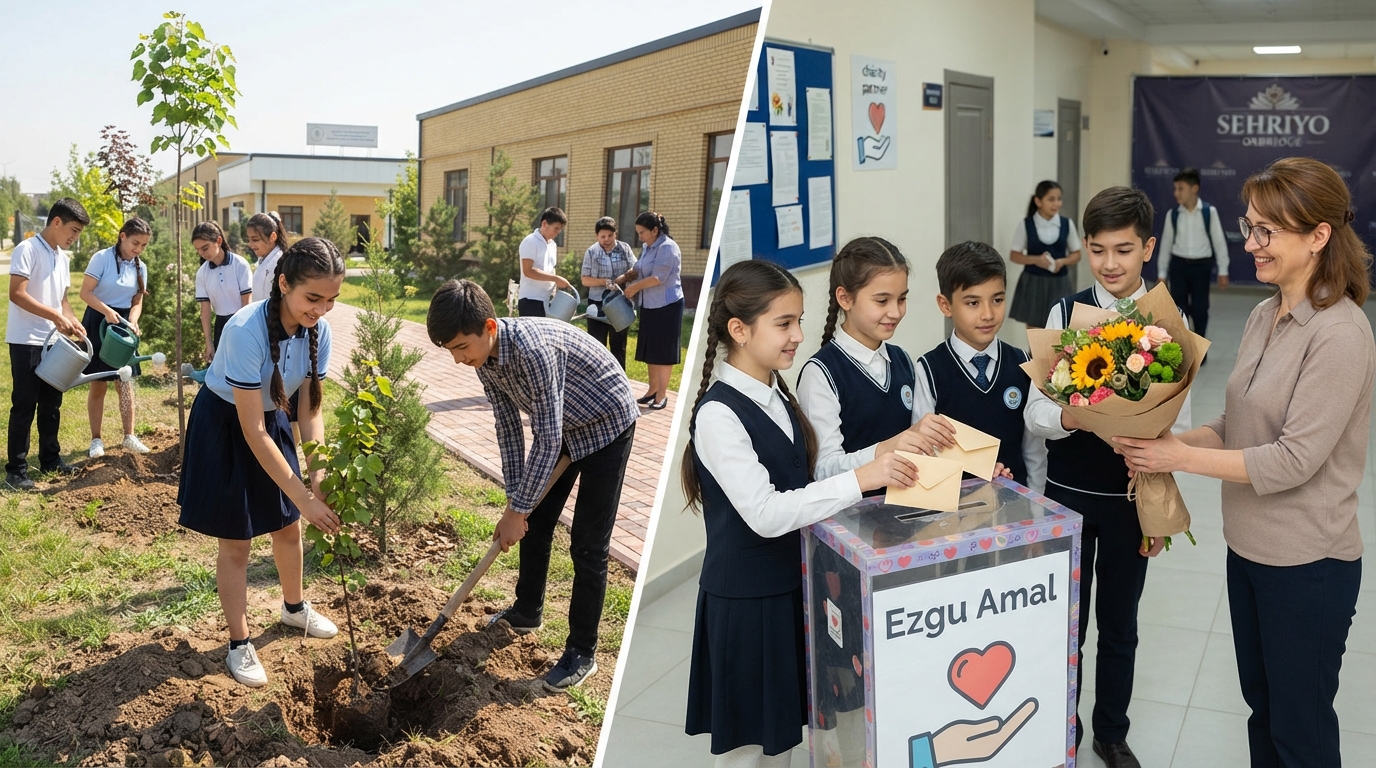
Charity instead of bouquets: how Tashkent schools are changing the tradition of starting the school year
The start of the school year in schools has long been accompanied by presenting bouquets to teachers. Although this is a beautiful tradition that expresses attention and respect for teachers, some schools are gradually moving away from it. In a number of private schools in Tashkent, parents and students are being offered not to buy flowers that will wither in a few days, but to participate in charity campaigns.
At Leader School, saplings have been collected for planting in the city for several years, and in recent years — on the territory of the Taskin children's hospice. At Sehriyo, Oxbridge School, and Vosiq International School, funds were collected this year for the Ezgu Amal Public Fund to help children with oncological diseases. "Gazeta" reports on the campaigns that helped schoolchildren start the school year with good deeds.
For six years now, the school year at the private Leader School has started with the "Unfading Goodness" campaign. Instead of bouquets for teachers, parents and students buy saplings — young trees, shrubs, and flowering plants, which are then planted in various districts of Tashkent.
"A sapling is not just a plant, but a symbol of new life, hope, and the future. The main goal of our campaign is to form a society of caring people for whom the words 'help', 'care', and 'compassion' are filled with real meaning and confirmed by actions," Firuza Vakhabova, the founder and director of the school, told "Gazeta".
In previous years, young trees and shrubs were planted on the territory of the Taskin children's hospice, which the school also supports as a sponsor. Throughout the year, students and teachers visit the young patients, bring gifts, and conduct creative activities and masterclasses.
This year, Leader School participated in greening the territory of an adult hospice, which is set to open soon. Twenty-five high school students took part in the campaign. They brought and planted Syrian hibiscuses, thyme, paulownias, catalpas, conifers, as well as saplings of apple, pear, cherry, persimmon, and other fruit trees.
"For us, this is not just an environmental campaign, but an opportunity to involve teenagers in a real, socially useful cause, the result of which they can see with their own eyes. We want the planted trees to be not only a contribution to the improvement of the territory, but also a symbol of attention, support, and human involvement," noted Firuza Vakhabova.
The school plans to monitor how the saplings take root and grow, and, if necessary, participate in caring for them.
The "Unfading Goodness" campaign is part of a broader charitable and social activity of the school, in which students, teachers, and parents are involved, the director said.
"It is important for a child not just to participate in an activity proposed by adults, but to understand why and for what purpose they are doing it, who will benefit from their action, and what trace they will leave behind.
For us, this is what pedagogy is — the pedagogy of meanings: not to organize a beautiful event, but to help children live through the experience of responsibility, care, and involvement. So that goodness does not remain an abstract word, but becomes a concrete action whose meaning the child understands," she emphasized.
Sehriyo School supported the "Children Instead of Flowers" campaign, which was held for the first time in Tashkent this year by the Ezgu Amal Public Fund. The initiative originated in Russia 13 years ago and has since been held in other CIS countries. Its essence is that a class gives the teacher one shared bouquet from all students, and the money that could have been spent on individual bouquets is directed to charity.
"We really resonate with the philosophy of this campaign. Flowers are certainly beautiful, but they will wither in a week, while help provided to a child can bring long-term and real benefits. We thought it would be great to launch such an initiative in Tashkent," said Kamilla Turakhodjaeva, a teacher and psychologist of the Ezgu Amal Fund.
The start of the school year, according to her, is a suitable occasion to talk to children about kindness, mutual help, and compassion, confirming the importance of values with real actions.
"It is not enough for a child just to hear that they need to be kind or that it is important to help others. It works much more powerfully when they can see the result of their action and understand: 'I really helped someone.' Then charity stops being something distant and abstract, and children begin to understand that even their small action matters," the psychologist said.
Turakhodjaeva spoke about the campaign on social media and invited educational institutions to join it. Two branches of the private Oxbridge school, Vosiq International School, and Sehriyo responded to the call, where 23 classes decided to support the campaign.
"We consider it important to foster a culture of mutual help, care, and involvement in children. Therefore, it was natural for us to join this campaign. The idea received a warm response from the entire school: teachers supported the initiative, parents readily joined the collection, and students took an active part in it," the administration of Sehriyo noted.
Several flower shops joined the initiative: some offered discounts to campaign participants, others offered to transfer a portion of the proceeds from bouquet sales to the fund. Donations were accepted via a QR code on the fund's website and charity boxes installed at Oxbridge and Sehriyo schools.
The donations will go toward helping the beneficiaries of the Ezgu Amal Fund with oncological and hematological diseases — for the purchase of expensive medicines, examinations, or other expenses related to treatment.