

"Inspiration for the First Step into Science": How the Formula 35 Science Festival Took Place in Tashkent
The Formula 35 science festival took place at the Tashkent Botanical Garden. In themed locations dedicated to chemistry, physics, astronomy, biology, and art, schoolchildren could observe experiments and, in some, take part. Gazeta reports on how this introduction to science turned out.
"Inspiration for the First Step into Science": How the Formula 35 Science Festival Was Held in Tashkent
Science begins with curiosity: first, a person learns how everything works, then asks why it works that way, and after that — how it can be changed. The organizers and invited specialists spoke about this to the participants of the Formula 35 science festival in the Tashkent Botanical Garden. The event was hosted by the Academy of Sciences of Uzbekistan, bringing together experts from various scientific institutes for interactive activities with children.
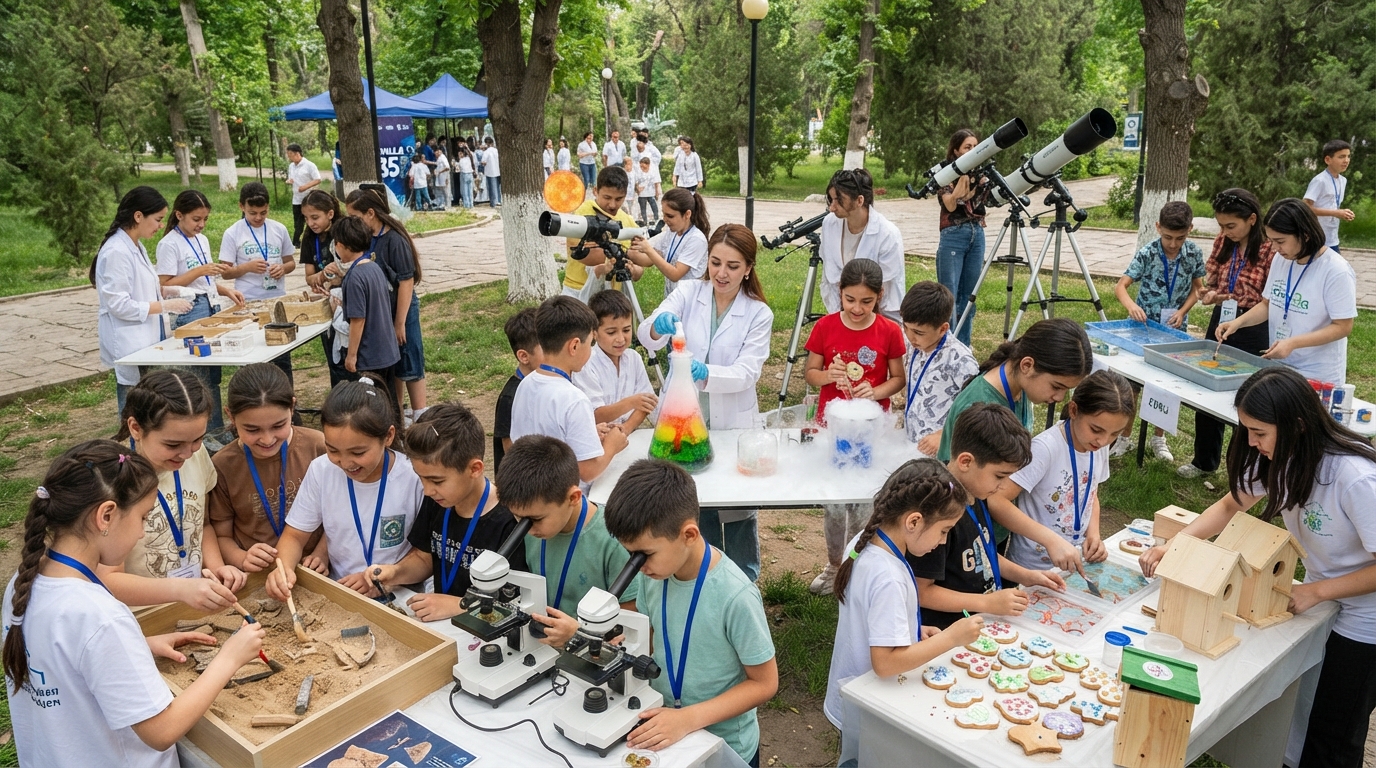
The venue was divided into nine thematic zones dedicated to chemistry, physics, astronomy, biology, technology, and art. Instead of the usual lesson with explanations at the blackboard, here the introduction to the world of science took place through experiments, observations, and the opportunity to make something independently.
On regular days, institute scientists conduct research, striving to simplify, improve, and change the existing order. But on this day, they faced a different task, and it could not be called simple. The specialists built a dialogue with children who did not forget to bring their thousands of "whys" to Formula 35.
At the booth of the Institute of History, young participants were given small shovels and brushes and invited to carefully, dust particle by dust particle, unearth a find.
A task that seemed simple at first glance captivated the children for a long time. While some slowly but surely approached their first archaeological discovery, others looked through microscopes at what plants looked like magnified 100 and even 400 times.
Meanwhile, at the main Formula 35 booth, a group of schoolchildren surrounded the speakers demonstrating what the solid form of carbon dioxide — that is, dry ice — looks like.
Here, children were also invited to "ride" an imaginary motorcycle and feel how the wind blows at different speeds. To do this, the schoolchildren were asked to stretch their arms forward and imitate the roar of an engine. The children instantly joined in and responded to any tasks.
At another booth, one could "hold" fire in their hands. Even adults did not refuse such an offer.
Kamilla Mardieva, head of a laboratory at the Institute of the Chemistry of Plant Substances, showed the children a chemical reaction whose result resembled a lava lamp. She explained which elements need to be mixed with what so that the multi-colored compounds smoothly descend or rise in the flask.
"We also demonstrated plant cells under a microscope to the children, as well as safe rhizobia bacteria isolated from soybean roots," she said.
The introduction to acid-base reactions was also visual. Ordinary purple cabbage was used as a natural indicator. Depending on the environment, it changed color: it remained purple in a neutral solution, turned dark green in an alkaline one, and crimson in an acidic one.
"Such a transformation helps explain the chemical properties of substances without complex formulas. A child first sees the color change, and only then learns what process lies behind it. An abstract concept turns into an observable phenomenon, the meaning of which is remembered better," explains Kamilla Mardieva.
"Is this a real topaz?" marvels an adult passing by, examining semi-precious stones. Schoolchildren crowd next to him, looking back and forth from the table to the scientist near the booth.
Temur Usmanov from the Laboratory of Nuclear Analytics at the Institute of Nuclear Physics tells visitors about technologies that connect fundamental physics with industrial production. For example, about how neutron irradiation can change the color of minerals due to changes in their crystal structure.
"Topazes come to us in this white form. After irradiation in a reactor with a neutron stream, they change their color. This example shows that nuclear technologies are applied not only in energy and scientific research, but also in materials processing," Temur Usmanov explains.
Questions were also asked to schoolchildren at this booth. They were asked about the speed of light, the length of the equator, and the radius of the Earth. Some, as the scientist says with regret, could not answer simple questions from the school curriculum. However, they were still awarded prizes — branded caps, T-shirts, and notebooks. As the specialist explained, this was because the children did not give up, looked for answers, and suggested options.
"It seems to me that young people are less interested in physics than, for example, in IT. Perhaps after the festival they will have an opportunity to look at the world in a new way," the scientist suggested.
Young talents could also make a name for themselves at the festival. For example, Iymona Pulatova, a student at Sehriyo School, recreated Martian soil together with her classmates. It is about 400 million kilometers from Earth to this planet, but even such a distance does not prevent studying the Red Planet.
"We participated in the NASA Space Apps hackathon. There we had the opportunity to use data from Mars rovers. We analyzed the chemical composition of the dirt from Mars and divided it into substances available to us. We tried to make sure that the resulting mixture had a composition as similar as possible to Martian soil," she said.
To prepare the mixture, the schoolchildren used 20% Earth soil and sand each, and also added various salts, acids, and other chemicals. According to the girl, NASA representatives who came to the hackathon later checked in a laboratory and confirmed that it was indeed similar to Martian soil.
The next stage was the study of how Earth organisms, in particular worms, can exist in a mixture of ordinary soil and artificially reproduced Martian soil in a ratio of 70% to 30%.
In addition, the team is working on recreating lunar regolith and another version of the Martian soil composition. For this, the schoolchildren plan to use fragments of solidified volcanic lava, which is well-suited for new experiments in its chemical composition.
Yodgor Radjabov, a junior research fellow at the Institute of Astronomy, admitted that he did not expect such an influx of visitors.
Many schoolchildren stopped near two telescopes.
Children were helped to adjust the instruments on their own, change the focus, and observe the Sun through special filters, while also receiving explanations about why it has spots.
"We told them that through these and other telescopes you can see the Moon and its craters, as well as the planets of the Solar System. In my time, such events were probably held too, but I didn’t know about them. If I had attended such an event, I probably would have become interested in science even earlier," noted Yodgor Radjabov.
Science at the festival was not limited to natural disciplines. A separate table was dedicated to Ebru — the art of creating patterns on the surface of water, followed by transferring the drawing onto paper.
"The word 'Ebru' came to us from the Persian language and translates as 'air clouds'. If you look at the patterns, they are always different and really look weightless," explained Dr. Bashorat Khodjaeva, head of the Department of Conservation and Restoration at the Institute of Oriental Studies.
Bashorat Khodjaeva said that the Ebru technique was used in the 16th century in Bukhara. Paper with such patterns was used to decorate book bindings. Over time, the tradition of artisanal production gradually faded away. Meanwhile, in Turkey, Ebru continued to develop and remains popular. Today, such paper is used, among other things, for calligraphy and other artistic works.
"To create patterns, you need water thickened with seaweed concentrate and natural pigments. Before work, powdered paints are mixed with water and ox gall, which allows them to stay on the surface and form a drawing. This technique requires observation and precision; the movement of paint on water depends on the properties of the materials and human actions," noted Bashorat Khodjaeva.
Visitors to the science festival could try creating a unique drawing on water, dip a blank sheet into it, and, after drying it, take "air clouds" home on paper.
Another way to engage children was offered by employees of the Institute of Microbiology. At their booth, schoolchildren decorated gingerbread cookies with drawings of bacteria and algae, while simultaneously getting acquainted with the world of microorganisms. Dildora Amirsaidova, a junior research fellow at the Human Microbiome Laboratory, said that the stream of children seemed endless.
In addition to the activity with cookies, children could assemble birdhouses from prepared parts. They were allowed to take the finished structures with them or leave them in the Botanical Garden, which is home to many birds.
"Time flew by unnoticed. There were fewer seats at the table than those who wanted one, so not everyone managed to try it. The children were interested; we wanted to dedicate time to everyone. Such festivals are important, they need to be held as often as possible," shared Dildora Amirsaidova.
Towards the end of the festival in the Botanical Garden, the results of the Republican Science Hackathon were also summarized, where the Institute of Botany won first place with a project for an innovative solution to combat salinization, soil degradation, and desertification.
In farewell, Dildora Amirsaidova expressed regret that the festival, which lasts one day, has time limits. Visitors may become interested in an experiment, but do not always have time to understand its principles. The Formula 35 festival will not replace school lessons, but it can become a valuable addition to them, and for someone — an inspiration for the first step into science.