

"Space is not something far away." How the second Space Fest student festival went
New Uzbekistan University hosted the second Space Fest festival. School and university students assembled rockets from scrap materials, designed satellites, and defended Martian missions. How the festival is conducted and how Uzkosmos attracts youth to the aerospace industry — in Gazeta's report.
"Space is not something far away." How the second student Space Fest went
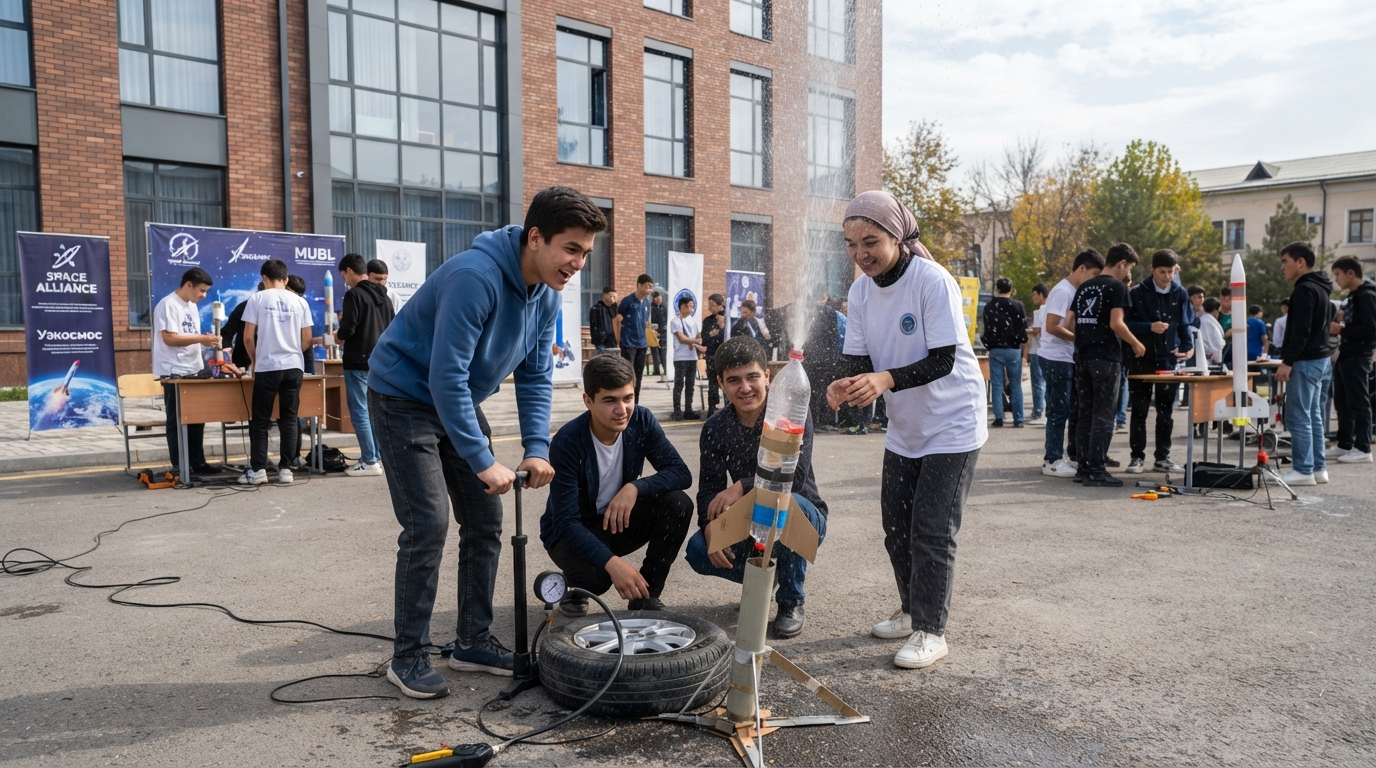
In the courtyard of New Uzbekistan University, a car compressor works loudly. A team of high school students has gathered around a plastic mineral water bottle wrapped in tape and fitted with paper stabilizers.
A few seconds of pumping pressure, a loud pop, a splash of water — and the homemade apparatus swooshes into the autumn sky, rising ten meters while spectators in the courtyard cheer the young engineers with applause.
Last Saturday, New Uzbekistan University hosted the second Space Fest.
The main rule for launching rockets in the courtyard is simple: you can only use the materials provided by the organizers on site — plastic bottles, thick cardboard, paper, and tape. The winner is the team whose rocket stays in the air the longest.
Ozodbek Azizov, a tenth-grader from the Al-Beruni school, nervously holds his apparatus right before the launch. For him, this is a first experience in rocketry. A teacher who is passionate about engineering himself told Ozodbek and his friends about the festival. The task seems simple only at first glance: you need to squeeze maximum aerodynamics out of ballast and available materials.
"First of all, there are many people here, you can feel this atmosphere. You know, when young people are creating something interesting. Being in such an atmosphere motivates you to do more," Ozodbek shares.
For his classmate Daler Tadjimukhamedov, assembling the apparatus was also a debut.
"I didn't think they could fly like that. When I was coming here, it never even crossed my mind that you could launch a rocket made of a bottle and paper using water," he says.
The teens do not hide their practical interest either. They believe that diplomas and participation in such festivals will boost their portfolios when applying for engineering majors at leading universities.
Space Fest was timed to coincide with World Space Week. This year, the festival was organized by the MUBL (Mirzo Ulugbek Legacy) student club of New Uzbekistan University together with the Space Alliance association of space clubs and the Uzbekcosmos agency, supported by ArticularUZ, Lumen Space Academy, and ISEC.
After the opening ceremony in the assembly hall, the festival immediately broke up into several independent venues. While rockets were taking off in the courtyard to the accompaniment of the university music club, a space art workshop was being held and board games were unfolding at separate tables.
This year, the festival grew noticeably: more than 400 people registered, compared to 200 last year. The number of activities also doubled — from four to eight.
According to Takhir Kasimov, leading specialist at Uzbekcosmos, they decided to revise the format based on observations from the previous festival.
"Last year we invited great speakers, but we noticed that the participants' attention shifted more to technical projects when they did something with their own hands. Based on this, we decided to focus specifically on practical venues," Takhir Kasimov explains.
In the courtyard, Kasimov is not just observing what is happening, but joins the teams himself: he takes the rockets of school and university students into his hands, explaining literally on his fingers why it is worth lengthening the nozzle or adding a little mass to the nose so that the apparatus has a better chance of a smooth flight.
"We want the participants to see that space is not something far away. It is a sphere where today you can already develop skills, create projects, work in a team, and in the future become engineers, researchers, and leaders of your own tech teams," Takhir Kasimov shares.
Sessions are held in the university classrooms where participants can try themselves as space program organizers and agency heads designing complex missions.
The Build a Satellite venue, prepared by Lumen Space Academy and ISEC, resembles a board game based on real engineering problems. Two-person teams are given a virtual budget and a limit of 100 points. They need to "buy" and balance the key components of a future space station: power, communications, control, and orientation subsystems, as well as a payload for a mission specified by the organizers. 20 minutes are allocated for one session, so 15–20 people rotate at the tables every half hour.
The tension rises when a factor of chance enters the game: as soon as a team submits a project, the organizers check the payload and "throw in" an anomaly — from a sudden solar flare to a radio module failure. The winner is the apparatus that not only completed the mission task, but also survived the emergency situation.
In a neighboring classroom, the Mars Transportation Challenge, organized by ArticularUZ and Uzbekcosmos, takes place. Participants are invited to plan a large-scale mission to transport people and cargo from Earth to Mars. 180 days are given for preparation, the budget is conditionally unlimited, but only existing technologies or those realistically achievable in the near future are allowed to be used. The main criterion is the maximum volume of delivered cargo with guaranteed safety.
After working in teams of up to six people, the participants defend their projects before university professors, who analyze every solution.
Among the jury of the Martian hackathon is Maksim Tyan, associate professor of mechanical engineering at New Uzbekistan University with 15 years of experience in the aerospace industry. While the teams at the tables work out their ideas, he observes the process and shares his impressions. The expert sees the main benefit for future engineers in the fact that high school and university students are encountering the logic of real development for the first time.
"Here at least they can feel what real work is and how proposals are born. If you want funding, if you want a project, you need a proposal. How do you draft it? For real projects, that's how it works: you sit down and brainstorm," Maksim Tyan notes.
Reflecting on the vector of development for Uzbekistan's aerospace industry, he adds:
"It is good that the government and the agency [proceed from the fact that] Uzbekistan is not such a large country as Russia and the US. We cannot build something huge, so we focus on what we can do: on satellites, mapping, data processing. I think this is a smart and useful approach."
One of the main drivers of the festival is the MUBL (Mirzo Ulugbek Legacy) student club, headed by Samira Ochilova, a third-year student at New Uzbekistan University.
According to her, the club appeared two years ago almost by accident. It all started with an announcement about selection for the CanSat team to build a microsatellite. Classes in 3D modeling and electronics were held for the students, and the process absorbed them completely.
"We initially didn't expect it, but somehow suddenly we got totally drawn into this topic. We sat in the lab until eight, until ten in the evening, working. Of course, we got very angry when something didn't work or broke. But feeling these intense emotions, you realize that you already love this business, since you sit and do it instead of dropping everything and leaving," Samira Ochilova recalls.
The university team won the UGCanSat competition organized by Uzbekcosmos, and the winners were invited to create their own student community. They started with just 10 people.
Later, the club launched a six-month course on robotics and AI for school and university students, and its members began performing on international platforms — for example, taking third and fourth places at the Teknofest festival in Turkey.
Today, MUBL is part of Space Alliance, an association of space clubs spanning New Uzbekistan University, Inha University, Webster University, Westminster Lyceum, and School No. 285. The Uzbekcosmos agency strives to ensure that similar communities appear in every university, and the initiative must come from the students themselves, Takhir Kasimov shares.
An example of such an initiative is Webster University. There are no engineering majors there, but a law student, having completed the UniSat satellite assembly project for girls, suggested opening a club at her university and asked Uzbekcosmos to send a speaker on space law. The agency supported the idea, and today the Webster club is not only operating, but also launched the Lumen Space Academy, where students are taught to design lunar rovers.
The evening at Space Fest ended at 18:00 with an award ceremony in the assembly hall: the winners of the competitions received prizes and certificates from Uzbekcosmos. But the main thing the festival provides is a clear trajectory for those who want to develop in this field, Takhir Kasimov noted.
According to him, pathways into the industry are open for different ages. For 11th-grade high school students, the agency offers to undergo an interview and apply through the El-yurt umidi Foundation to leading foreign universities for aerospace majors — with a guarantee letter of employment at Uzbekcosmos for five years. Senior university students are offered internships in the field of geographic information systems (GIS) and artificial intelligence. And starting next year, students will be taught to write scientific papers and submit abstracts to the International Astronautical Congress.
"There is a quote: 'Curiosity comes before learning'. First, young people get fascinated, infected by the idea, and only then do they want to work. They ask themselves: 'I want to assemble a satellite, but what is it made of?' — and go look for answers, learn, and create," Takhir Kasimov concludes.