

Infographic: Socio-Economic Development Indicators of Bukhara Region, 2017–2025
CERR has prepared an overview and infographic on the dynamics of socio-economic development in Bukhara Region in 2017–2025.
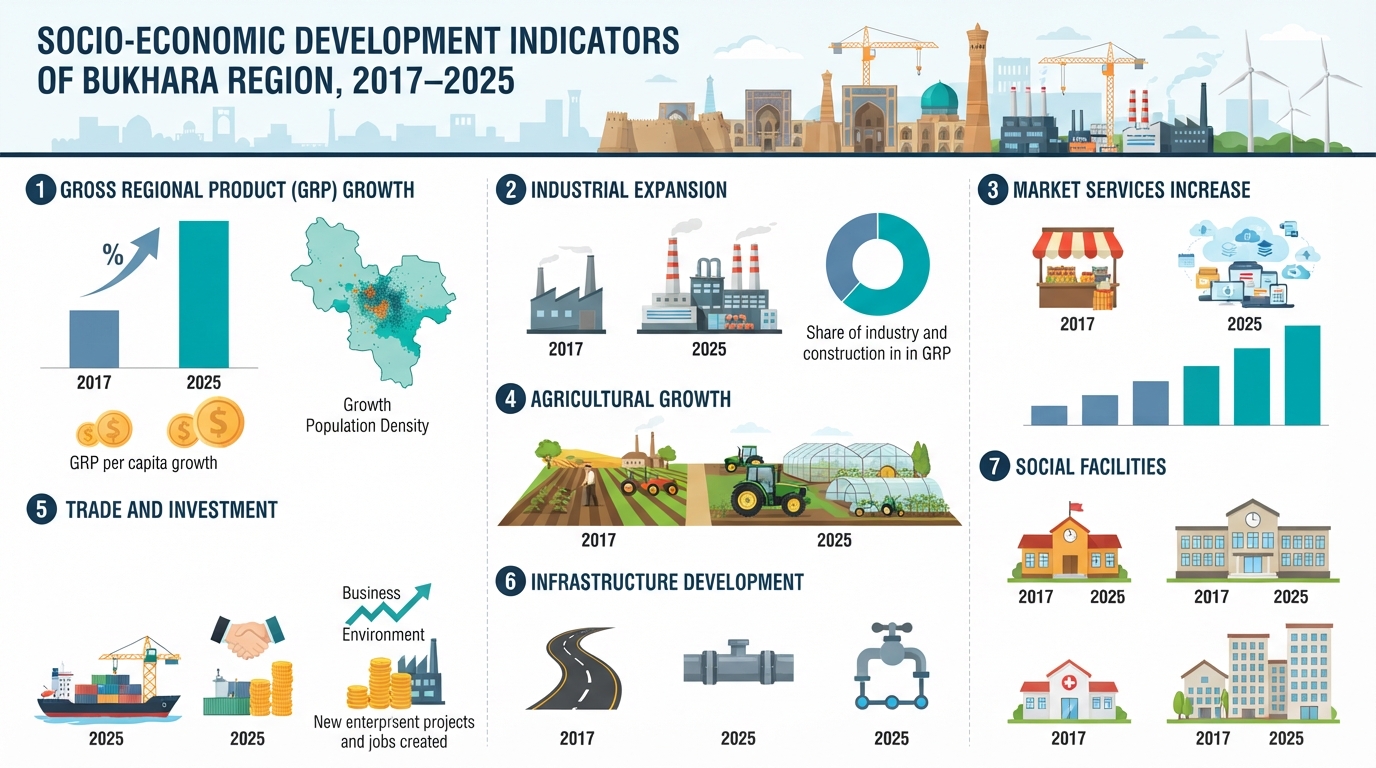
**Infographic: Socio-Economic Development Indicators of Bukhara Region, 2017–2025**
Bukhara Region is the second-largest region in Uzbekistan by area, after Navoi Region. In recent years, the region has seen large-scale construction and development projects. The number of major industrial enterprises has risen sharply, and new social facilities and multi-storey residential buildings have been built.
Between 2017 and 2025, the Gross Regional Product (GRP) of Bukhara Region grew from **17.1 trillion sums to 86.6 trillion sums**, marking **47.4% growth in real terms**. GRP per capita increased from **10.5 million sums to 41.4 million sums**. Over the same period, the region’s population expanded by **12.6%**, reaching **2.1 million people**.
Thanks to the effective use of industrial potential and the launch of modern production facilities, industrial output rose from **6.4 trillion sums to 53.5 trillion sums**, which equals **36.7% growth in real terms**. This made a major contribution to the region’s economic progress. As a result, the share of industry and construction in GRP climbed from **21.6% to 31.1%**.
Efforts to meet the growing demand for modern and household services helped increase market services from **8.1 trillion sums to 42.7 trillion sums**, representing **88% growth in real terms**.
Agricultural reforms and the creation of a favorable agribusiness environment led to a **32% increase in agricultural output in real terms**, bringing it to **48.3 trillion sums**.
Trade liberalization, along with measures to support and encourage entrepreneurial export activity, resulted in a **53% rise in regional exports** over the nine-year period, with their value reaching **$414 million**.
During this period, steps to further improve the business environment and support entrepreneurship made it possible to implement investment projects worth **$20 billion**. As a result, the number of operating enterprises reached **25,100**, and about **278,000 new jobs** were created.
To improve living conditions, the region commissioned **7,100 km of roads, 404.6 km of gas pipelines, and 2,350 km of drinking water supply networks** over the nine-year period.
Special attention was given to expanding social infrastructure. The region commissioned **10.1 million square meters of housing** and created **19,100 places in preschools, 42,000 additional places in schools, and 16,000 hospital beds**.