

Indonesia's toxic haze is giving its neighbours a political headache
Governments in Singapore and Malaysia are split between anxious citizens and an irascible neighbour.
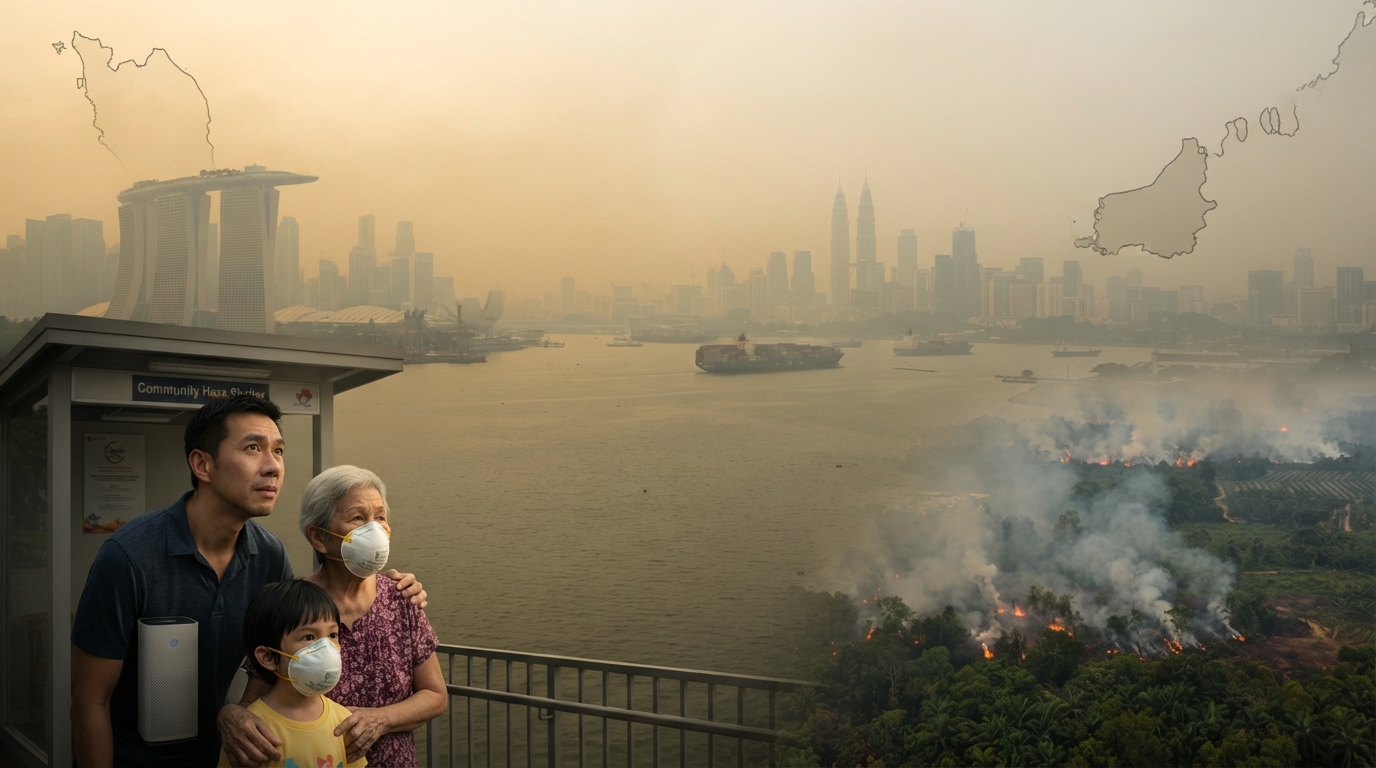
Indonesia's toxic haze is creating a political problem for its neighbours
The smoke from wildfires in Indonesia has spread to Singapore and Malaysia
The haze rising from fires in Indonesia’s Kalimantan, Papua and Sumatra regions does not respect national boundaries.
Blown by the wind into nearby Singapore and Malaysia, the poisonous smog has affected people across maritime South East Asia in recent weeks, causing breathing problems and headaches.
It is also causing a different sort of headache for the region’s governments, caught between growing public anger and the danger of damaging ties with Indonesia.
“People are fed up, angry and anxious,” Eugene Tan, associate professor of law at Singapore Management University, tells the BBC. “The governments have to respond to them, or else what is more an external issue has become an internal one with ample headroom for politicisation.”
Indonesia’s wildfires happen every year and are commonly linked to large-scale land clearing for crops such as oil palm.
But this year’s fires have been especially hard to control because of a strong El Niño, which has worsened drought in the country’s forests and peatlands.
Unlike earlier haze events in Singapore and Malaysia, which usually lasted only a few days, this one has continued for weeks.
In Malaysia, people began boycotting Indonesian goods in protest over the haze after lawmaker Syed Saddiq called for sanctions on companies tied to the fires and said Malaysians should “treat them as an outcast in the region”.
There have also been complaints in Singapore, a country that has come to expect smooth efficiency from its leaders.
“There appears to be the view that the government dropped the ball in dealing with the haze, given that it was known that the El Niño weather phenomenon would be severe and that early warning was given,” says Tan.
“Clearly, Singaporeans expect the government to decisively deal with the polluters.”
For its part, Singapore’s government has made clear that the haze is a priority.
Hundreds of haze shelters have been established across the island, and masks are being handed out to children, the elderly and other vulnerable residents.
Officials have also said they are seeking to strengthen existing haze laws and are investigating 10 Singapore-registered companies for possible links to the wildfires in Indonesia.
Last week, Singapore’s foreign minister Vivian Balakrishnan met Indonesian President Prabowo Subianto in Jakarta for what Balakrishnan described as “honest” and “sincere” talks that led to “constructive approaches”.
The meeting came as both countries announced plans to create a joint task force to address the haze, an apparent easing of tensions after weeks of rising bilateral friction.
As the haze became yet another crisis for Prabowo’s troubled administration, some officials pushed back against criticism.
One senior official caused offence when he said the wildfires were beyond human control and that oxygen in neighbouring Singapore and Malaysia “also comes from our forests”.
That comment was “disappointing” and “not right”, according to Singaporean senior minister K Shanmugam, in a rare rebuke from the city state, which prides itself on diplomatic skill.
“The haze is affecting our health seriously, and it’s really unacceptable,” Shanmugam told reporters. Since the haze affects people on both sides of the border, there should be “any bilateral issues” in dealing with it, he added.
Days later, Indonesia said it would cut gas exports to Singapore, citing domestic energy needs - a move many viewed as retaliation for Singapore’s comments.
To be sure, Indonesia has recently faced electricity shortages in parts of the country. Singapore also says the cut, which is less than 2% of its total daily demand, will have little effect on its gas supply.
But the sudden announcement came only days after Indonesia’s energy minister warned that exports could be halted to countries that do not “respect Indonesia”. That same day, Prabowo referred to “countries that like to insult Indonesia” while discussing the wildfires.
“It’s a tired playbook of using Singapore as the bogeyman, driven by the ‘abang-adik’ [big brother-little brother] syndrome,” Tan says, referring to a historical dynamic Singapore’s leaders have long tried to dismiss: the expectation that it should defer to its larger neighbours.
“Singapore leaders expressing concerns about the haze and how it affects the people of both countries have been taken to mean that Singapore has been disrespectful to its neighbour.”
Malaysia’s official response to the haze has been comparatively restrained.
Its foreign minister Mohamad Hasan has ruled out filing a formal diplomatic protest with Indonesia or pursuing legal action, saying such steps “would mean we were prepared to sever relations”.
For now, Malaysia has agreed to explore a memorandum of understanding with Indonesia to strengthen wildfire prevention efforts.
Mohamad said it would also rely on diplomatic channels - such as the Asean Agreement on Transboundary Haze Pollution.
The agreement, which took effect in 2003, commits members of the Association of Southeast Asian Nations (Asean) to work together to address the recurring haze.
But many regard it as toothless, since it cannot punish agricultural companies linked to wildfires or compel individual governments to do so.
The agreement has proved “just not worth the paper it was signed on”, says James Chin, professor of Asian studies at the University of Tasmania.
“The moment the haze disappears, the moment the political pressure’s off, it’s back to business as usual.”
In 2016, Asean countries set a target of eliminating haze in the region by 2020. When that deadline passed quietly, they set a new goal of achieving it by 2030 instead.
Malaysia’s position is further complicated by the fact that it is also a major palm oil producer. The commodity is often associated with commercial “slash-and-burn” methods that are widely blamed for the region’s wildfires.
Malaysia has also at times faced severe haze from fires on local land.
In 2019, when Malaysia blamed hotspots in Indonesia’s peatlands for the haze covering the region, Indonesian authorities pointed back at Malaysia, saying the smog came from their side.
“As long as we place a lot of importance on oil palm planting, [the haze] is going to recur,” says Ei Sun Oh, principal adviser at the Pacific Research Centre of Malaysia.
And even if Malaysia did speak out, Oh adds, it is unlikely to have the same “leverage” over Indonesia as Singapore, which is Indonesia’s biggest foreign investor and an offshore financial centre for many wealthy Indonesians.
For now, Malaysia “doesn’t want to unduly provoke Indonesia”, says Oh.
“The government is just wringing their hands till the wind blows [the problem] over. Because eventually it will blow over.”