

Indian state gives taxi and tuk-tuk drivers a year to learn local language
A new rule making it mandatory for drivers to learn Marathi or lose their licence had sparked protests.
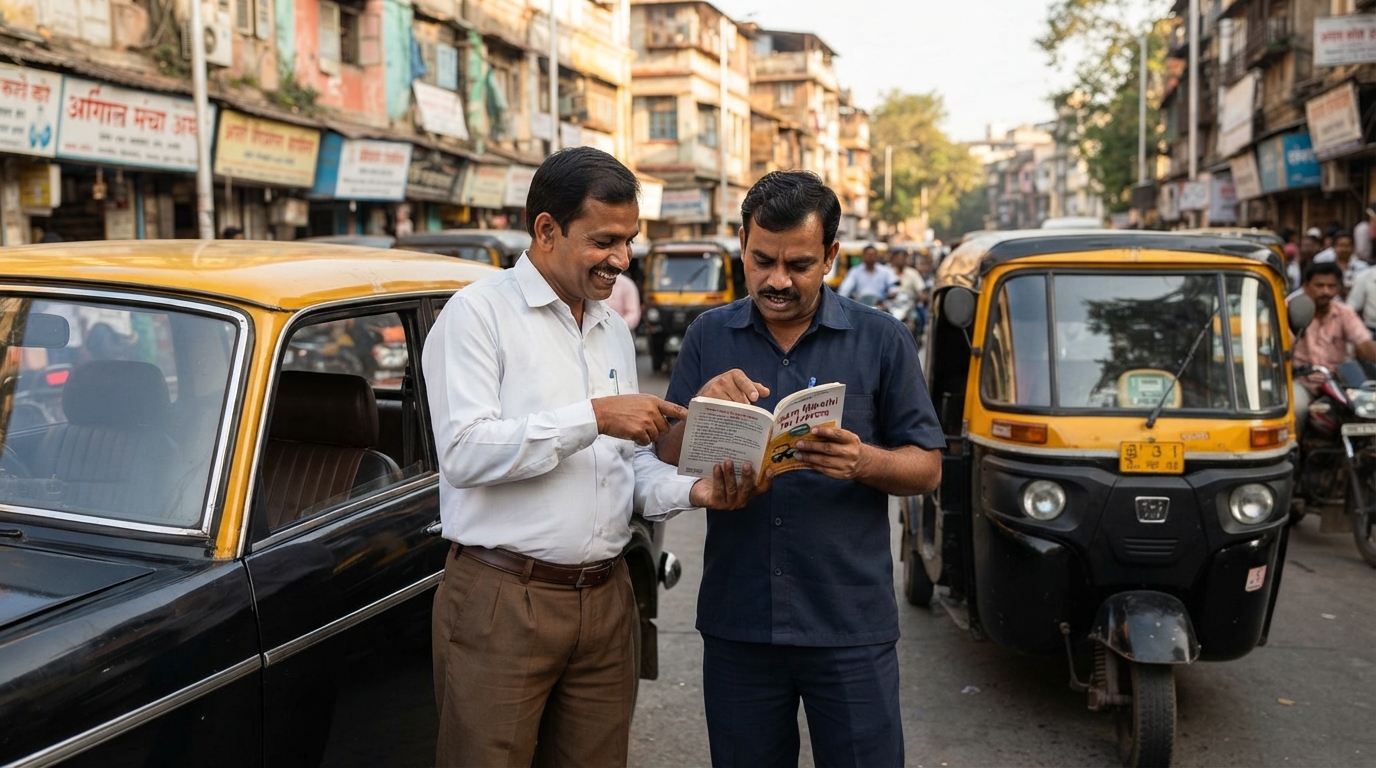
Indian state gives taxi and tuk-tuk drivers a year to learn local language
An Indian state has granted taxi and tuk-tuk drivers an extra year to learn the local language after a new mandatory rule triggered protests.
Transport officials in Maharashtra, in western India, began checking drivers’ ability to hold basic conversations in Marathi, the state’s official language, on 20 August. Drivers who did not pass were given one month to learn the language, after which they faced the possibility of having their licences suspended or revoked.
The government said the measure was intended to improve communication between drivers and passengers and make journeys safer.
Drivers’ unions, however, were alarmed by the rule, arguing that workers should not be at risk of losing their livelihoods while still learning the language. Many of the drivers are migrants who moved to Maharashtra from elsewhere in India for work, including the heavily populated Hindi-speaking states of Uttar Pradesh and Bihar.
Following protests, Maharashtra Chief Minister Devendra Fadnavis announced last week that drivers would get another year to learn Marathi, saying many had been outside the formal education system for years and needed more time.
State Transport Minister Pratap Sarnaik has said drivers will be expected to learn Marathi during the year and that further extensions will be given.
Maharashtra has nearly 979,000 valid tuk-tuk and taxi permits, almost half of them in the Mumbai metropolitan region.
The extension has eased fears among drivers who worried they might lose the ability to work.
"We were worried that if our licences were suspended, our daily income would be affected," says Lakhan Pandey, a taxi driver in Mumbai. "Now we feel somewhat relieved."
But the dispute has revived a much older debate in Maharashtra, where language, migration and jobs have influenced politics for decades.
"The issue is not simply about communication between drivers and passengers, but about Marathi identity, migration and employment," says Prakash Akolkar, a journalist, author and political analyst.
Those tensions date back to the creation of Maharashtra itself. The state was established in 1960 after a long campaign for a Marathi-speaking state.
As Mumbai developed into India’s financial centre, it attracted generations of migrants from across the country seeking work. Language became increasingly tied to arguments over jobs and opportunities for Marathi speakers.
In 1966, the Shiv Sena, a regional political party rooted in Marathi nationalism, was formed on a "sons of the soil" platform, claiming Marathi speakers were losing jobs to migrants. It later became one of Maharashtra’s most powerful political forces, with Marathi identity central to its appeal.
Today, Maharashtra is ruled by a coalition led by Fadnavis’s Bharatiya Janata Party (BJP) and one faction of the Shiv Sena, which split in 2022. The rival faction and another regional party, the Maharashtra Navnirman Sena (MNS), have also promoted the Marathi cause.
Akolkar says it is fair to expect people who move to a state to learn some of the local language. But he distinguishes that from the politics surrounding the issue.
"Ordinary people do not always treat language with the same intensity as political parties," he says, adding that parties have often raised the issue when it suited the political circumstances.
Deepak Pawar, a political scientist and president of the Marathi Abhyas Kendra (Marathi Training Centre), which promotes the language, takes a firmer stance. He says people who have lived in Maharashtra for years should already have gained at least a basic knowledge of Marathi.
Refusing to learn the local language after living and working in the state for years is "linguistic arrogance", he says.
The same tension has appeared in other states, including Karnataka, where language activists fear Kannada is being marginalised because many migrants believe they can manage with Hindi or English.
In Maharashtra, the government says drivers are not expected to read or write Marathi, or to speak it fluently. Under changes to the state’s motor vehicle rules, they must have a "working knowledge" of the language.
To support them, the government has arranged classes focused on Marathi words and phrases drivers may need at work - asking passengers where they want to go, discussing fares or giving directions.
About 166,000 drivers have completed the training and passed an oral test, according to the state transport department.
Munawar Sheikh, a 58-year-old tuk-tuk driver, was among those who enrolled.
Over four days at a training centre in Thane, near Mumbai, he and other drivers learned 16 commonly used questions and phrases, including "Where do you want to go?", "don't worry" and "the fare will be according to the meter".
At the end, they took an oral test, and those who passed received a certificate to show transport officials during inspections.
Sheikh says the course taught him enough Marathi to handle basic conversations with passengers.
But for some drivers, finding time to study is part of the challenge.
Ajay Singh, a taxi driver in Mumbai, says he wants to learn Marathi but has struggled to fit classes around his working day.
"From the time we wake up until late at night, we have to drive. Otherwise, there is no food on the table," he says. "Taking a few hours out of the day for a class is financially difficult for me."
Singh says he earns between 1,500 and 2,000 rupees ($17-$23; £13-£17) a day and fears that losing even a few days’ income could leave him unable to pay rent and his children’s school fees.
Instead, he is trying to learn while working - listening to Marathi radio stations while driving and practising with Marathi-speaking passengers.
Lakhan Pandey, also a driver, says the extra year has made a major difference.
He says he never opposed learning Marathi - he simply wanted enough time to do it.
"We live here, we work here. Of course we should learn Marathi," he says. "Just give us the time to learn it without putting our livelihoods at risk."