

Indian solar mission's new findings throw light on enduring Sun mysteries
Why is the Sun's corona millions of degrees hotter than its surface? And how does it maintain its inexplicably high temperature?
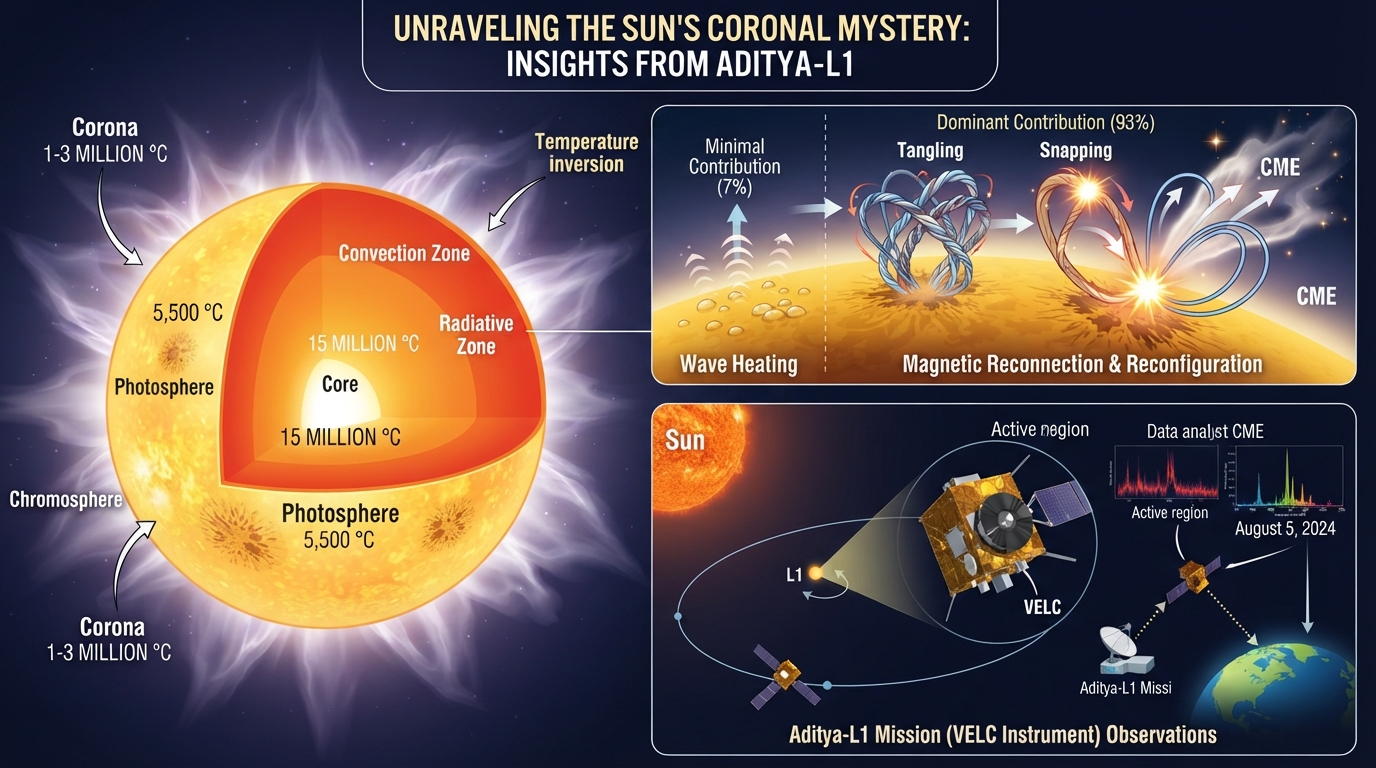
New discoveries from India's solar mission are shedding light on long-standing enigmas about the Sun, particularly the perplexing temperature variations across its different regions, which scientists note seem to defy the laws of physics.
A persistent puzzle for scientists has been why the Sun's outer atmosphere, the corona, is millions of degrees hotter than its surface. Furthermore, how does the corona maintain such extreme temperatures despite frequent eruptions that cause it to lose vast amounts of energy?
Indian astrophysicists now report that the latest data from Aditya-L1, India's inaugural space-based solar observation mission, have provided crucial insights into these mysteries. Their findings were recently detailed in a paper published in the esteemed Astrophysical Journal Letters.
Professor R. Ramesh, a leading Indian solar astrophysicist from the Indian Institute of Astrophysics (IIA) who spearheaded the study, stated that the temperature discrepancies in various solar regions challenge established physical laws.
Delving into the Sun's structure, the core reaches a scorching 15 million degrees Celsius. Moving outward to the surface, or photosphere—the visible part from Earth—the temperature drops to approximately 5,500°C. Yet, the outermost layer, the corona, located far from the core, boasts temperatures around 2 million°C, occasionally soaring to 40 million°C.
Professor Ramesh explained that the corona is the origin point for extreme solar events like solar flares and coronal mass ejections (CMEs), during which the Sun releases immense amounts of energy into space. While CMEs create stunning auroras, they can also impact Earth by triggering geomagnetic storms capable of disrupting power grids and affecting weather and communication satellites.
During periods of normal or low solar activity, the Sun typically launches two to three CMEs daily. However, during the peak of the 11-year solar activity cycle, this number can exceed ten in a single day.
"If the Sun were to continuously lose such enormous amounts of energy with each CME without replenishment, the star at the center of our solar system would eventually deplete all its energy, plunging Earth into an irreversible deep freeze," Professor Ramesh remarked.
Since this scenario is not occurring, it implies the existence of a "mechanism" that enables the corona to sustain its inexplicably high temperature, he added.
An illustration depicts the Sun's layers, from the core to the periphery: the core, radiation and convection zones, photosphere, chromosphere, and corona.
Scientists attribute this phenomenon to two primary factors. First, the turbulent, boiling motions on the Sun's surface constantly generate waves that, as they propagate outward, transport energy to the corona—much like ocean waves carrying foam and froth to the shore.
The second factor involves the "tangled magnetic field lines" within the Sun's atmosphere, which repeatedly snap and then reconnect. Professor Ramesh elaborated that CMEs occur when these twisting, looping lines, resembling braided hair, rupture, expelling massive clouds of magnetized plasma and gas into space. These events often originate near sunspots, which are cooler, darker areas on the Sun characterized by exceptionally strong magnetic fields.
"However, these lines then reconnect, and the Sun replenishes the lost energy within hours," he noted.
In their published paper, Professor Ramesh stated that they have successfully quantified the energy contribution of each of these two systems to the corona. This quantification helps explain both the corona's initial extreme temperature and its ability to maintain that temperature despite consistent energy loss.
Their study, he emphasized, clearly indicates that the second system is responsible for supplying the majority of the energy.
"Although the waves generated by the bubbling, boiling motions on the Sun's surface do generate and transport energy, their contribution is minimal—they supply only 7% of the required energy. The remaining 93% comes from the Sun's ability to reconfigure itself and replenish the lost energy."
The Sun's corona is only visible to the naked eye from Earth during a total solar eclipse.
To arrive at this calculation, Professor Ramesh explained that they analyzed a "very energetic" CME that occurred on August 5, 2024. Emissions from this event were recorded by Aditya-L1's coronagraph, known as Velc (Visible Emission Line Coronagraph).
"We observed that within 10 hours after the CME, the tangled field lines returned to their original configuration, reconnected, and the corona's energy was restored," he stated.
"While we acknowledge that energy generated by bubbly motions plays a significant role, we have evidence that it is not sufficient. Our study demonstrates that the snapping and reconnecting magnetic field lines across the Sun are the primary source for supplying most of the energy."
Professor Ramesh believes these data "provide an important benchmark" for future research into potential energy generation mechanisms within the Sun's atmosphere.
"I believe they will help answer fundamental questions in physics that currently defy logic," he concluded.