

In Uzbekistan, business activity indicators continue to grow
In January–September 2026, growth was noted in Uzbekistan across all five main indicators of business activity. The highest growth rates were recorded in tax revenues, exchange trading, and exports.
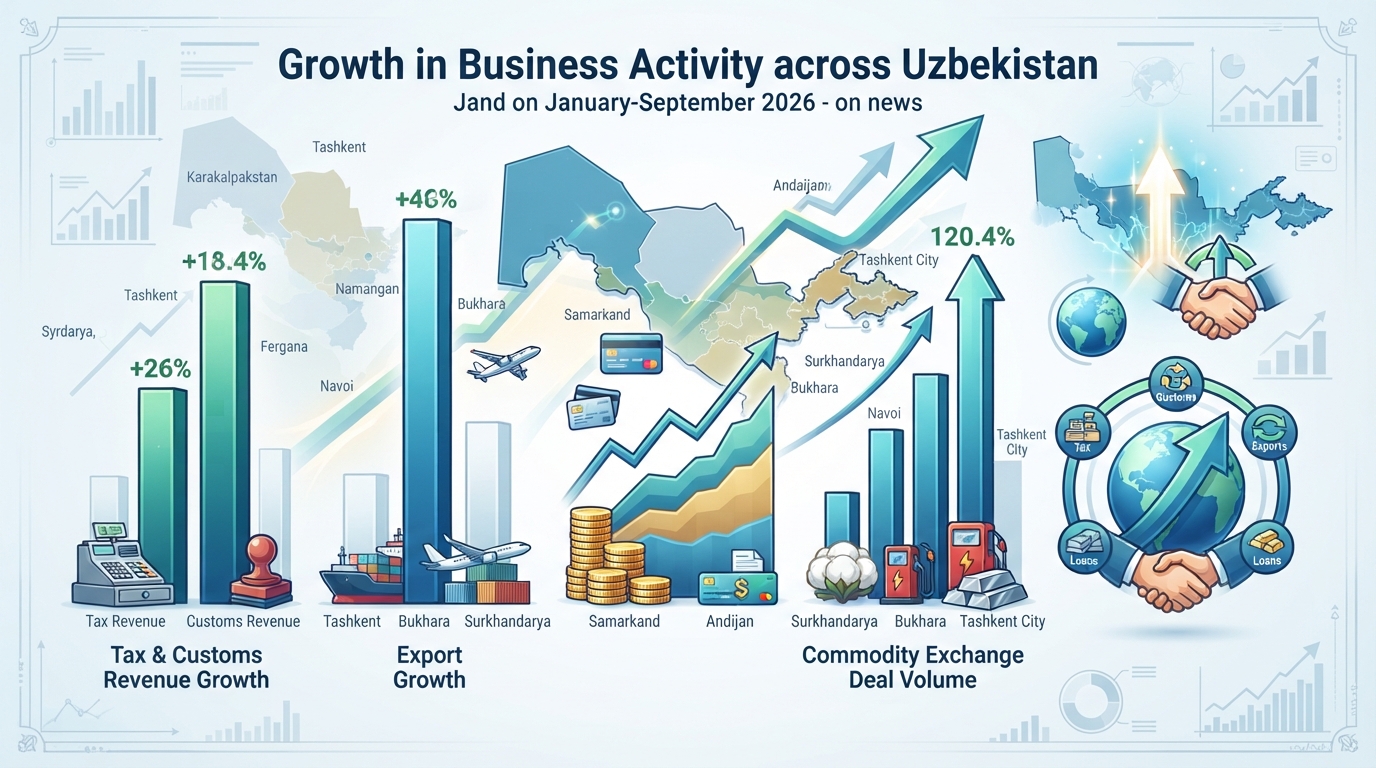
Growth in business activity indicators persists in Uzbekistan
The Center for Economic Research and Reforms analyzed business activity in the regions of Uzbekistan for January–September 2026. The study included the dynamics of tax and customs revenues, exports of goods, bank lending, and transaction volumes on the commodity exchange.
The results of the analysis showed an increase across all five areas for the republic as a whole.
In January–September 2026, tax revenues across the republic grew by 44.3% compared to the same period last year and reached 229.1 trillion soums.
By region, the highest growth rates in tax revenues were recorded in Tashkent (37.3%) and Syrdarya (32.2%) regions, as well as in the city of Tashkent (30.4%).
During the reporting period, customs revenues increased by 17.4% and reached 63.5 trillion soums.
The largest growth was noted in the Republic of Karakalpakstan (74.3%). A significant increase was also recorded in Namangan (43.0%), Fergana (34.5%), and Navoi (27.3%) regions.
In January–September 2026, Uzbekistan's exports of goods amounted to 12.9 billion dollars, which is 34.2% more than in the same period last year.
The highest export growth rates were noted in Tashkent (63.1%), Bukhara (59.7%), and Surkhandarya (50.9%) regions, as well as in the city of Tashkent (42.6%).
In January–September 2026, the volume of loans issued by commercial banks reached 302.5 trillion soums, an increase of 6.9% compared to the same period in 2025.
Among the regions, a noticeable growth in lending volumes was noted in Samarkand (41.7%) and Andijan (31%) regions.
The volume of transactions concluded on the Uzbek Commodity Exchange grew by 39.7% compared to the same period last year and reached 147.9 trillion soums.
The highest growth was recorded in Surkhandarya region (120.4%), where trading in cotton fiber, gasoline, and diesel fuel played the main role.
In Bukhara region, transaction volume increased by 98.5%. The most noticeable contribution was made by trading in building materials, diesel fuel, and gas condensate.
In Navoi region, growth reached 48.2% and was associated with the trade in building materials, diesel fuel, and mineral fertilizers.
In the city of Tashkent, exchange transaction volume increased by 48.6%. Non-ferrous metals, diesel fuel, and cotton fiber were noted among the main commodity categories.