

In Uzbekistan, a total of more than 3 trillion soums have been paid for IMEI codes in 7 years. Where is the money going?
The UzIMEI operator told Gazeta that over the past 7 years, more than 97.8 million codes of mobile devices have been registered. For this, $253 million, or more than 3 trillion soums, was paid. Does the mandatory payment for IMEI have a legal status? Where are the proceeds being spent? Official explanation.
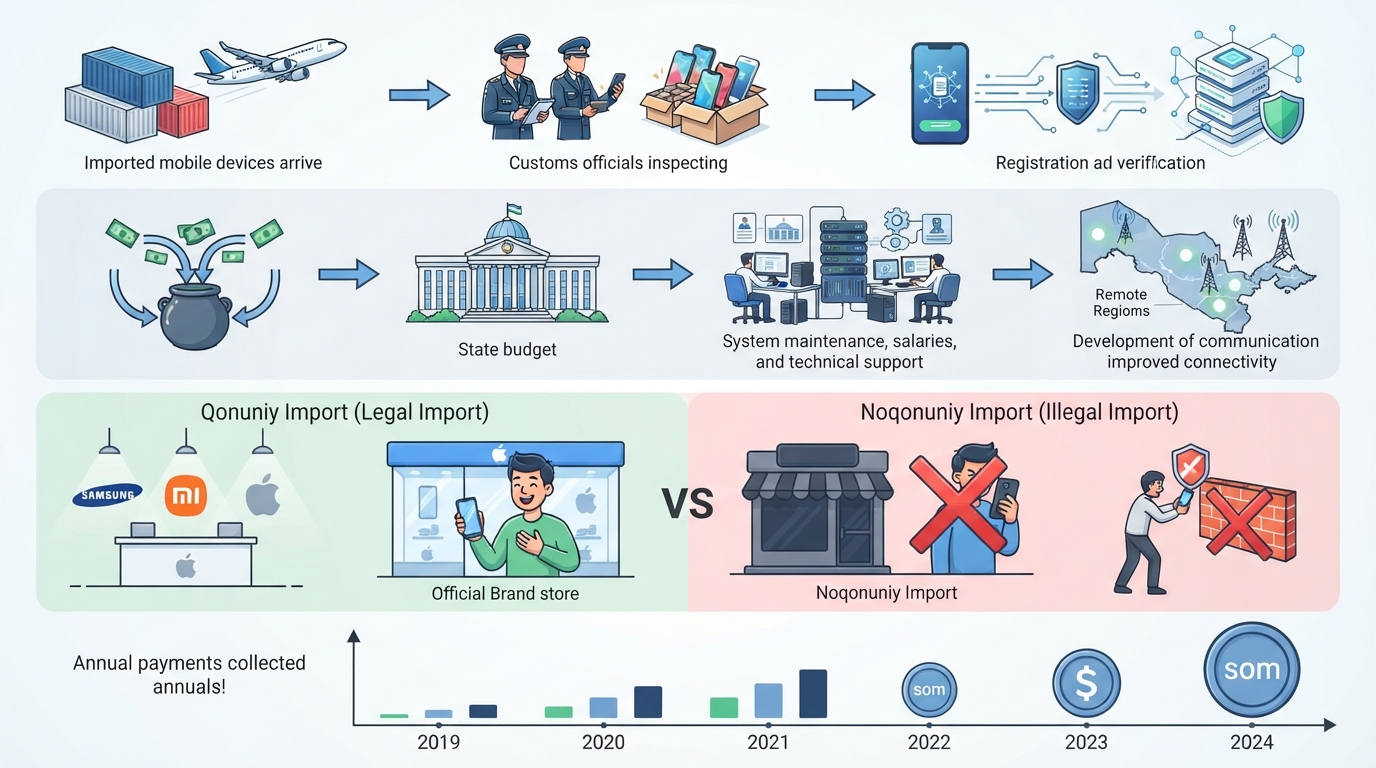
In Uzbekistan, over the past seven years, more than 3 trillion soums have been paid for IMEI codes. Questions are being raised about where this money is being directed.
In accordance with the Resolution of the Cabinet of Ministers No. 778 of 2019, the procedure for state registration of IMEI codes of mobile devices and the amount of payment are established. According to it, importers are required to pay 20 percent of the basic calculation amount (BHM), and individuals - from 20 to 25 percent. Otherwise, the phone may be blocked within 30 calendar days.
As the head of the department of the Republican Center for Management of Telecommunications Networks, Otabek Azimov, told the Gazeta correspondent, these payments do not have tax status, but are a fee for services provided by the center. Azimov gave a short interview on these and other issues on August 24 as part of the Silk Road Finance & Technology forum.
“What does this give us? Currently, 95 percent of mobile devices are imported by importers, and the remaining 5 percent by individuals for their own needs. This creates the basis for the opening of official stores and service centers. That is, foreign mobile device manufacturers can operate in Uzbekistan, seeing that only officially imported phones are used, and that illegal ones are not allowed, and gain confidence in us,” Azimov said.
It has been almost seven years since the UzIMEI system was introduced. According to official data, during this time, official stores of Samsung and Xiaomi have started operating in Uzbekistan. Apple stores have not yet opened.
“They have distributors, but their official stores have not yet been opened. Discussions with them have been going on for more than a year. Because Apple also has its own privacy policy. After we agree on these things, our official store will also be opened,” Otabek Azimov noted.
According to information provided to the newspaper, more than 97.8 million IMEI codes have been registered by the state since 2019. In the first year of the new system’s implementation, 47.6 million (48.7 percent) IMEI codes were automatically registered without any fees. The rest are divided as follows:
Among registered devices, the largest share belongs to Samsung (35.5 million), Xiaomi (18.1 million), Nokia (7.7 million), Apple (5.8 million), Huawei (2.4 million), and others (28.4 million).
By device type, the number of devices is smartphones (72.5 million), push-button phones (20.3 million), portable devices (238 thousand), tablets (1.4 million) and others (3.03 thousand).
The number of unregistered devices, but in the process of being transferred, is 366,326, and the number of blocked devices is 20.1 million. During this period, more than 3 trillion soums were paid for the registration of IMEI codes. This figure is as follows by year:
* 2019: 100.4 billion soums
* 2020: 260.8 billion soums
* 2021: 480.6 billion soums
* 2022: 800.2 billion soums
* 2023: 1.03 trillion soums
* 2024 (as of July): 330.2 billion soums
It was stated that the collected fees will be directed to the state budget, as well as to the salaries of workers and technical support of the sector.
“When calculating, the money received is intended for the operation of the system, the operation and updating of server devices, the development of the republic's communications sector, including improving the quality of communication in remote areas, and the salaries of workers,” said Otabek Azimov.
Thanks to UzIMEI, the share of legally imported phones has increased to 93 percent. When asked by a newspaper reporter whether there are plans to abolish the UzIMEI fee in the future after this number reaches 100 percent, officials answered as follows:
“After creating a free system, it is necessary to support it. This ultimately leads to “eating” the budget. In our case, 95 percent of the payment is borne by importers. For example, an importer imported a mobile device, registered it, and the person who bought it later does not pay for the IMEI. However, there are also fraudulent cases where they say that they have registered the IMEI code on the “black market” and that they can use it freely. That is why the IMEI code of each phone is written on the box, and you can check whether this code has been registered or not through the website,” said Akhmadjon Orifjonov, head of the center’s press service.
“What does the importer do now? He imports mobile devices, places them in a customs warehouse, submits an application to UzIMEI. He cannot import his phones until he pays for UzIMEI. It is also cheaper. He pays 17 percent, that is, 12 percent VAT and 5 percent for customs services. That is why it is more convenient for importers to import. In this case, he can register 2 IMEI codes at once,” said Otabek Azimov.
Uzbekistan has established clear value and quantity limits for individuals to import or export goods without filling out a customs declaration and paying duties. These limits vary depending on the type of transport and direction of movement.
From May 1 last year, these limits were reduced by a government decision. In practice, the import fee for air transport is set at up to $1,000, for rail and river transport at up to $500, and for automobile and pedestrian crossings at up to $300.
According to representatives of the Republican Center for Telecommunications Network Management, in addition to the declaration to prevent illegal import of mobile devices, a Face ID system has been introduced to register the IMEI code.
"Before, when the UzIMEI system was launched, it was possible to register a passport for a person who had gone abroad. In this process, passport data began to be sold on the "black market". According to unofficial information, there were times when personal data was sold for $ 1 to $ 5. That is, passport data from people who had gone abroad and entered were given. Those who received this data entered the data on the UzIMEI website and registered.
Then, to prevent this, we added Face ID and phone numbers from the passport to the system. The declaration can only be done through the passport for which it was issued. That is, let's say I came from abroad, I am filling out a declaration for my passport for going abroad, so I cannot register with my ID card. Because the declaration contains a passport for going abroad. In this case, I can register myself using Face ID," said Azimov.
He added that at the time of the declaration requirement, the Face ID system was not yet in operation. Later, this system was introduced as an additional means of personal identification when registering a device.
The head of the department noted that the procedure for registering IMEI codes falls within the competence of several agencies, therefore, the revision of the declaration requirements can also be carried out in consultation with the relevant agencies.
For your information, over the past 7 years, customs duties collected from the official import of mobile devices through customs clearance have exceeded 5 trillion soums:
* 2019: 200 billion soums
* 2020: 300 billion soums
* 2021: 600 billion soums
* 2022: 1.2 trillion soums
* 2023: 2.1 trillion soums
* 2024 (as of July): 600 billion soums
We recall that 4 years ago, the Minister of Digital Technologies Sherzod Shermatov noted that UzIMEI should be paid and that it legally has the status of a tax.
“You have to pay taxes. Nothing is free. After paying taxes, there will be work,” he said.
Last year, economist Behzod Hoshimov argued that the MPs could enrich Uzbeks by billions of dollars by removing UzIMEI. He said that consumers pay for IMEI with both money and time.
For your information, the mandatory registration system for mobile devices using IMEI codes is actually operated by Information Technology Center LLC. According to public data from the National Statistics Committee, 51 percent of this company still belongs to the American company Delta Telecom International, and the remaining 49 percent belongs to the Center for Telecommunication Network Management.
In 2024, by a corresponding presidential decree, the 49 percent of the state-owned shares were put up for sale, and the enterprise was fully privatized.