

In Urgench, the construction of a new terminal has begun. What the renovated airport will look like
The construction of a new passenger terminal has begun at Urgench International Airport. A large-scale reorganization of the airport complex, worth $242 million, is being carried out jointly with the South Korean Incheon International Airport Corporation. Details on how the airport will change are in this article by Gazeta.
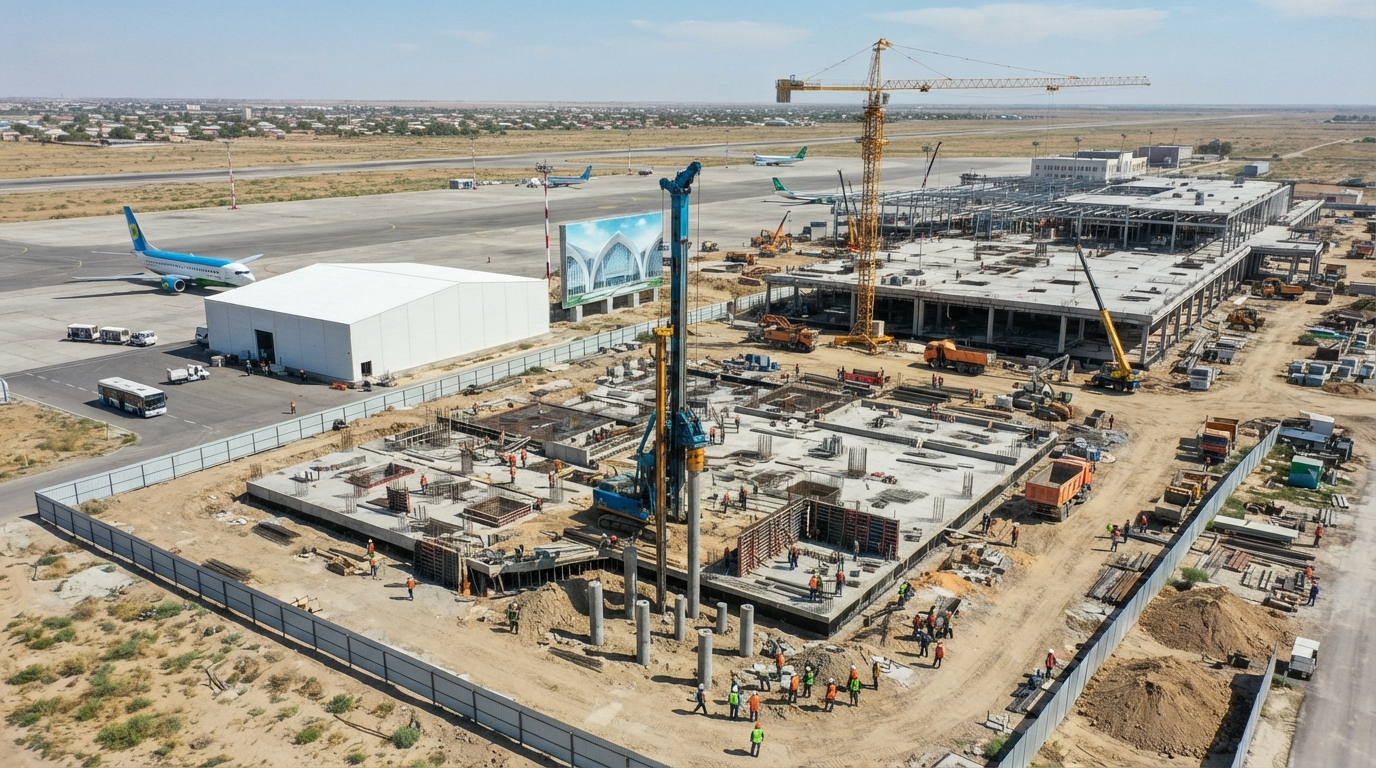
Construction of a new passenger terminal has started in Urgench. What the renovated airport will look like
On September 29, journalists were shown the site of the future passenger terminal of Urgench International Airport, which is being built by the South Korean Incheon International Airport Corporation.
The old arrivals terminal on this site has been completely dismantled, and the area has been cleared and leveled. Currently, special concrete piles are being driven under the foundation to reinforce the soil. In total, 1,495 piles are planned to be driven.
The representative of the contractor — the South Korean company BoMi Engineering & Construction — Hwang Young-jae, who is in charge of construction, explained that the piles are necessary due to the soil characteristics in Urgench: the upper layers here are water-saturated and insufficiently stable. The piles, about 12 meters long, pass through these layers and rest on dense, dry clay. After that, the pouring of the foundation will begin, followed by the installation of metal structures.
To ensure the airport does not stop operating during construction, the Korean side built a temporary arrivals terminal, said airport director Oybek Matkarimov. This is a lightweight hangar made of sandwich panels. While construction is underway, flights are received there, and after the completion of the new terminal, the hangar will be dismantled.
The project is being implemented under a public-private partnership scheme of "Build-Operate-Transfer" (BOT). The project duration is 22 years, including three years of construction.
Preparation of the project began in 2024. First, the Cabinet of Ministers approved the concept, and then a two-stage international tender was held. On April 17, 2025, the Korean Incheon International Airport Corporation was declared the winner.
As early as November 2025, the project company ICN-Urgench Airport Services was established, and on December 26, a PPP agreement was signed in Tashkent between Uzbekistan Airports, Urgench Airport, and this company. On March 2, 2026, the Ministry of Economy and Finance signed a state support agreement for the project with the project company.
According to Oybek Matkarimov, eight companies participated in the tender. The participants were evaluated based on criteria such as passenger traffic growth, investment volume, technology, and the company's experience.
"Under the PPP, the private partner builds the terminal to serve passengers. In addition, it is planned to construct auxiliary buildings, as well as a catering building and a cargo terminal. The state's responsibility is the main runway, taxiways, and aprons," Matkarimov said.
The total cost of the project is 242 million dollars: 134 million is allocated for the private partner's facilities, and 108 million for the state's facilities.
Oybek Matkarimov also explained why the choice fell on Incheon and BoMi.
"Incheon is among the ten strongest airports in the world. Over the past five years, they have ranked first twice in terms of passenger traffic and passenger service. They have a lot of experience, and there is much to learn from them. As for the builder, it is BoMi Corporation. If you have seen Tashkent City, BoMi has a 30-story building there. These are reliable builders, that is our opinion," the airport director said.
On behalf of Incheon, Yoo Byung-nam, the head of the PPP project in Urgench from the Korean company, spoke to journalists. He has been working at Incheon for over 20 years in the field of airport facility operations and has participated in major construction projects.
"The core of operations for Incheon is service. We do not mean to say that the service at Uzbekistan's current airports is bad. Over almost 25 years, we have accumulated our own standards and experience on how to make departures and arrivals comfortable, convenient, and fast. We want to implement this experience in Urgench," Yoo Byung-nam said.
According to him, specialists from Incheon and Samsung from South Korea are being brought in to set up ICT, power supply, and other special systems. At the same time, the Korean side is training local personnel. Yoo Byung-nam emphasized that starting from 2029, the company will operate this airport for 19 years. Therefore, Incheon is already recruiting staff and trying to select those who will be able to work in airport operations.
According to Oybek Matkarimov, about 30 specialists came from South Korea, while the rest of the workers are local. While the pile driving is underway, about 100 people are working on the site, but during excavation work, the number of people will increase. The airport director believes that eventually, their number will exceed 1,000.
Sherzodbek Saidniyozov, manager of the property relations department at Uzbekistan Airports, explained how management will be divided between Incheon and the airport. Under the contract, management of the terminal has been transferred to the Korean company. It is building the terminal and auxiliary buildings, and also receives the right to store and upgrade special equipment serving passengers.
Urgench Airport employees will continue to handle aircraft arrivals, ground handling, and passenger boarding. Upon transitioning to operations, a regulation will be approved between the three parties, detailing the interaction.
When asked why Incheon participated in the tender, Yoo Byung-nam replied that the main motive was the contribution to the economic development of Uzbekistan and the growth potential of Urgench, located near Khiva.
The contract provides for concession payments: the private partner will transfer a portion of its revenues to the airport. Payments will amount to 5% of total revenue in the first three years, 16% in 2032–2035, and 27% in 2036–2047. Over 22 years, a total of 408.7 million dollars is expected.
Construction is planned to be completed by the end of 2028.
The airport was founded in 1932, with the last modernization taking place in 2014. It is located 3 km from the center of Urgench and about 30 km from Khiva, occupying an area of 294 hectares.
The runway length will be increased from 3,000 to 3,300 meters. The surface will be made of concrete. There will be four taxiways instead of one, and a high-speed taxiway will also appear. The number of aircraft parking stands will increase from 6 to 18. Currently, the airport accepts aircraft up to Class E, but after construction, the runway, taxiways, and parking stands will be designed for Class F (for example, Boeing 747-8, Airbus A380).
The airfield lighting equipment was manufactured in 1997: with a design service life of 10 years, it has been operating for 28 years. It will be replaced with modern equipment meeting ICAO requirements, and CAT-II will be installed instead of CAT-I. According to Oybek Matkarimov, after the equipment replacement, aircraft will be able to land with visibility of 300 meters instead of the current 750.
The terminal area will be about 39,000 square meters, which is more than four times larger than the previous 9,200 square meters. The terminal's capacity will increase from 300 to 1,300 passengers per hour.
The building will have three floors. On the first floor, departures and arrivals will be separated, and the baggage handling system will also be located there. On the second floor, there will be a lounge for VIP passengers, retail outlets, and catering. On the third floor, there will be retail areas, boarding gates with jet bridges for international flights, CIP and business lounges, family lounges, and children's rooms. Online check-in and self-service baggage drop will be introduced in the terminal.
The architectural concept incorporates elements of Khorezm architecture and patterns. The building will be based on large glazed facades, high interior spaces, and natural lighting.
Sherzodbek Saidniyozov noted that the visualizations shown are indicative, and the final interior concept has not yet been approved.
"There is a concept of 'parallel design,' and we are working according to it. This means that adjustments are made along the way. If we finish the design first and only then start the work, the project will drag on even longer," the airport director explained.
By the end of 2028, they also plan to build a cargo complex, a parking lot for about 1,000 vehicles, catering facilities, and a complex for special vehicles. The project also includes a technical service center with an area of over 1,000 square meters, a heated garage for snow removal equipment of about 900 square meters, and a car wash for special vehicles. A forecourt of about 20,000 square meters with new access roads and pedestrian zones will be developed in front of the terminal.
The new terminal will be directly connected to the railway station. The journey from Urgench Airport to Khiva by electric train takes 47 minutes.
In the first eight months of 2026, Urgench Airport served 800,000 passengers; currently, its capacity is 1.2 million. According to forecasts, passenger traffic will reach 3.4 million by 2047. Cargo turnover will grow from 196 tons in 2025 to 1,152 tons in 2047.