

In the Tashkent region, a court verdict has been handed down to a criminal group that beat up a citizen of Kazakhstan and robbed him of 300 million soums
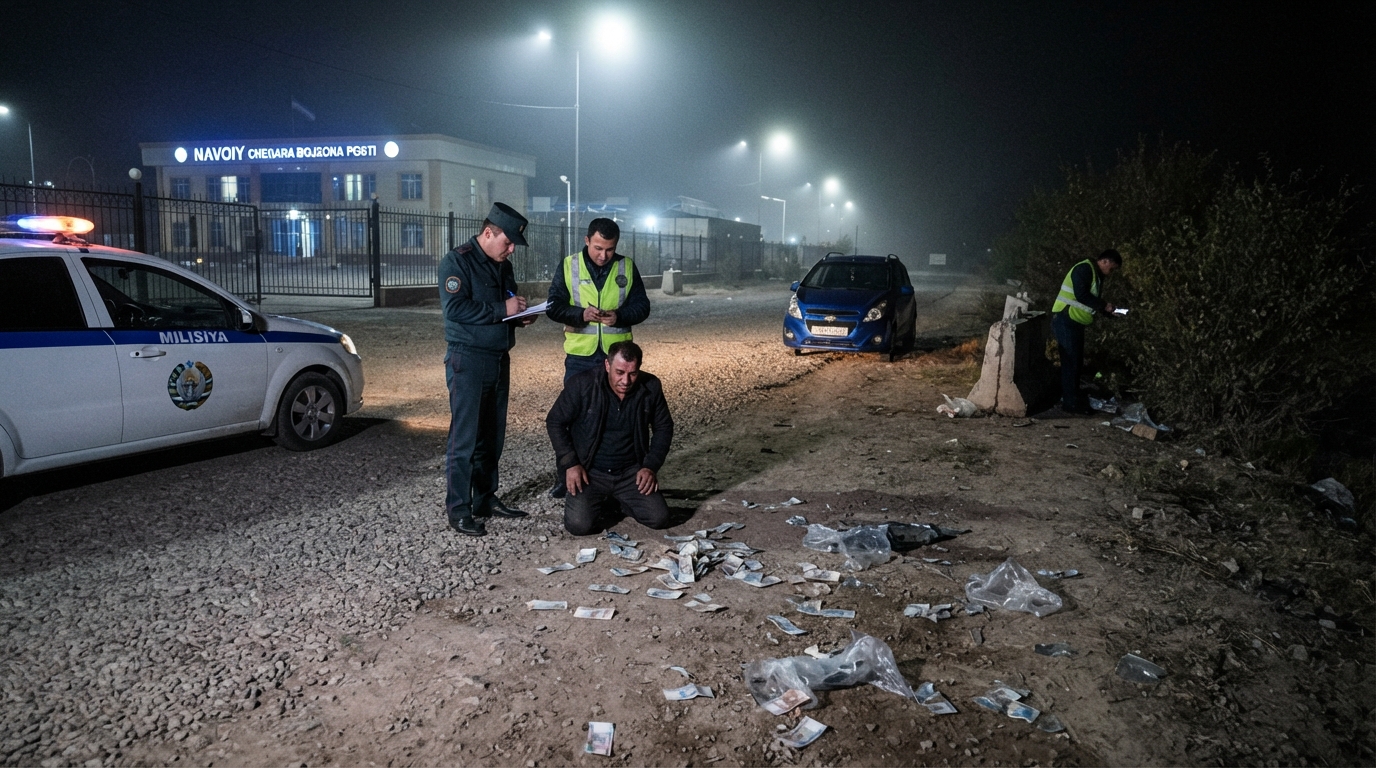
In Tashkent region, a court verdict has been handed down to a criminal group that beat up a citizen of Kazakhstan and took 300 million soums from him.
In the Tashkent district of Tashkent region, near the border customs post, a court verdict was read out against four individuals who beat up a citizen of Kazakhstan and snatched 300 million soums from him.
The incident took place on October 10, 2025, at around 23:30 near the "Navoiy" border customs post in Tashkent district.
It was revealed that the citizen of Kazakhstan, T.D., was engaged in carrying cash from Uzbekistan to Kazakhstan and delivering it to its owners. He had three or four partners in this business. Since one person can only carry up to 100 million soums across the border, the large sum was distributed among the partners.
On October 9, 2025, his acquaintance L.E. called him and asked for help in bringing money from Uzbekistan. Agreeing to the proposal, T.D. entered Uzbekistan through the "Qoplonbek" border customs post at around 19:00. He was met near the post by his partner and a person named U. in a Gentra car. While riding in the car, the man received 400 million soums packed in four plastic bags.
While T.D. was walking towards the border post carrying the bags, he noticed two people following him from behind. He tried to call his partners, but could not contact them because the Kazakh mobile network did not work on the territory of Uzbekistan.
"After walking about 200 meters, I reached a dark part of the road. Unexpectedly, someone hit me in the face repeatedly, and another person hit me from behind. Then the bags in my hands fell to the ground, and the money scattered," the victim testified.
The attackers took a total of 300 million soums from three bags and fled the scene. T.D. reached the border post with the remaining one bag and contacted law enforcement agencies.
The investigation revealed that the attack was not accidental. A.M., Sh.J., F.S., and N.S., who live in the same neighborhood, knew in advance about citizens carrying large amounts of money to Kazakhstan in front of the border post and planned to rob them by means of assault. According to the plan, A.M. and Sh.J. were supposed to keep watch, while F.S. and N.S. were to attack the citizens.
However, the incident was captured by surveillance cameras installed at the logistics center near the border post. The footage showed that after T.D. got out of the car, a Spark arrived and stopped behind him, one person got out of the car, and another man came out from behind a tree and lunged at him. The suspects were identified through the state license plate of the car.
During the search, 211.5 million soums were found on the roof of the toilet at Sh.J.'s residence.
"At first, I did not agree to his proposal. Later, because I was in financial difficulty, I agreed. I did not hit the victim, 'Nurik' hit him. I gathered the money scattered on the ground," F.S. said in court.
A.M., Sh.J., and N.S. did not plead guilty in court. Sh.J. stated that A.M. left 22 bundles of money with him to keep temporarily, saying it belonged to "my client." He stated that he did not know where the money came from.
"I took the money into the house and hid it on the roof of the toilet so that my family members would not misunderstand. I did not take a single soum from them," Sh.J. testified.
A.M. stated that F.S. brought the money to him and said it was "his own." N.S. also said that he did not attack the victim and claimed that he gave testimony under pressure during the investigation.
In court, the victim stated that the damage caused had been fully compensated and that he had no claims against the defendants.
According to the verdict of the Zangiota District Criminal Court, F.S., A.M., Sh.J., and N.S. were found guilty under Article 164, Part 4 (clause "a") of the Criminal Code. Applying Article 57 of the Criminal Code, each of them was sentenced to eight years of imprisonment.