

In Russia, businesses that fail to protect themselves from drones will be taken over by the state
Russian President Vladimir Putin has authorized the introduction of temporary state administration over the property of companies if the government finds that important facilities are not adequately protected from drone attacks.
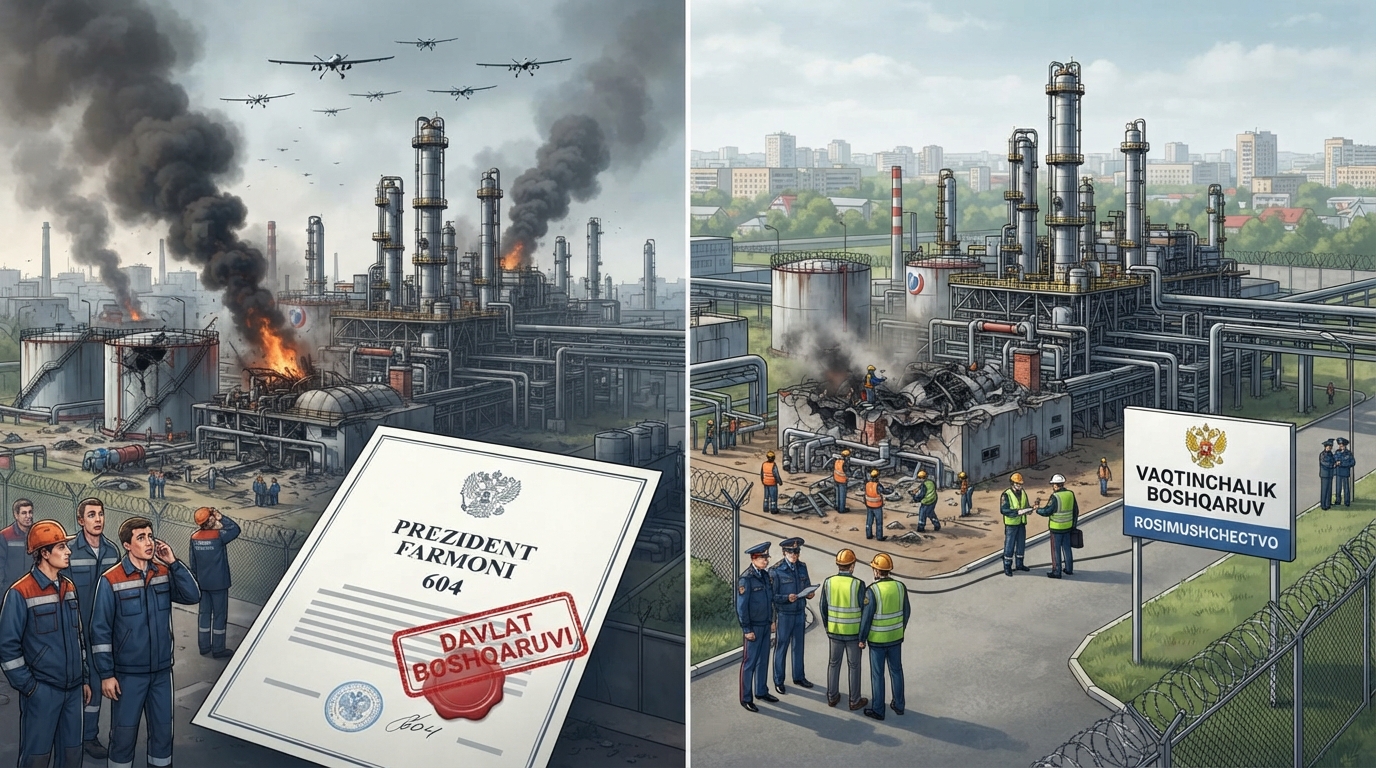
In Russia, enterprises that are not protected from drone attacks will be transferred to state administration. On August 24, President Putin signed Decree No. 604 "On measures to ensure the security of critical infrastructure facilities of the Russian Federation." The document entered into force after its publication on the official legal information portal.
The following may serve as grounds for the introduction of temporary administration: failure to take or untimely take security measures, violation of established requirements, threat to the normal operation of the facility or delay in its restoration after damage. The decree also specifically mentions "ineffectiveness of implementing measures" aimed at preventing drone attacks.
The government may transfer all or part of the company's movable and immovable property, securities and shares in Russian legal entities belonging to it, as well as property rights, to temporary administration. This decision is made by the government on the instructions of Putin.
The Rosimushchestvo is appointed as a temporary administrator, but the government can also appoint another organization. The administrator assumes all the powers of the owner, except for the right to dispose of the transferred property. The term of temporary administration is not limited by the decree; it can also be terminated by the government on the instructions of the president.
The decree includes "critical infrastructure facilities" in the list of "critical infrastructure facilities" including fuel and energy complex and industrial enterprises, communications, utilities, transport and logistics infrastructure, energy, including nuclear energy, and life support facilities. The list remains open: this mechanism can also be applied to other facilities that the government considers "of paramount importance" for Russia's security, economic stability, or the lives of the population.
The decree was adopted against the backdrop of a sharp increase in the number of attacks by Ukraine on Russian industrial and logistics infrastructure. Since the beginning of 2024, oil refineries (ORFs) have been a regular target of Ukrainian drones, and in 2025, the intensity of the strikes increased even more. In 2026, Ukraine significantly expanded the scale of the campaign: in the first half of the year alone, Ukrainian drones successfully attacked plants at least 194 times, which is 11 times more than in the same period in 2025. After the attacks, some ORFs reduced or completely stopped oil refining for a long time, and some plants were unable to resume normal operations for weeks.