

In Qashqadaryo, exports of chemical industry products increased fourfold
The prospects for the development of the chemical industry in the Qashqadaryo region were studied. The results of the analysis showed that there are growth in production volumes, expansion of export markets, and broad opportunities for producing high-value-added products based on local raw materials in the region.
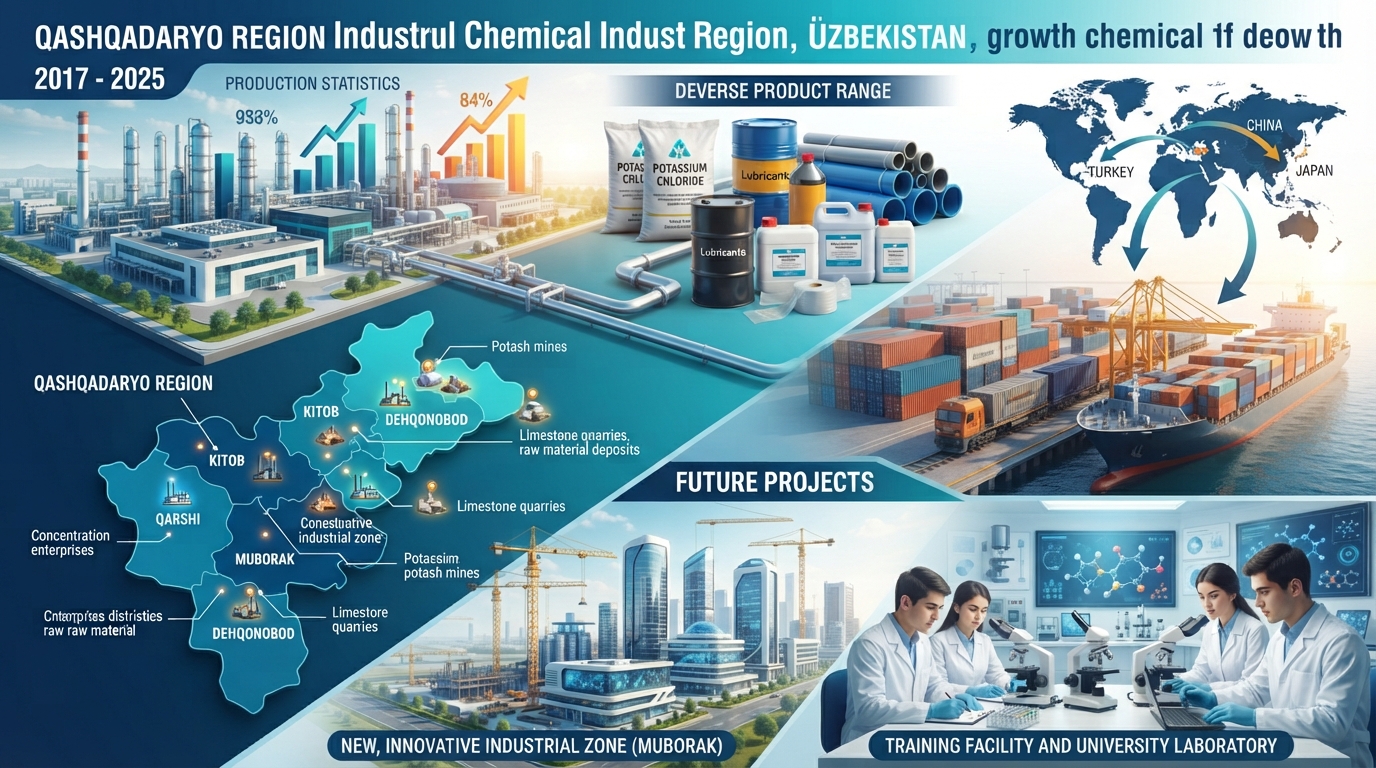
**Exports of chemical products in Kashkadarya increased by 4 times**
### Production and export performance
In 2025, chemical products worth 2.7 trillion UZS were produced by 150 enterprises in Kashkadarya region. This figure represents an increase of 193.6 percent compared to 2017. In particular, polyethylene products worth 1.8 trillion UZS were produced at the Shurtan Gas Chemical Complex.
In the structure of products, the production volume of potassium chloride amounted to 822 billion UZS, paint and varnish products — 28 billion UZS, lubricants — 25 billion UZS, detergents — 10 billion UZS, oxygen — 3 billion UZS, and alcohol — 1.5 billion UZS.
In terms of the number of chemical industry enterprises, the city of Karshi stands out with 35 enterprises, Kitob district with 25, Yakkabog district and the city of Shahrisabz with 13 each, Mubarak and Shahrisabz districts with 12 each, and Koson district with 10 enterprises.
By areas of production, 27 enterprises producing plastic plates, strips and pipes, 23 enterprises producing soap, detergents and cleaning preparations, and 19 enterprises producing paints, varnishes and mastics are operating.
6.4 thousand residents are employed in the sector. 56 percent of employment is accounted for by the Shurtan Gas Chemical Complex, and 32 percent by the Dehkanabad Potash Plant. Labor productivity per employee reached 422 million UZS, standing at 294.9 million UZS at the Dehkanabad Potash Plant and 1.06 billion UZS at the Shurtan Gas Chemical Complex.
In 2025, exports of the region's chemical industry products reached $46 million, increasing by 4 times compared to 2024.
The export structure includes petroleum products, mineral fertilizers, chemical salts, glue, paints and varnishes, detergents, cosmetics, and perfumery products.
The main export markets are China (69 percent), Japan (8.5 percent), Turkey (8.2 percent), Argentina (7.1 percent), and Latvia (5 percent).
By 2030, it is expected to increase export volumes to $100 million due to the production of new types of potassium compounds, liquid mineral fertilizers, household chemicals, and other products, as well as to expand opportunities for accessing Central Asian and European markets.
### Domestic market and production capabilities
In 2025, total demand for chemical products in Kashkadarya region amounted to 6.6 trillion UZS. Of this, the needs of agriculture and industrial enterprises equaled 5 trillion UZS, while population demand reached 1.6 trillion UZS.
68 percent of this demand is covered by local production.
According to forecasts, annual demand for chemical products in the region is expected to reach 9 trillion UZS in 2030 and exceed 12 trillion UZS by 2035.
The annual agricultural requirement for mineral fertilizers is estimated at around 216 thousand tons. Specifically, demand for nitrogen fertilizers stands at 152 thousand tons, phosphorus fertilizers — 51 thousand tons, and potash fertilizers — 13 thousand tons.
Annual demand for plant protection products is estimated at 270 tons, including 222 tons of herbicides, 26 tons of fungicides, and 22 tons of insecticides.
These indicators demonstrate market opportunities for expanding local production of chemical products and mastering new types of fertilizers and plant protection agents.
### Local raw material reserves
Kashkadarya region possesses a large mineral and raw material base for the development of the chemical industry.
194 non-metallic mineral deposits are registered in the territory, 163 of which have been developed. In particular, raw material for bricks is being mined in 42 deposits, gypsum in 3 deposits, bentonite clays in 3 deposits, pegmatite in 2 deposits, cement raw materials in 4 deposits, raw materials for porcelain items in 1 deposit, glass raw materials in 7 deposits, and building stones along with other non-metallic materials in 101 deposits.
The main reserves important for the chemical industry are located in Dehkanabad district. Reserves of 49.5 million tons of potassium salts, 1.3 billion tons of mineral salts, 200 thousand tons of bromine, and 9 million tons of bentonite clays are present in this area.
These resources allow for the development of the production of potash fertilizers, potassium hydroxide, potassium chloride, chlor-alkali products, industrial salt, bromine reagents, and drilling materials.
According to estimates, by industrially processing 1 million tons of salt per year, it is possible to establish a production chain encompassing 570 thousand tons of caustic soda, 500 thousand tons of chlorine, and over 1 million tons of PVC products.
Additionally, reserves of 23.5 million tons of dolomite exist in Kamashi district, 2 million tons of quartz sand in Yakkabog district, as well as 39.5 million tons of limestone and 2.5 million cubic meters of marble and marble limestone in Kitob district.
These raw materials can serve as a foundation for expanding the glass industry, silicate chemistry, construction chemistry, and the production of mineral fillers.
### Investment projects and new jobs
To develop the chemical industry in Kashkadarya region, 28 investment projects worth a total of $2 billion 762 million were formed.
Of these, 5 are sectoral projects worth $2 billion 128 million, and 23 are regional projects worth $634 million.
As a result of implementing these projects, it is planned to launch the production of more than 20 new types of chemical products.
According to expected results, there are opportunities to annually produce an additional 2.5 trillion UZS worth of high value-added products, ensure export volumes exceeding $100 million, and create 1,600 new jobs.
In particular, within the framework of establishing the Mubarak Innovative Industrial Zone in Mubarak district, 10 investment projects were developed, including 7 medium and 3 large projects.
Among the large projects are projects for the production of fiberglass and composite materials worth $110 million, PET fibers and yarns worth $100 million, as well as full-cycle non-woven materials worth $40 million.
Within the scope of medium projects, the production of SNF superplasticizer, epoxy paint and varnish materials, reactive dyes, BOPET film, PVC-based cable compound and medical tubing, CPVC sheets, PVC sealants, and heat-shrinkable films is envisaged.
The region's energy base also creates opportunities for implementing new industrial projects. In 2024, the installed capacity of power plants was 2,295 MW, with plans to bring it to 4,225 MW by 2028.
### Industrial infrastructure and staff training
As part of the analysis, proposals for developing industrial infrastructure and creating ready-made production sites for investors were also developed.
In particular, it is proposed to establish the "Bunyodkor" technopark on a 40-hectare area of a former oil plant in Koson district.
The technopark envisages leasing ready-made production buildings to entrepreneurs and investors on preferential terms based on the Ready-Build mechanism. The proposed rental rate is set not to exceed the equivalent of $2 per 1 square meter per month.
Furthermore, it is proposed to establish the Mubarak Innovative Industrial Zone on a 200-hectare area in Mubarak district, locate high-tech chemical and gas-chemical projects, and attract foreign direct investment.
Special attention is also paid to training qualified personnel for industrial development.
Today, 179 specialists with higher and professional education, as well as 300 specialists with specialized secondary education, are trained annually in chemical and chemical technology directions at Karshi State Technical University. 32 researchers and associate professors are working in the field.
To implement the new investment projects, an additional need exists for 300 engineer-technologists and 180 specialized chemist personnel.
In this regard, it has been proposed to expand cooperation between higher education institutions, scientific organizations, and industrial enterprises, and to increase capabilities for scientific-technological expertise and laboratory research.
### Development prospects
The study results show that opportunities exist in Kashkadarya region to develop the chemical industry through deep processing of local raw materials, mastering new types of products, and establishing high value-added manufacturing.
The developed proposals are aimed at supplying industrial enterprises with local raw materials, improving production infrastructure, developing transport and logistics links, attracting investments, and expanding export markets.
The implementation of 28 investment projects will open up additional opportunities for diversifying the types of chemical industry products in the region, increasing export potential, and creating new jobs.