

"In production — it's necessary, I don't see any point in monitoring the subsequent process." Zafar Hoshimov — about digital marking
Zafar Hoshimov called it illogical to impose a fine for not having a label on a water bottle. He noted that the potential risk becomes a cost for any business and is borne by the consumer. "I don't see any point in monitoring the production process," he said.
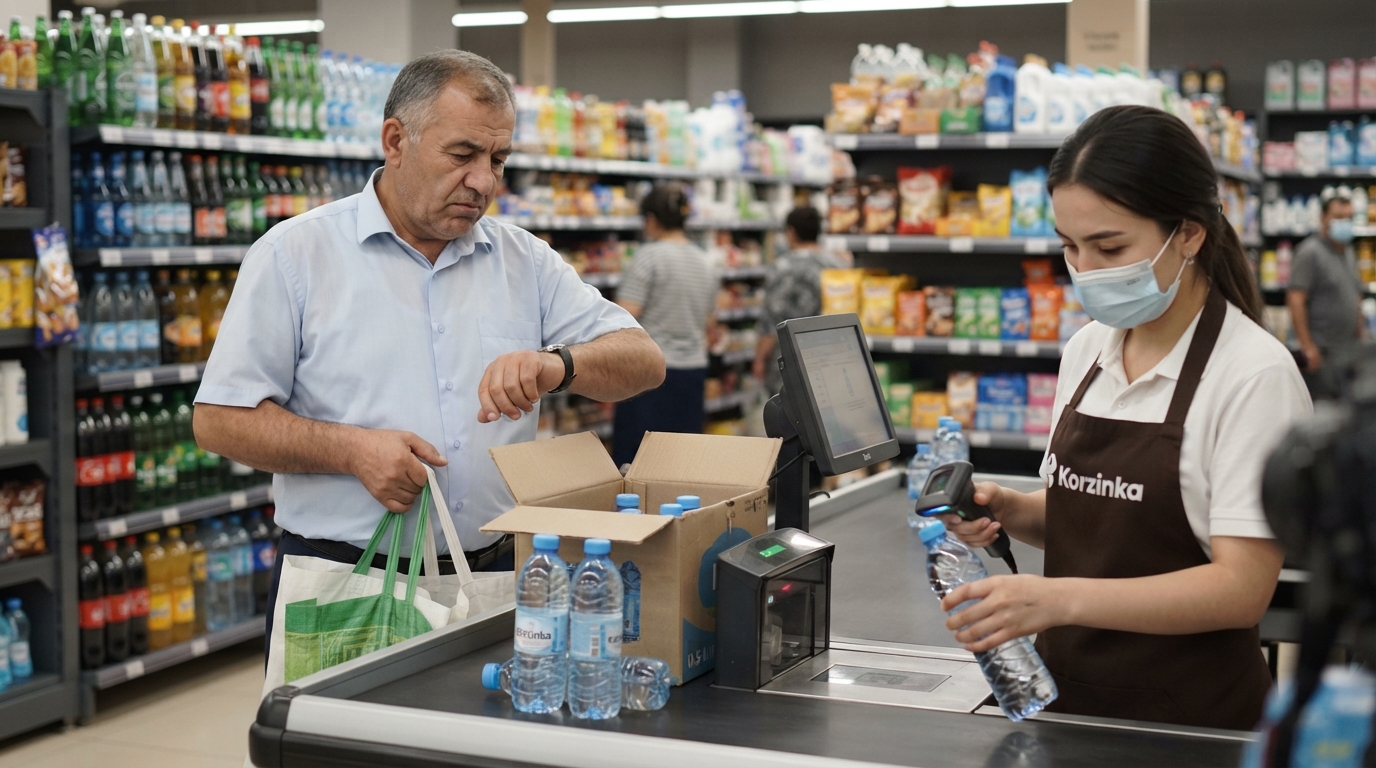
“It is necessary in production, I do not see any point in monitoring the subsequent process.” Zafar Hoshimov on digital labeling
Zafar Hoshimov, founder of the Korzinka supermarket chain, answering a question on the mandatory digital labeling system on the “Lolazor” podcast, noted that labeling is necessary in the production process, but monitoring the subsequent stages of the chain is useless.
Financier Otabek Bakirov raised the issue of a mandatory digital labeling system for water and soft drinks and asked Zafar Hoshimov, as the chairman of the “Trade and Service” association and an entrepreneur, about his attitude to this system, the transaction costs, advantages and efficiency of the system.
Zafar Hoshimov did not deny that the labeling system serves to combat the underground economy, since it is impossible to sell a marked product without taking into account At the same time, he noted that everything has its own price, raising the question of whether the transaction costs of the system are justified.
“I believe that [for example] in pharmaceuticals it should definitely be there. Because there is counterfeiting in this industry, so there should be monitoring from beginning to end. I also know that it should be there in alcohol and tobacco. Because its tax base is large, that is, the taxes collected justify the costs of labeling. But, for example, in a 1,500-sum water bottle, this should be there... even if it is done, it should be put into production. I see absolutely no point in [monitoring the process] after that,” he said.
In this regard, the entrepreneur gave an example of a real situation with labeling observed in Korzinka’s activities. He recounts how an acquaintance went into one of the Korzinka stores to urgently buy a large amount of water (several blocks) for a funeral, but left without buying anything.
The acquaintance said that when the water was being passed through the cash register, the cashier had to open the block and scan each product separately. The customer waited for about 20 minutes. Then, realizing that waiting for each block to be passed through the cash register separately would be a waste of time, he left the store. After that, he said that he had the necessary amount of water loaded directly into the trunk of his car from another roadside store.
Otabek Bakirov noted that the system was “punishing those who work legally” by stealing time. The businessman confirmed his opinion, saying that the flow of customers, on the contrary, was going towards those who work illegally. He added that the volume of deliveries of soft drinks from the Korzinka supermarket chain to cafes, restaurants and other establishments via BTB (business to business) has fallen sharply.
“This year, that segment has fallen by 80-90 percent. Why do we say that HORECA — [hotels], restaurants, cafes are charging less than us, and our prices are cheaper, but everything has gone to cash,” he said.
Explaining why they switched to cash sales, Zafar Hoshimov gave an example of a situation he encountered. He said that he recently entered a coffee shop and asked for water. While he was sitting at the table drinking coffee, the waiter brought the water and asked him whether he wanted to buy it. When the entrepreneur said he would buy it, the customer scanned the water bottle in front of him.
“This is how legal businesses work. I say that you should always approach it logically, from an economic [efficiency] perspective,” he said. The entrepreneur noted that the costs of achieving a certain goal should ultimately justify themselves.
At this point, lawyer and blogger Khushnud Khudoiberdiev joined the discussion, noting that while the goal of labeling is to combat the underground economy and include shadow businesses in the ranks of legal businesses, the system actually serves the opposite purpose.
“The burden of this reform, of the system, is falling on us, that is, in the end it still falls on the consumer,” he said.
Zafar Hoshimov expressed his disagreement with the opinion that the labeling system does not serve to combat the underground economy.
“I think that after the introduction of the labeling system, some part of the business still switched to legal work. That is, it did not benefit, let's say, it reduced the underground economy. [But] how much did it cost? .. For example, there is a real risk to society, to consumers from [counterfeit] drugs, alcohol, Coca-Cola. But what is the risk from this water?”, — he said.
Zafar Hoshimov called it illogical, saying that the lack of labeling on a bottle of water, which costs 1,200 soums, would lead to a fine. So far, no one may have been punished for this reason, but, he noted, the potential risk becomes the price for any business.
“The consumer pays for the risk that the entrepreneur takes,” — he said.
At this point, Otabek Bakirov, as a consumer, shared his personal observations on how the price of water in supermarkets has changed after the introduction of mandatory labeling.
“As a consumer, I can say that before labeling, the price of water in supermarkets in Uzbekistan was 2.5-3 times cheaper than in the European Union. Now, [if] it is cheap, it is 15-20 percent cheaper. Especially small-liter water - 0.25 l, 0.33 l - up to 0.5 liters - has almost reached the level of the European Union,” he said.
The expert added that if relevant data is available, if you compare prices before and after labeling, you can see that the price of water up to 0.5 liters has increased sharply, and this increase in price is borne by the consumer.
In this regard, Otabek Bakirov reminded Zafar Hoshimov that he is a member of the Public Council for Entrepreneurship Support under the President and asked whether the council had considered the issue of such regulation leading to an increase in transaction costs.
“Because there is also the issue of introducing other new products, such as labeling… They want to add it to cement, vegetable oil, etc. What consequences will this lead to? We made one mistake, but we need to talk about the cost of subsequent mistakes,” he said.
Zafar Hoshimov called the activities of this public council useful for business activities. According to him, the public council is heard, and the draft laws returned by the council are reviewed and amendments are made. However, according to certain rules, there are also a small number of legislative documents that are approved without being discussed by the council, and according to the businessman, it is these that cause the most harm to business.
At the same time, Otabek Bakirov noted that no one can assess the impact of regulation better than entrepreneurs. At the same time, Zafar Hoshimov emphasized that the point of view of entrepreneurs in this regard may not be based on an impartial approach. In his opinion, if a norm that the state considers necessary works to the detriment of an entrepreneur, entrepreneurs may react negatively to this. In this sense, he said that the country lacks research centers (think tanks).
“What we really lack in our economy in general are good think tanks. There are scientists, economists, other [experts]. Think tanks calculate the economic benefits and harms of each regulatory document or law and conduct an examination. Because, for example, if it is possible for us entrepreneurs not to be affected, but changes should still be made. What is the role of the state? In leveling the rules of the game. For example, this [marking] is also a sign of leveling the rules of the game,” he said.
The entrepreneur gave an example of shadow businesses operating in workshops organized in apartments without paying taxes and without adhering to sanitary standards.
“They don’t pay any taxes, there are no sanitary standards. There should be some order here too. That’s why I’m saying, let it be introduced in production, but it shouldn’t affect the subsequent process,” he said.
The introduction of a system of digital labeling and tracking of products in Uzbekistan (first tobacco and alcohol products, and later medicines and household appliances) has been underway since 2019. The sole operator of the system is CRPT Turon, established by the Russian Center for the Development of Promising Technologies. It operates a platform similar to the “Chestnyy znak” system in Russia.
The introduction of the water and beverage labeling system has been postponed several times: first from October 2022 to July 1, 2023, and then to March 1, 2024. In the summer of 2021, water and beverage producers proposed to stop the pilot project on labeling, which, in their opinion, was economically unprofitable. CRPT Turon, however, called these concerns a “myth.”
At the end of March 2026, before the introduction of the aggregation stage, the UzBev Association of Beverage and Juice Producers warned of serious risks and stated that the model being introduced was unrealistic and the algorithms had not been fully developed. In its response, CRPT Turon called for “not to speculate” on the inconveniences and called for joint support for the principles of ensuring economic transparency and protecting consumer rights.
Later, this issue was raised at a meeting between market participants and Deputy Prime Minister Jamshid Khodjayev. He instructed the Tax Committee to study the issue and prepare it for submission to the country's leadership. Entrepreneurs were promised that fines would not be applied for violation of the rules.
In early May, it became known that President Shavkat Mirziyoyev supported the postponement of the aggregation stage in the digital labeling system for water and soft drinks and the reduction of fines in this area.