

In Namangan region, a man who fought in Ukraine has been sentenced
In the Namangan region, a 25-year-old citizen of Uzbekistan was sentenced to two years in prison for participating in the war in Ukraine on the side of Russia.
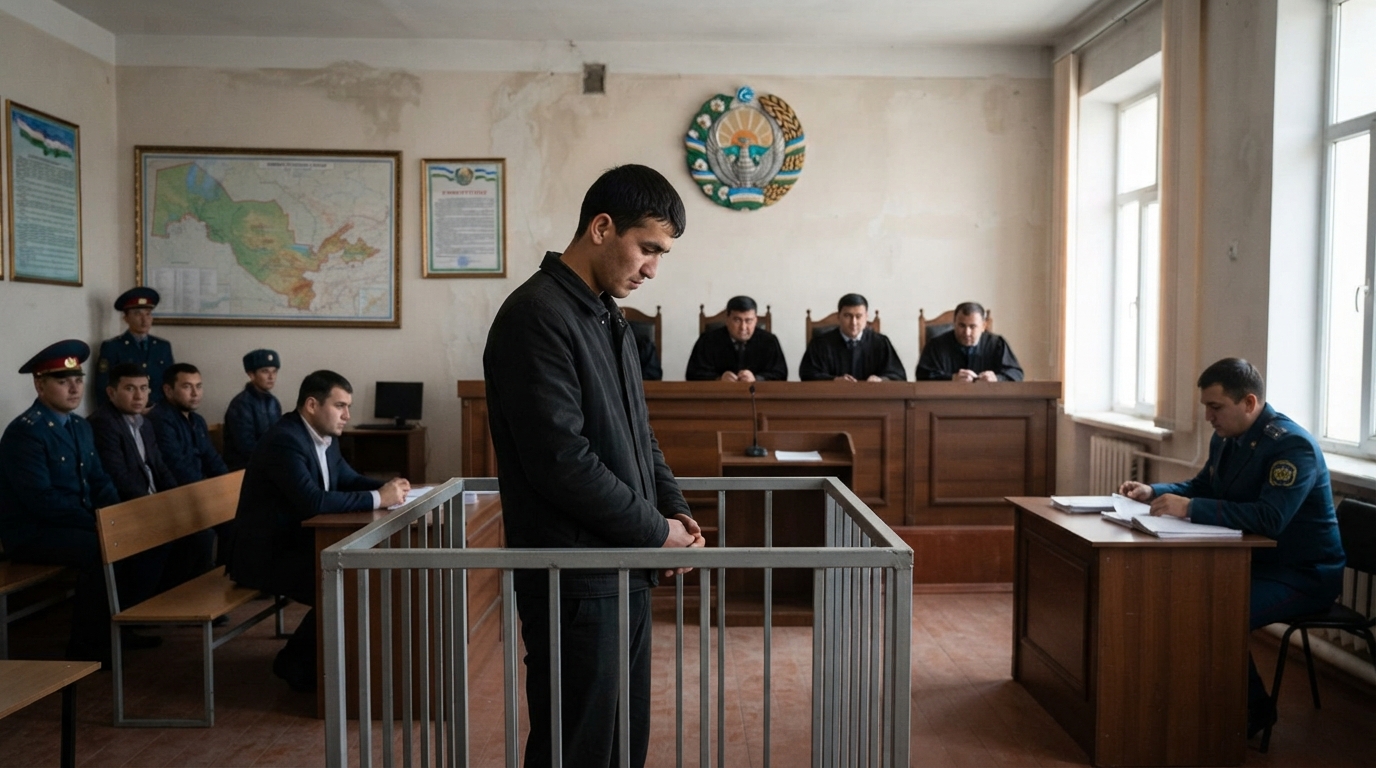
In the Namangan region, a verdict was handed down to an Uzbek citizen who fought in Ukraine
On August 12, the Pap District Criminal Court of the Namangan region sentenced 25-year-old Uzbek citizen F.A. to two years in prison for participating in hostilities in Ukraine on the side of Russia.
The court found him guilty under Part 1 of Article 154 of the Criminal Code of Uzbekistan, which provides for liability for mercenary activity. The man will serve his sentence in a general regime penal colony.
According to the case files, in November 2021, F.A. left Uzbekistan for Russia to work. In October 2023, a court in Penza sentenced him to 8 years and 6 months in prison for illegal drug possession.
While serving his sentence, he was offered to sign a contract with the Russian Ministry of Defense and participate in the hostilities in Ukraine. F.A. agreed and signed a contract at the end of July 2025.
He was assigned as a grenade launcher operator to a military unit in Kaliningrad. After training, the serviceman was sent to the Malinovka area of the Kharkiv region of Ukraine.
According to the case files, on September 2, 2025, F.A., along with seven other servicemen, left for the combat zone.
En route, the vehicle they were in was attacked by a drone. As a result, the man sustained wounds to the left side of his abdomen and his right thigh.
F.A. told the court that he lost consciousness after the explosion. He woke up in a hospital in Rostov-on-Don. During surgery, a shrapnel piece was removed from his abdomen, but the shrapnel in his thigh area was left untouched.
For his participation in the hostilities, according to the case files, 400,000 rubles were transferred to his bank card.
After treatment, F.A. remained in the hospital until the end of September 2025, and was then transferred to a military unit in Kaliningrad. He stayed there until February 2026. Since the serviceman was declared unfit for service, he was no longer sent to the combat zone.
In court, F.A. stated that he initially did not want to participate in the war. According to him, Russian military personnel offered prisoners in the colony to go to the combat zone, promising monetary payments and Russian citizenship.
F.A. claimed that prisoners who refused to participate in the war, including citizens of Uzbek, Tajik, and Kyrgyz ethnicities, faced pressure from colony staff. According to him, some of them were tortured and placed in solitary confinement.
Also, as the defendant said, colony staff told the prisoners that they could remain in prison for life and would receive no help. F.A. stated that he could not withstand the pressure and eventually agreed to sign the contract.
At the same time, he noted that the actual payment turned out to be less than promised. According to him, the terms of the contract stipulated a one-time payment of 1.9 million rubles and a monthly allowance of 210,000 rubles. After being delivered to his place of service, he was issued a military uniform, a Kalashnikov assault rifle, and a bank card, to which 400,000 rubles were deposited.
From September 2025, the man underwent military training, including instruction in handling combat weapons and defending against drone attacks. He served as a grenade launcher operator in the marines.
In September 2025, F.A. received Russian citizenship.
In February 2026, a sergeant whom F.A. met during his service informed him that he might be sent back to the combat zone.
On February 8, the man left the military unit in Kaliningrad and went to the airport. Using his Russian passport, he bought a ticket to Moscow, after which he contacted the Embassy of Uzbekistan.
At the diplomatic mission, F.A. wrote an application regarding the loss of his passport. On February 16, he was issued a "Repatriation Certificate." After that, according to him, he tore up his Russian passport and threw it away.
On February 17, F.A. flew from Moscow's Vnukovo Airport to Tashkent.
At the court hearing, the man fully admitted his guilt and repented. He also stated that participating in the hostilities was a forced step for him, and asked the court to take this into account when sentencing.
The court considered the admission of guilt, repentance, and the defendant's family situation as mitigating circumstances. No aggravating circumstances were established.
As a result, F.A. was sentenced to two years of imprisonment to be served in a general regime penal colony.