

In Gaza, students returned to offline education after three years
In Gaza, Students Returned to Offline Education After Three Years
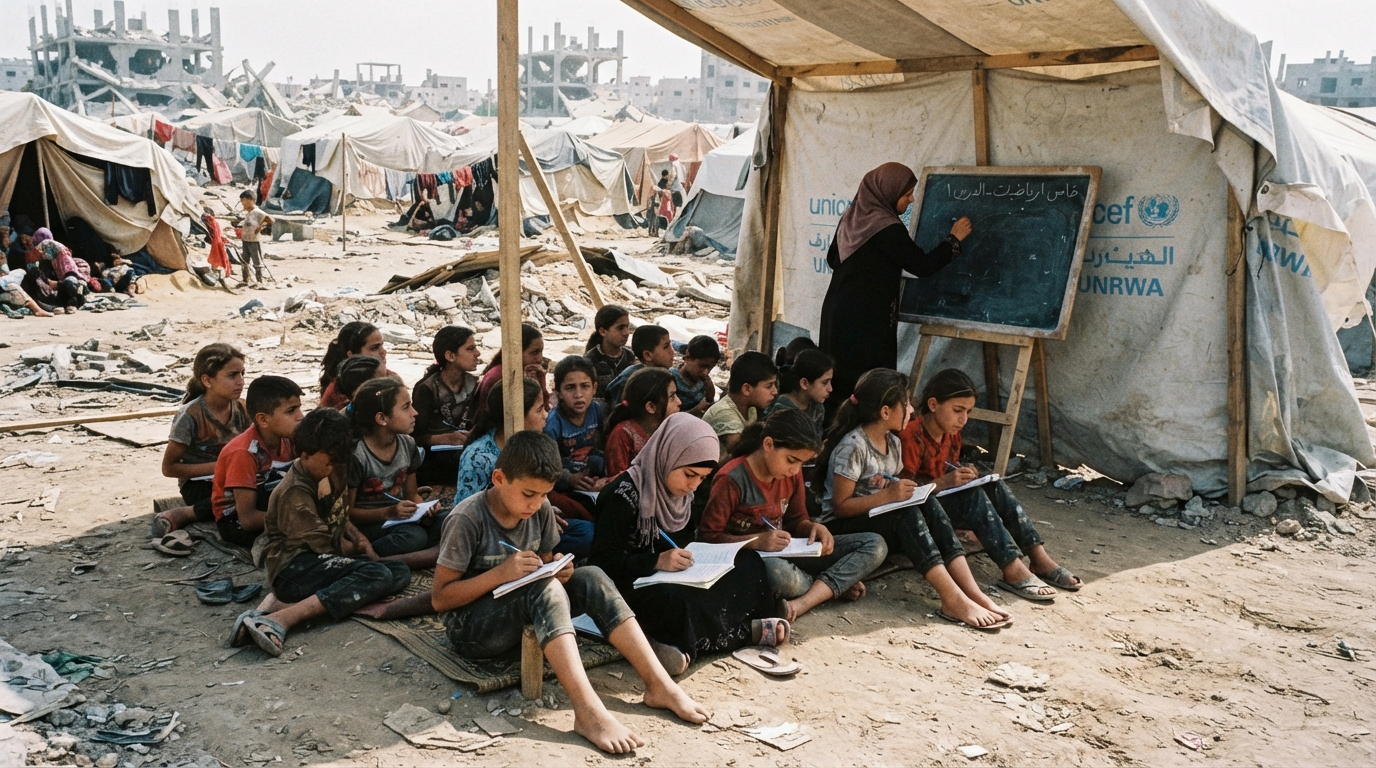
In the Gaza Strip, hundreds of thousands of children returned to school for traditional education on September 19 for the first time after a three-year break. However, classes are being conducted in damaged buildings and temporarily restored tents. Many families are also struggling to buy clothes, notebooks, and pens.
According to the United Nations Children's Fund (UNICEF), 98 percent of schools in Gaza were destroyed or damaged during the war. Gaza Strip education officials stated that about 660,000 students were deprived of school education. Also, about 22,000 students and more than 770 education workers, including 532 teachers, were killed in this war.
Ibrahim Ramadan, the education director of Eastern Khan Younis, said that the reopening of schools is an important post-war event.
"The last time I went to school was three years ago. Now we are starting the new school year. This will be a year of joy, happiness, and success," said school student Moayed Abu Mustafa.
Mustafa lost his friends in the war. He also has no shoes, notebook, or pen. Despite this, he is ready to study, even if it means sitting on the ground in a tent.
"Despite all this, we will study; even if it is in a tent, we will continue to gain knowledge," he said.
Samar Abu Salmi, a 15-year-old student living in a tent with her family, also returned to classes.
"We studied through phones and did not see our teachers. Now, even though we are moving from one tent to another, we continue to strive towards our dreams," she said.
She also lacks many necessary school supplies because her family cannot afford to buy them.
"Before the war, we had everything: notebooks, pens, clothes. We bought everything at a cheap price," Salmi said.
Despite the destruction in Gaza, the Ministry of Education started the 2026/27 academic year with the support of international and local organizations. Dozens of temporary schools made of tents, tarpaulin, tin, and wood were established to accommodate students. Some schools are built on sandy ground, while in others, classrooms consist of only a few mattresses and a blackboard.
Yamen Abu Samra, a 14-year-old going to another school, shared his experiences.
"Previously, we used to wake up happy to go to school. Now, when we come to school, we are afraid of bullets, rockets, and strikes. Now I am sitting in a hot tent with absolutely nothing," he added.
Education officials announced that with the support of UNICEF, at least 540,000 students are expected to attend offline classes in temporary private schools, learning centers, and educational points in 2026. Online education will continue for those who cannot attend classes or who left Gaza during the war.
Despite the ceasefire that halted major hostilities in 2025 but failed to completely end the conflict, Israeli forces still control more than 60 percent of Gaza's territory. As a result of the war that began between the Hamas group and Israel in October 2023, 73,914 Palestinians have been killed and 174,952 others have been injured to date.