

In China, the first drug created using artificial intelligence has been approved for production
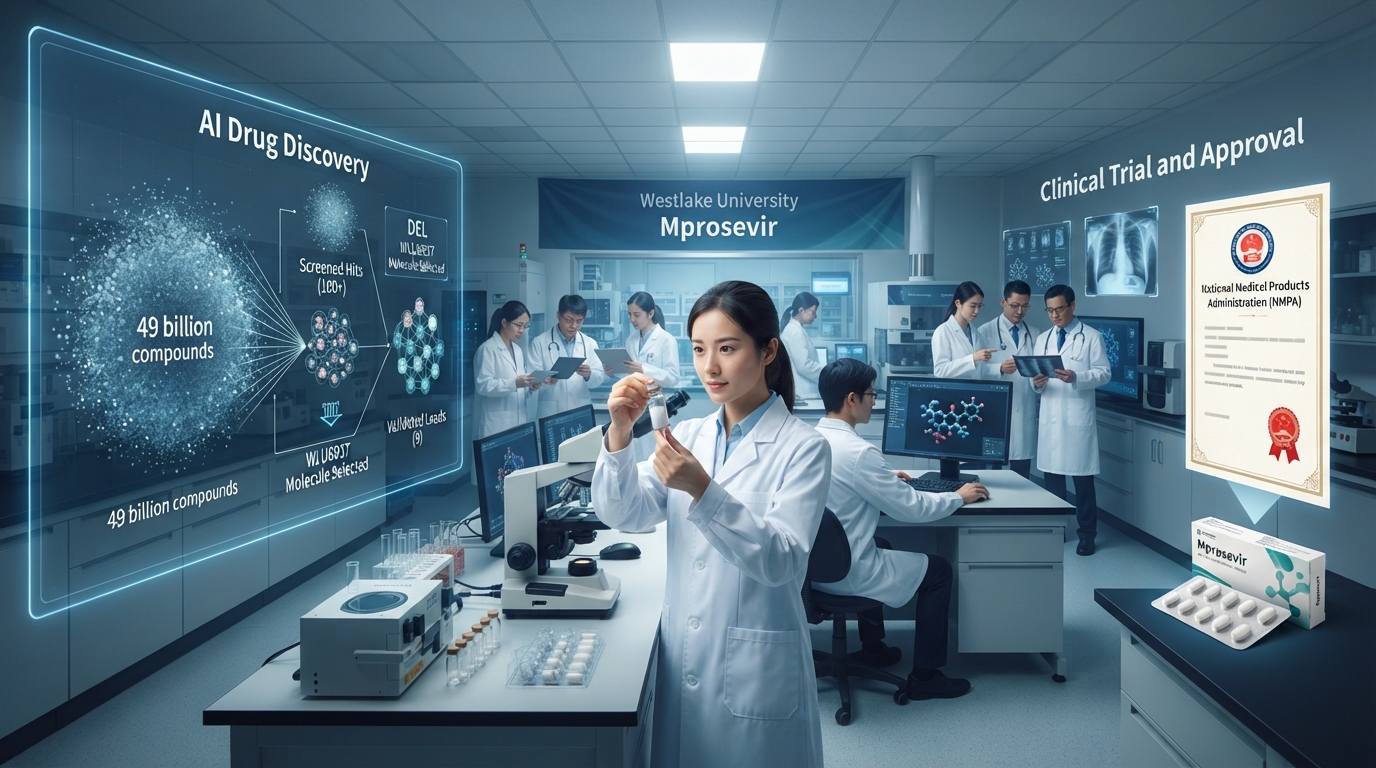
The first innovative drug created with the help of artificial intelligence has received approval for production in China. The new drug took only three and a half years from the identification of the substance to being tested on humans. This was reported by the Global Times, citing Westlake University.
The drug, named Mprosevir, was jointly developed by Westlake University, Westlake Laboratory, and Westlake Pharmaceuticals. The administration granted conditional marketing approval for the drug to treat mild to moderate COVID-19 infections in adults.
According to the Xinhua News Agency, this drug is a new medication that has not been previously marketed either in China or abroad. It is an entirely new development with a completely new chemical structure, a new mechanism of action, and clear clinical value.
This drug became the world's first small-molecule innovative drug successfully approved based on "DNA-encoded library technology" (DEL). According to Tide News, this is a historic result achieved 34 years after the concept of DEL technology was first proposed.
At the very beginning of the work, scientists combined the use of artificial intelligence and DEL technology. Artificial intelligence filtered out incorrect compounds and selected substances with a high probability of becoming a drug. A massive database of 49 billion compounds was used to find Mprosevir. Initially, more than 100 suitable substances were isolated from this database.
Typically, testing more than 100 substances individually requires a significant amount of time and resources. However, artificial intelligence narrowed this list down to 9 in just a few days. As a result of the activity testing of these nine molecules, six of them were found to exhibit high activity. This demonstrated a very high level of predictive accuracy.
After toxicity, metabolism, and other tests, the scientists ultimately selected the WLU6937 molecule as the most optimal substance. The research team stated that Mprosevir has proven that drug discovery using artificial intelligence is currently a highly efficient and feasible process.
Over the next two years, the team carried out full optimization work on this molecule. Its activity was increased, drug properties were improved, and toxicity was reduced. Additionally, stages ranging from in vitro and mouse experiments to clinical trials were completed. Artificial intelligence played an important role in this stage as well.
Artificial intelligence indicated the possibility of a stroke and recommended taking the child to a doctor. The mother took the child to the hospital. However, after the examination, the doctors sent him home.