

In China, a highway is being built with almost its entire route passing through bridges and tunnels.
Track laying on the Chongqing-Kunming high-speed railway in China has been completed. Trains are expected to run at a speed of 350 kilometers per hour on the nearly 700-kilometer main line. Bridges and tunnels account for 87.4 percent of the route.
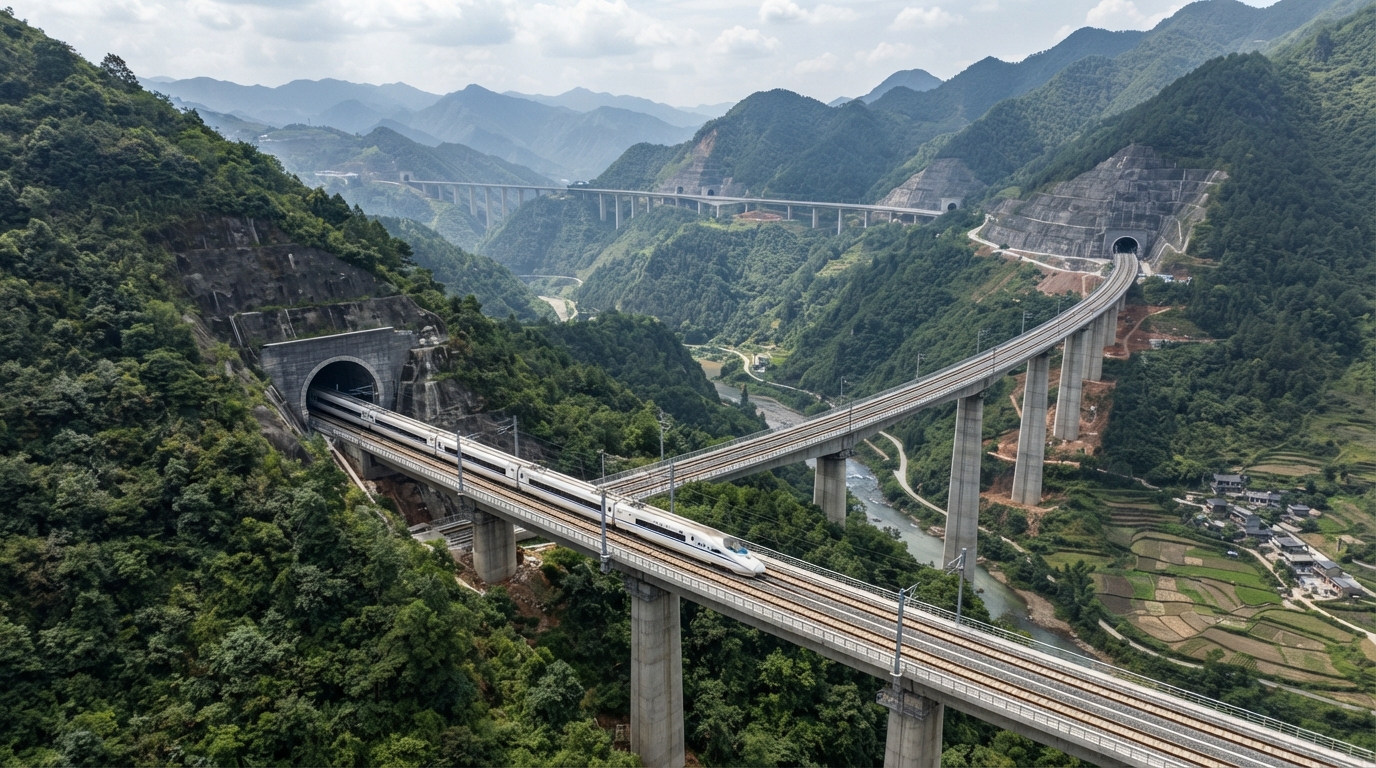
A highway that consists almost entirely of bridges and tunnels is being constructed in China.
According to CGTN, the last pair of 500-meter steel rails was laid in the Junlian Tunnel on the border of Sichuan and Yunnan provinces.
These works marked an important stage in preparing the line for commissioning. According to the forecasts of railway authorities, the full launch of the highway is scheduled for the first half of 2027.
The line will connect Chongqingxi station in Chongqing with Kunmingnan station in Kunming. The route passes through the territory of Chongqing city, and Sichuan, Guizhou, and Yunnan provinces.
The highway crosses the Wumeng Mountains, which have complex geological conditions. For this reason, a large part of the road consists of bridges and tunnels, the construction of which required solving serious engineering tasks.
Once the line is fully commissioned, the travel time between Chongqing and Kunming is expected to be reduced to approximately 2.5 hours.
The Chongqing–Kunming highway is an important part of the Beijing–Kunming railway corridor. It is part of China's national high-speed railway network, which covers eight north–south and eight east–west routes.
The new line is expected to strengthen connections between the Chengdu–Chongqing economic cluster and the cities in the central part of Yunnan, as well as contribute to the development of trade and tourism.