

In Bukhara, a tutor who wrote a "love letter" to a female student was jailed and dismissed from his job
Fearing the incoming text and voice messages from her teacher, the female student, dissatisfied with his actions,
In Bukhara, a tutor who wrote a "love letter" to a female student was jailed and dismissed from his job
The news spread on social networks under the headline "In Bukhara, a tutor who harassed a female student was jailed" has become an unpleasant situation for the noble city, which has historically been a place of science and enlightenment. Therefore, we immediately contacted Feruz Sharopov, the head of the information service of the Bukhara Regional Court.
As we review the decision of the Bukhara City Court on Criminal Cases provided to us, we see in this document that a teacher in a potential stronghold of science has lost the value of his position, status, and the trust placed in him.
It is worth saying that no position, acquaintance, or status gives a person the right to humiliate the honor and dignity of another individual. Especially, the responsibility of every employee working in the field of education is very high. A student not only gains knowledge in a subject from a teacher, but also takes an example from their behavior, culture, manners, and attitude towards others. However, trust between a teacher and a student is a very delicate concept, and if it is broken, it is not easy to restore.
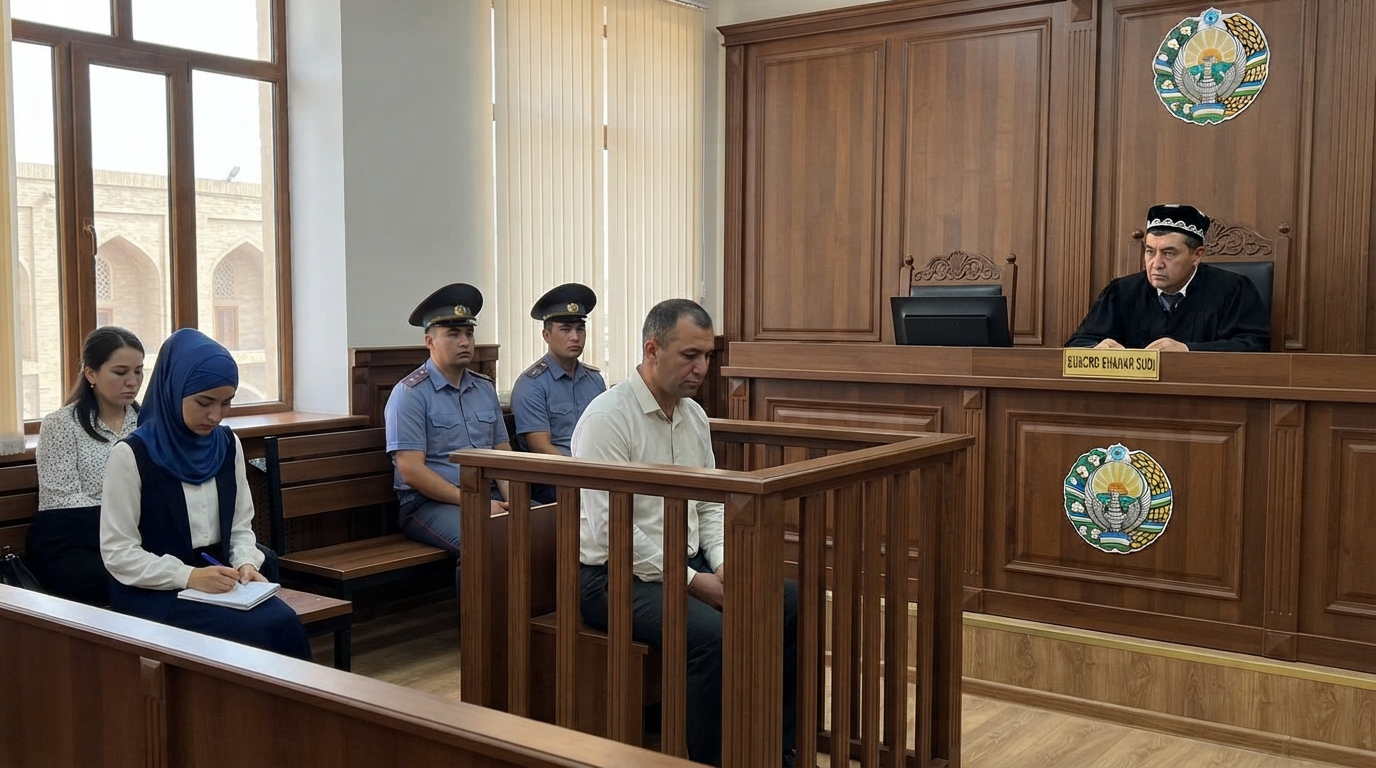
The administrative case reviewed in the Bukhara City Court under the chairmanship of Judge Farrux Qahhorov also became a clear example of this.
According to the court decision, A.A., originally from the Jondor district, who had been working as a tutor at the Asia International University, called university student G.Sh. by phone in the evening. During the conversation, he proposed a romantic relationship and sexual intimacy to her.
He also said words to his student that were inappropriate and insulted her honor and dignity. The most painful aspect is that this was not a simple conversation between two ordinary people; there was a teacher-student relationship between them.
Frightened by the SMS and voice messages coming from her teacher, the student, dissatisfied with his actions, repeatedly stated that she would contact law enforcement agencies about this. Despite this, A.A. did not stop writing "love letters" and making continuous calls to the student.
A.A. admitted his deed in court. He stated that he was in a state of intoxication because he had consumed alcohol that day, regretted the words he said, apologized to the victims, and stated that such a situation would not happen again. The excuses presented in the court documents, such as "I just called," "I just talked," and "I was drunk," cannot undo the discomfort caused to his student's heart.
"A state of intoxication does not release the offender from liability for his actions; on the contrary, the court evaluates this situation as an aggravating circumstance of the offense," the judge says.
In making the decision, Judge Farrux Qahhorov took into account not only the commission of the offense, but also the need to prevent it. He evaluated A.A.'s admission of guilt as a mitigating circumstance, and the commission of the offense while intoxicated as an aggravating circumstance.
As a result, the offender was found guilty of committing the offense provided for in Part 1 of Article 41-1 of the Administrative Responsibility Code of the Republic of Uzbekistan, and a punishment of three days of administrative arrest was imposed on him.
This event recalls another truth: a person's reputation is built over years, but a single wrong decision is enough to lose it. For this reason, any position holder, especially a specialist working with youth, must approach their actions with double responsibility.
According to the rector of the Asia International University to "Xabar.uz", A.A., who could not control his behavior, was immediately dismissed from his job. "Such individuals can never remain at work," the rector said.