

If the current pace does not change, it will take 171 years to achieve gender equality — UN
A political backlash against gender equality has begun in the world. If the current pace does not change, it will take another 171 years to achieve full equality, according to a UN report. Over the past two years, the authority of one in three institutions in this field has been reduced, while key leadership remains in the hands of men.
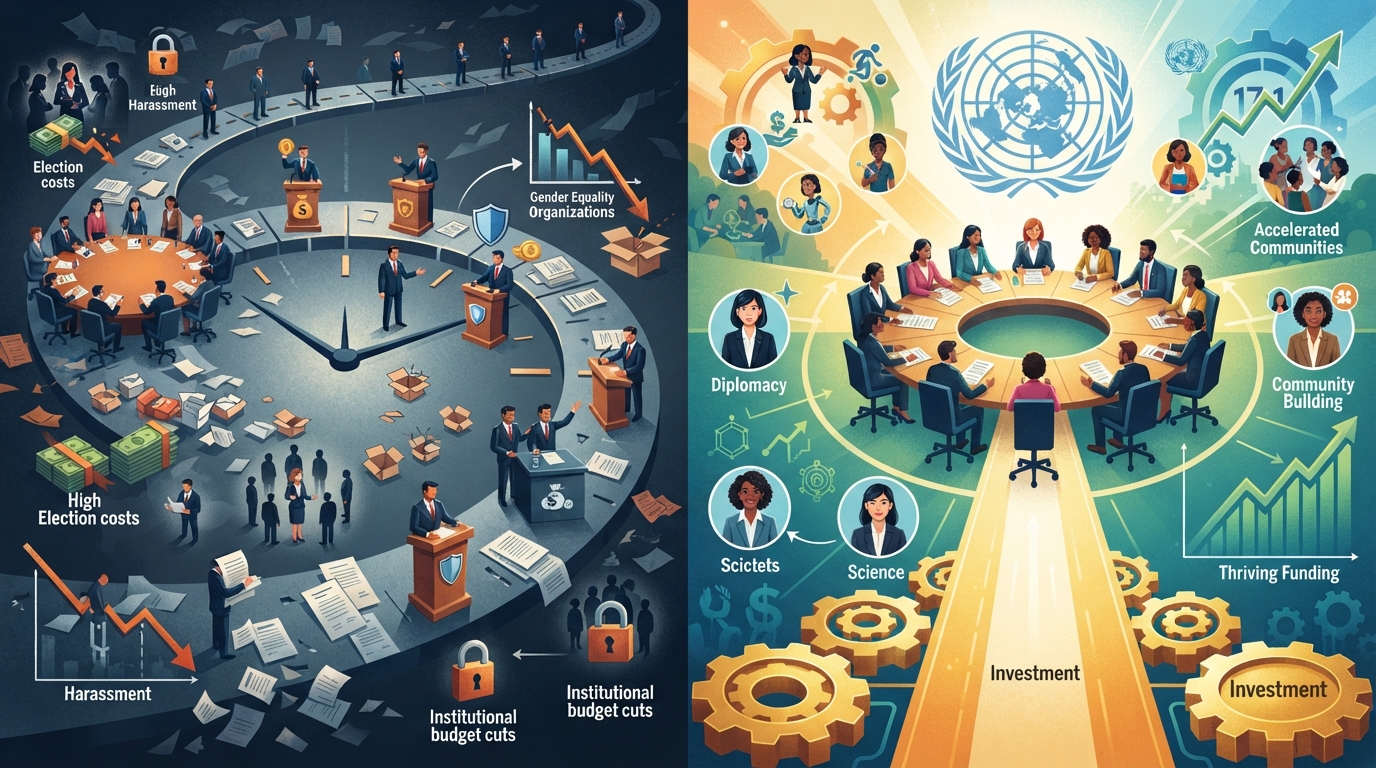
If the current pace continues, it will take 171 years to achieve gender equality — UN
Globally, a regression is being observed in the achievements made over decades regarding gender equality.
The document notes that significant positive shifts have been recorded in areas where women have decision-making authority, in the Sustainable Development Goals for 2030 — indicators related to peace, education, the fight against poverty, and climate change. However, the very systems that serve these goals are being systematically weakened.
According to analyses, over the past 2 years, institutional powers have decreased in one out of every three state mechanisms dealing with gender equality. In one out of every four institutions, operational expenses have been cut, and one out of ten has been completely deprived of the right to control its own budget.
The volume of funding directed to the sector has fallen to its lowest level since 2021. This, first of all, has dealt a serious blow to the activities of public organizations defending women's rights. Against the backdrop of financial cuts, 42 percent of entities within the UN system also reported a slowdown in their efforts towards gender equality.
Political power in the world is still significantly concentrated in the hands of men: as of January 1, 2026, only 28 countries are led by women — as head of state or government. This means that men lead six out of every seven countries.
Women face systemic barriers when entering politics. In some countries, the cost of participating in an election campaign is up to 100 times higher than the average per capita income, pushing many women aside at the very beginning of the process. In some regions, eight out of every 10 women who run for election face harassment and violence in public life.
Even when appointed to government positions, they are rarely given key portfolios related to security and the economy. In particular, today nearly 90 percent of the world's defense ministers and more than 80 percent of finance ministers are men.
This disparity is also clearly visible in other areas: globally, women account for only 6 percent of chief executive officers (CEOs) of major corporations, and less than 20 percent of heads of supreme courts.
Furthermore, globally, women hold only 64 percent of the legal rights that men enjoy.
The authors of the report emphasize that not a single indicator under Sustainable Development Goal 5 on gender equality will be fully met by 2030.
"The numbers leave no room for doubt: at the current pace, we are still 171 years away from achieving gender equality. What the report shows is that this is not an inevitability — it is the result of visible choices. Investing in gender equality, in institutions, and in the statistical systems that hold them accountable is not some cost. It is the fastest way to return to the promise of equal power and authority for all on the 2030 agenda," said Li Junhua, UN Under-Secretary-General for Economic and Social Affairs.
Sima Bahous, Executive Director of UN Women, reminded that when women are in leadership, societies are stronger and economies are more stable:
"If power continues to concentrate in institutions that systematically exclude women, societies will not be able to fully realize their potential. Equality cannot be achieved without equal authority — because equality without authority is not equality at all."
The report calls on world governments to halt the political regression, adequately fund specialized institutions and women's organizations, and grant women equal authority in public administration and economic decision-making.