

'I'd talk to the TV': The paid companions bringing warmth to China's lonely
As loneliness grows in China, a new industry is emerging to provide companionship and support.
‘I’d talk to the TV’: The paid companions bringing warmth to China’s lonely
“The biggest difficulty really was the loneliness. Sometimes, if I wanted to talk to someone I’d talk to the TV.”
Yang, 91, lives on the edge of China’s busy capital, Beijing. After her husband died, she became so lonely that she says she even thought about voluntary euthanasia.
“I asked my son about it but he told me it was banned. I told him that if it ever becomes legal I want to do it - I didn’t want to live any longer.”
With glaucoma and worsening eyesight, she could not even manage simple tasks such as adjusting the settings on her air conditioner.
Situations like Yang’s are becoming more common in Chinese cities, which Associate Professor Teresa Kuan of the Chinese University of Hong Kong says are “exacerbated by the structure of society and the modes by which people interact”.
There are many reasons for isolation in China. Much of it comes when rural migrants leave behind close-knit support systems to chase economic opportunities in urban areas, where loneliness and uncertainty can be hard to shake, or when graduates move across the country in search of work.
With glaucoma and failing eyesight, 91-year-old Yang found everyday life and basic chores increasingly hard to manage alone.
But a growing “loneliness industry” has now emerged to try to fill these gaps in people’s lives.
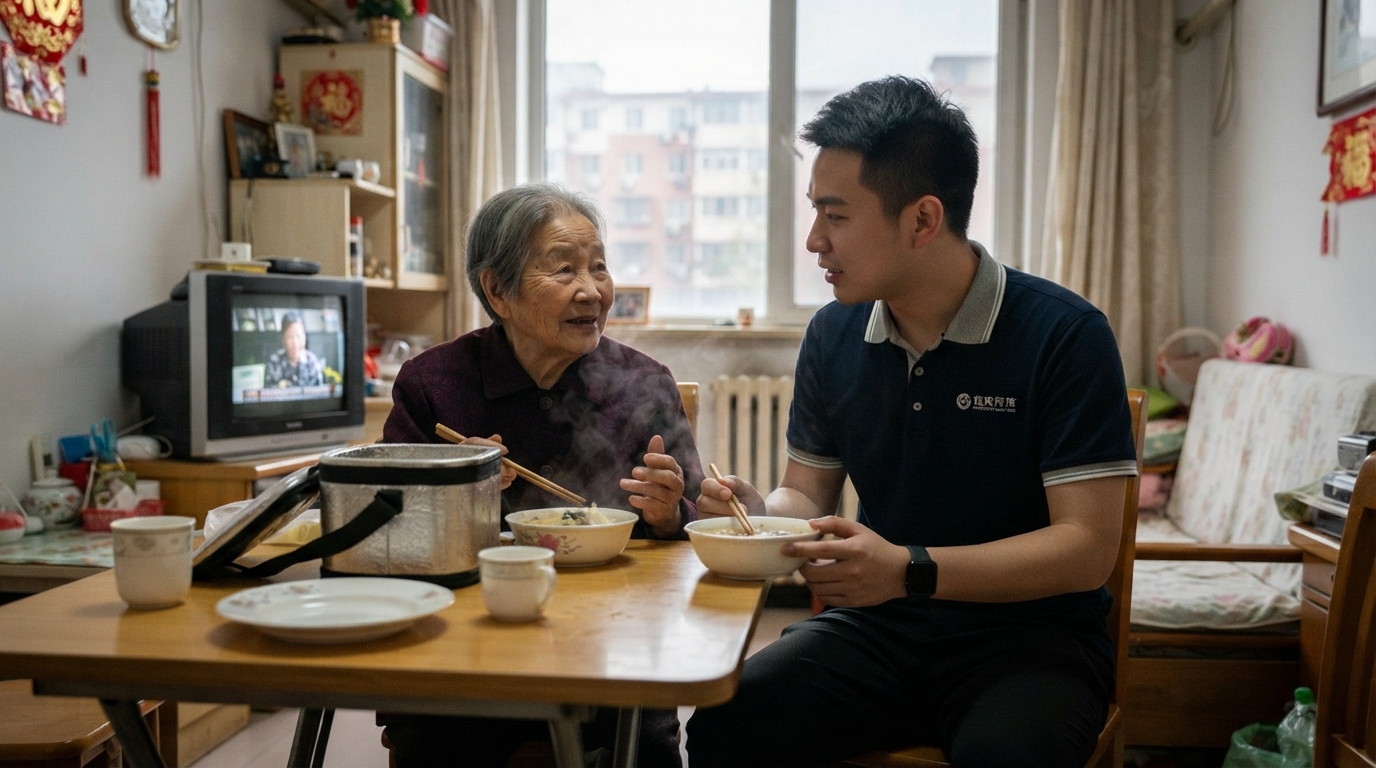
Yang says her life has been changed by one of these services - Wang Yingwei and his electric scooter delivery team - who began visiting twice a day with hot meals but whose assistance goes far beyond that.
“We see ourselves as community children,” Yingwei told the BBC. “It means putting yourself in the shoes of older people and carefully considering their needs.
“For example, they may be drinking tap water which can be cloudy and contain a lot of lime. I can fix this problem with a filtered water tank. Such a small thing can make them much happier. Maybe they can’t shower because their equipment is broken. I’ll buy a part, replace it and their shower is fine.”
“The elderly treat us like their children, and we treat them like our own parents,” he added.
Yingwei’s services cost less than half the price of hiring a caregiver.
Wang Yingwei and his small delivery team provide more than meals, offering human connection to older residents.
The former mobile phone salesman says he launched the company to help seniors stay in their own homes rather than move into retirement facilities. He was motivated after his father-in-law, who had developed Alzheimer’s, had to enter a nursing home. Yingwei said the conditions there were so sub-standard that he wanted to help others avoid institutions like that for as long as possible.
His small business now employs four people, but he says it could expand as demand increases.
There is still no solid data on the size of this sector - which operators say has surged in recent years - but securities company Sinolink valued it at about $7.4 billion in 2025. It is expected to keep growing given the direction of modern lifestyles.
Zheng Ruizhi, another of Yingwei’s clients, who lives on Beijing’s northern outskirts, greeted him at the door with a broad smile.
“After retiring, I don’t have much opportunity to hang out with others,” the 75-year-old, whose son lives two hours away, told the BBC.
She was recovering from a recent injury, which she said was making ordinary tasks harder.
But Yingwei’s arrival - she calls him her “dear boy” - lifted her spirits.
“I call you ‘dear boy’ because I am so fond of you. I genuinely like you from the bottom of my heart. I also admire and trust you. When you help me out, I don’t have a single worry or fear,” she told him.
The services in this sector are not confined to home visits.
Twenty-three-year-old Liu Yanyan, for example, works as a “medical escort”. She serves as a friendly companion for clients going to see a doctor, or for collecting test results or medication from city hospitals, which can be intimidatingly large and bureaucratic.
“Some of my customers are people in their 20s who came to Beijing to build a career. They might not have friends here or feel awkward asking colleagues to accompany them because of the concept of social reciprocity in Chinese culture,” she said. “If I accompanied you to a doctor’s appointment for free, you might feel obligated to buy me a meal or a movie ticket afterwards.”
She said that, for this reason, many people in modern Chinese society tend to keep to themselves.
“So, they hire someone like me to accompany them to the hospital. If they had to go alone, they could feel scared or anxious.”
At the heart of many businesses serving loneliness in China is a straightforward offer: human connection.
Teresa Kuan said some people prefer the chance to pour their hearts out to a complete stranger for a fee.
“If there is a companion you have paid for, the relationship is not exactly equal. It is a service relationship, so you don’t have to deal with the unpredictability of a standard relationship. The thing about friendship is that it can be unpredictable. You don’t know when someone might disappoint you. But, in a service relationship, you have a better idea of what to expect.”
Wang Zhoutao runs a hiking business for people who want to climb Huangshan, China’s famous mountain in Anhui Province.
“We provide emotional support, like cheering them up, taking their photo or telling jokes. It’s really a service based on companionship,” he said.
The former soldier said he usually hikes up the mountain with clients 10 to 15 days a month. When fully booked, that can rise to as many as 30 times a month.
He described one young woman he once accompanied who felt excluded at work. “She felt useless and wanted to prove something to herself,” he said.
“We started climbing but it was a tough trek as the weather was really hot and we were sweating a lot. There were moments she wanted to give up but I told her, ‘If you quit now and can’t get over this mountain how will you handle anything else in life?’. I kept encouraging her.”
After they reached the top, he said she sent him a long thank-you message describing her inner journey and expressing gratitude.
“The pace of life is just too fast these days. People face pressure from work, relationships and family expectations,” he said. “I think my clients are mostly people who feel a void in their relationships or have suffered a setback.”
Human connection is essential, but in a society dealing with loneliness across generations, it has also become a commodity.
Back in her small Beijing apartment, Yang says she feels more at ease now that Yingwei has fixed her air conditioner problem.
“It’s good to have someone around when you need it, someone you can share your innermost thoughts with,” she said.
“I did struggle with loneliness but that’s been resolved now. I’m quite happy.
“I can’t lose Yingwei and the others. They’ve all got a good heart.”