

Iceland holds knife-edge referendum on EU - and it could be decided on fish
On Saturday, Iceland will vote on EU membership talks, amid economic and geopolitical tensions.
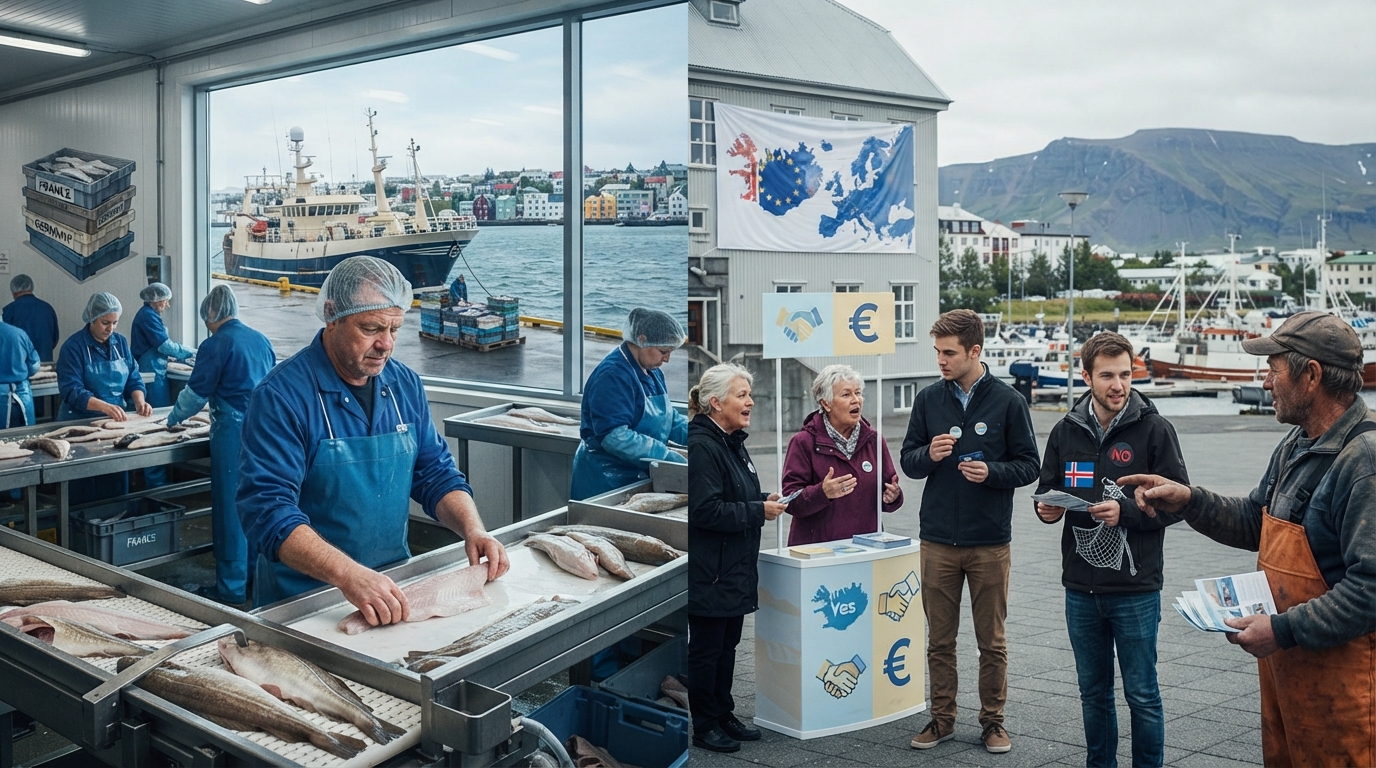
Iceland is on the verge of a closely contested referendum regarding its potential re-entry into discussions about joining the European Union, with the outcome potentially hinging on the issue of fishing rights.
Prime Minister Kristrún Frostadóttir, a proponent of EU membership, leads a government that supports the move.
Inside a factory by the water, employees in hairnets and blue uniforms meticulously sort freshly caught cod and haddock. Machines then process these fish into fillets, primarily destined for European markets.
Pétur Pálsson, a fishing industry executive at Visir, expresses concern that EU membership could lead to job losses in Iceland and prompt factories to relocate abroad. He states, "If we are in the EU, they will be the ones who make the policy."
This Saturday, the nearly 400,000 citizens of this island nation will cast their votes on whether to restart negotiations for EU accession. Opinion polls suggest the result is too close to call.
Advocates believe that stronger ties with Europe could help stabilize Iceland's volatile currency and address its escalating cost of living.
Conversely, opponents argue that Iceland's sovereignty and control over its "priceless" fishing waters are at risk, preferring the nation to remain independent. Fisheries and other marine sectors constitute nearly 40% of Iceland's exports.
This division has persisted among Icelanders for decades. However, following her centre-left government's victory in a snap election in 2024, Prime Minister Kristrún Frostadóttir pledged to hold a referendum by 2027.
Geopolitical developments, including Russia's war in Ukraine, intensifying Arctic rivalries, and US President Donald Trump's tariff threats and interest in Greenland, have accelerated this timeline.
Finance Minister Daði Már Kristófersson informed the BBC that "Things have been moving very rapidly with respect to geopolitical challenges," which has elevated Iceland's global position "up the agenda."
Situated in the North Atlantic, Iceland is strategically located near the GIUK gap, a maritime area where Western nations closely monitor Russian naval activities. Despite being a founding member of NATO, Iceland does not possess its own military.
The "No" campaign has adopted the slogan "Iceland for sale? No thanks."
A recent poll this week showed the "Yes" vote leading with 51.3% to 48.7%, while an earlier survey indicated a dead heat between the two sides.
Eirikur Bergmann, a professor of politics at Bifröst University, commented, "It's impossibly [hard] to predict. Both camps are throwing everything they have at it."
Kristófersson's Liberal Reform party is a prominent supporter of the "Yes" campaign. He contends that EU membership would bolster Iceland's security and trade standing, offering protection from larger global powers.
He also highlights the economic benefits, stating, "We see the opportunity of joining the EU and adopting the euro as a very significant benefit to Icelandic companies and to the Icelandic general public."
A "Yes" vote would initiate negotiations with Brussels, but any final membership agreement would require approval in a second referendum. Additionally, all 27 EU member states would need to consent. A "No" vote would temporarily halt talks.
Some Icelanders are expected to vote "Yes" because this is not the final referendum. Reykjavik resident Anna Ragnarsdottir explained, "We have to know what's in the package from the EU. If we say no, we won't ever know."
Given that Iceland is one of the world's most expensive countries, economic concerns are a central theme in the EU debate.
Although not an EU member, Iceland is part of the European Economic Area (EEA) alongside Norway and Liechtenstein, granting it access to the single market and the Schengen border-free zone.
Reykjavik commenced EU accession talks two years after the severe global financial crisis of 2008 but abandoned them in 2013. Fishing was the primary impediment then and remains a critical sticking point today.
Fish and marine industries contribute nearly 40% of Iceland's exports. Many "No" voters fear that under the EU's common fisheries policy, they could lose some control over their valuable fishing grounds.
Opposition leader Guðrún Hafsteinsdóttir, who heads the "No" campaign, has vowed that Iceland's waters will never be shared.
Professor Bergmann emphasizes that fishing is integral to Iceland's culture and political identity, asserting that no politician could make such a concession without being "expelled from the country."
Iceland's government aims to secure a "special arrangement" to safeguard its fishing and agriculture sectors. The finance minister expressed confidence in obtaining "some exemptions."
He cited Norway, a non-EU member, which achieved a special arrangement in 1994 despite not completing the accession process, and EU states Finland and Sweden, which secured special terms for agriculture in their northern regions.
However, Eurosceptics are doubtful that such a carve-out is feasible. Margrét Ágústa Sigurðardóttir, head of the Icelandic Farmers' Association, remains unconvinced, stating, "No member state has been granted a permanent opt-out." She worries that EU policies would prioritize "the interests of 450 million consumers, rather than the specific needs of a country of 400,000 people."
Iceland, lacking its own military, relies on its NATO allies and a 1951 defense pact with the US for security. It hosts alliance aircraft at Keflavik airport.
During a BBC visit to the Keflavik airbase this month, fighter jets were observed taking off, with the Stars and Stripes, Belgian tricolour, and NATO flags flying.
Trump's repeated remarks about acquiring Greenland and the potential weakening of the NATO alliance have heightened Iceland's security concerns. Officials identify Russia's maritime activities near Iceland as the primary security issue. In June, Icelandic authorities reported tracking a Russian intelligence ship through Iceland's Exclusive Economic Zone.
Icelanders reacted with disbelief when Trump mistakenly referred to their country four times in a Davos speech, intending to mention Greenland. The new US ambassador later apologized for joking that Iceland could become the 52nd US state.
Daði Már Kristófersson insists that the "special relationship" remains unchanged. Nevertheless, the finance minister believes "an additional pillar is important," and the government signed a defense partnership with the EU in March.
Despite overwhelming opposition from Greenlanders, Trump has not abandoned his desire to acquire the island, a factor weighing on Icelandic voters.
Surprisingly, geopolitics has largely been absent from Iceland's public discourse. Snærós Sindradóttir of the European Movement in Iceland finds this frustrating, asserting that the referendum is happening "100% [because of] security matters."
Giant red letters spelling "JA!" (Yes!) adorn the windows of the group's campaign office. The "Yes" camp argues that EU membership offers greater financial stability, and adopting the euro could help curb the country's persistently high inflation.
Since gaining independence from Denmark in 1944, Iceland has transformed from an impoverished island into one of Europe's most prosperous nations. However, according to an analysis by the academic union Viska, prices in Iceland were 84% higher than the EU average, and interest rates have climbed to 8%.
Sindradóttir laments, "We get higher salaries, and it goes straight to the cost of everything. It's like a dog chasing its own tail constantly."
Snærós Sindradóttir is frustrated that the pre-referendum debate has not focused on geopolitics.
In downtown Reykjavik, the high cost of living and sovereignty are the primary concerns for residents. Adolf Fridriksson, 62, stated, "The biggest problem right now is for the generation who are trying to buy their own housing. The mortgage rates are terrifying."
Meanwhile, Helga, 22, believes joining the EU would be too costly: "The fishing industry, and everything else, should be in our control."
Saturday's outcome is being closely observed across Europe. If the "Yes" vote prevails, Icelandic officials anticipate that talks with Brussels will take "months, not years," as 11 of the 35 negotiation areas were already finalized before they were suspended.
Leaders in neighboring Norway, a traditionally Eurosceptic country and fellow EEA member, are also paying attention. Support for joining the EU is also growing there.
Hallgrímur Oddsson, head of the EU-Iceland think-tank European Currents, suggests that gaining a wealthy and stable new member in Iceland would be a welcome victory for EU enlargement. "But a No vote could also be perceived as a loss."